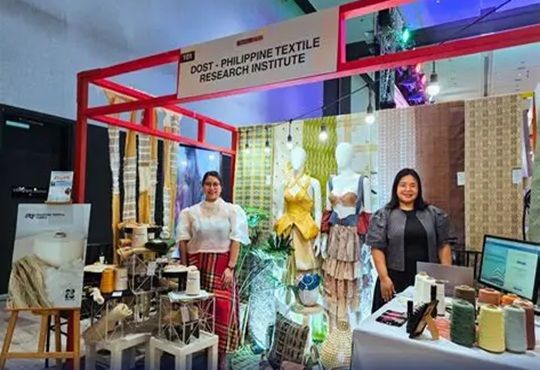
The Philippines is working to strengthen its domestic textile industry by engaging universities in the development of specialized skills, expansion of research capabilities, and reduction of reliance on imported raw materials. The Department of Science and Technology-Philippine Textile Research Institute (DOST-PTRI) is pursuing partnerships with 1,765 higher education institutions as the country aims for a larger share of the $1.2-trillion global textile market.
Global textile trade is projected to grow by 4.2 percent annually through 2033. This growth presents opportunities for the Philippines to rebuild its textile manufacturing base and reverse the decline in apparel exports. However, a nationwide assessment conducted by DOST-PTRI revealed a significant gap: while 1,765 colleges and universities offer programs that support the textile supply chain, none currently provides a curriculum dedicated solely to textile science.
Of these institutions, 71 offer programs related to textile raw materials, 646 cover product development, and 1,048 support supply chain activities such as fiber cultivation, machinery, and logistics. Relevant competencies remain dispersed across chemistry, engineering, design, and industrial technology programs. This fragmentation has underscored the need for a standardized academic framework focused on textiles.
Also Read: DOST, DepEd Launch Joint STEM Push in Davao Oriental
“Textiles are part of our everyday lives, yet textile science is not always given enough attention in our classrooms. Through its partnership with the academe, DOST-PTRI hopes to help develop a standard textile curriculum that will introduce students to the science, technology, and possibilities behind Philippine textiles,” said Evangeline Flor P. Manalang, officer-in-charge of DOST-PTRI, in a press statement.
To bridge the education gap, DOST-PTRI has established the Philippine Textile Consortium. Nearly 60 schools are expected to take part in curriculum development, joint research, laboratory partnerships, and technical training. The institute has also launched TELAkademi, a platform designed to support collaboration and knowledge-sharing in textile engineering, materials science, and production technologies.
The academic roadmap outlined by DOST-PTRI includes the introduction of courses on nonwoven textiles and fabric design in 2027, followed by textile analyses in 2028. In addition, the institute provides research assistance of up to P200,000 for graduate students, laboratory services, and access to a mobile textile laboratory.
These efforts form part of a broader push to rebuild the country’s textile capabilities. By connecting academic institutions more closely with industry needs, the initiative seeks to develop a pipeline of skilled professionals who can support domestic production and innovation. A key focus is encouraging the use of locally sourced agricultural materials in the creation of sustainable textile products.
The partnerships aim to strengthen three interconnected areas, the textile workforce, research capacity, and the domestic supply chain. Through specialized education, technical training, and collaborative research, DOST-PTRI intends to equip students and researchers with the knowledge required to advance Philippine textiles. The absence of a dedicated textile science curriculum has limited the depth of expertise available to the sector; the new consortium and TELAkademi platforms are intended to address that shortfall systematically.
By aligning higher education more closely with industry requirements, the program seeks to create a more resilient and self-reliant textile sector. The combination of standardized curricula, joint research projects, laboratory access, and financial support for graduate work is designed to build long-term capacity. Over time, these measures are expected to help the Philippines capture a greater portion of global textile trade while reducing dependence on imported inputs and fostering the growth of a new generation of Filipino textile professionals.
The initiative reflects a coordinated approach between government research institutions and the academe to revive an industry with significant economic potential. With clear targets for curriculum development, research collaboration, and practical training, DOST-PTRI is positioning higher education institutions as central partners in the effort to modernize and strengthen the Philippine textile industry.