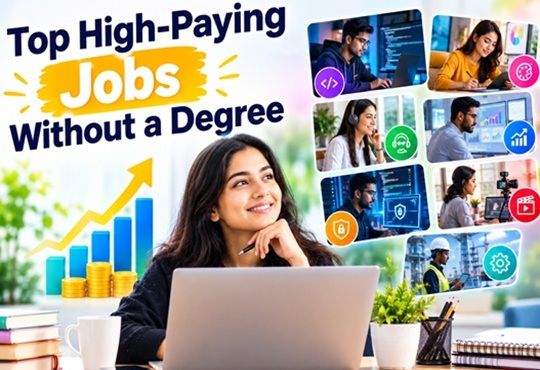
Top High-Paying Jobs Without a Degree Can Buy You in 2026

-
For decades, the formula for a good career felt non-negotiable, finish school, get into a good college, graduate with a degree, then look for a job. That formula is cracking, not slowly, but visibly, in real time, across India and the world. Employers are no longer asking 'where did you study?' as often as they're asking 'what can you actually do?' And the people answering that second question well are earning salaries that used to be reserved for engineers, MBAs, and chartered accountants.
This isn't a motivational myth cooked up for LinkedIn. It's backed by hard labour-market data. In the United States, roughly 5.7 million full-time workers without a bachelor's degree already earn $100,000 or more a year using data from the Bureau of Labor Statistics. In India, the story is just as striking, employability among India's workforce has risen to 56.35 percent according to the India Skills Report 2026, up from 54.81 percent a year earlier, reflecting a broader shift toward practical capability over formal qualifications.
Nearly 40 percent of IT sector jobs in India are now skills-based rather than degree-based, and salaries for no-degree roles in the country now span a real range from roughly Rs 3 lakh at entry level to Rs 30 lakh or more for experienced professionals.
This is the story of what that shift actually looks like the real roles, the real salary ranges, and the real pathways in.
Why the Degree Stopped Being the Only Ticket In
Three forces are colliding to make this possible.
First, remote work broke the geography of hiring. A digital marketer in Indore or a web developer in Kochi can now compete for the same freelance contract as someone in Bengaluru or Berlin. Distance stopped being a disqualifier the moment video calls and cloud tools became normal.
Second, AI and automation shortened the learning curve. Tasks that once required years of formal training writing code, designing interfaces, running ad campaigns can now be learned through focused, several-month certification programmes, because much of the routine work is now handled by tools. Employers care less about how long someone studied and more about whether their output holds up.
Third, and most importantly, companies got tired of paying a 'degree premium' for skills that degrees don't actually teach. SEO, paid advertising, UI prototyping, cybersecurity hygiene, and video editing are rarely taught with any depth in a traditional undergraduate programme. Employers increasingly evaluate candidates on practical skills, recognised certifications, and real-world experience instead of academic qualifications.
The result is a labour market where skill-based hiring and no-degree career paths aren't a fallback option anymore. For a growing number of roles, they're the fastest route to a six-figure income.
The Companies Actually Hiring This Way
Google developed structured skills assessments where candidates complete real project simulations under time constraints no credential required, just proof you can execute the work. Google's own hiring leadership has said every application is reviewed case by case, with each role carrying its own requirements, and that the company looks for a growth mindset whether a candidate is entering the workforce fresh or bringing decades of experience.
IBM popularised the term ‘new collar jobs’ for exactly this category skilled technical work hired on capability rather than credentials, through apprenticeship-style learning. As of recent reporting, half of IBM's US job openings do not require a four-year degree, a practice the company says it started well before the pandemic. IBM's own director of Career, Skills, and Performance has publicly framed this as a deliberate move to stop shutting out large parts of the population through blanket degree requirements.
Apple, Accenture, and Tesla have been named alongside Google and IBM as having made material changes to job requirements across their organisations, according to research from Harvard Business School and CompTIA with the report noting these companies formally announced the elimination of the four-year bachelor's degree as an application requirement for many roles.
Beyond the tech giants, Bank of America, General Motors, Walmart, Delta Air Lines, and Netflix have also been reported as having removed degree requirements from at least some postings, and Bank of America has specifically reported that roughly 30 percent of its recent hires entered through non-degree pathways.
The scale of this shift is measurable: LinkedIn's 2024 workforce report found that companies removing degree requirements from job postings received nine times more applications and reported measurably higher employee retention. Separately, NACE's Job Outlook 2026 survey found 70 percent of employers now say they use skills-based hiring for entry-level roles, up from 65 percent the year before.
One honest caveat worth including, because a ‘no fake content’ article should include it: not every company that dropped the degree requirement on paper has changed its hiring behaviour in practice. Research from Harvard Business School and the Burning Glass Institute found that 45 percent of companies that removed degree requirements from job postings did so ‘in name only’ with fewer than 1 in 700 actual hires going to non-degree candidates at those firms. The real winners of this shift, per that same research, are the roughly 37 percent of companies identified as genuine ‘skills-based hiring leaders,’ which increased their share of non-degree hires by nearly 20 percent.
The practical implication: a dropped degree requirement in a job listing is a signal worth acting on, but a portfolio, certification, or proof of real output is still what gets you through the door especially at companies where the policy change hasn't yet reached the hiring manager's actual screening habits.
The Digital-First Careers Paying the Most Right Now
Digital Marketing Specialist - The Entry Point Everyone's Talking About
 Digital marketing has become the most talked-about ‘no degree’ career for a reason: the barrier to entry is low, and the ceiling is high. Businesses hire specialists to manage SEO, paid advertising, social media, email campaigns, and content marketing based on measurable campaign performance rather than academic qualifications, with entry-level annual salaries generally ranging between Rs 4 lakh and Rs 12 lakh.
The real money, though, shows up at the senior end. Senior digital marketers who can manage Rs 10 lakh-plus monthly ad budgets, lead teams, and show measurable ROI earn Rs 8 lakh to Rs 25 lakh without a single line of code, and agency owners running their own digital marketing firms often earn Rs 20 lakh to Rs 50 lakh or more. Freelancers, meanwhile, can charge Rs 1,500 to Rs 5,000 an hour once they've built a track record, in work that is fully remote-friendly.
- Realistic path in: Pick one channel SEO, Meta Ads, or Google Ads, get certified, run real campaigns (even for a friend's small business, for free at first), and use the results as your portfolio.
Web Development- Still One of the Highest-Ceiling Skills You Can Learn
 Coding remains one of the purest meritocracies in the modern job market: if your code works and your product ships, almost nobody asks where you learned it. Web development is a high-income skill that does not require a degree if you have strong coding knowledge, and freelancers and remote developers can earn even more than salaried peers.
- Realistic path in: Build three to five real projects (not tutorials, actual working sites or apps), put them on GitHub, and start applying to startups or freelance gigs where a working demo speaks louder than a diploma.
UI/UX Design - Where Creativity Meets Six-Figure Potential
 User experience and interface design has quietly become one of the best-paying ‘no-code’ careers in India's digital economy. It requires no programming only a sharp eye for usability and visual clarity. UX/UI Designer is named among the best non-coding tech jobs in India, alongside Digital Marketing Manager, Data Analyst using no-code tools, AI Content Strategist, Product Manager, and Prompt Engineer most of them remote-friendly and accessible from any academic stream. Even without a degree, experienced UX designers are counted among India's highest earners in non-government, skill-based roles, alongside senior digital marketing managers, AI product specialists, and niche content strategists.
- Realistic path in: Learn Figma, redesign three existing apps or websites as portfolio case studies, and document your reasoning recruiters in this field hire based on process, not certificates.
Cybersecurity - The Certification-First Path to a Global Ceiling
 This is one of the more surprising entries on this list, because cybersecurity sounds like it should require an engineering degree. It doesn't. Self-taught professionals who earn recognised certifications CompTIA Security+ being the most common starting point can realistically progress into management roles, with reports citing management-level pay around $140,000 internationally, achievable via a Security+ certification even though entry-level roles still require targeted certification training. Cybersecurity is also repeatedly listed among the strongest skill-based career tracks in India, alongside coding, digital marketing, graphic design, and data analysis, all built through professional certifications that validate knowledge and improve hiring credibility.
- Realistic path in: Start with CompTIA Security+ or an equivalent entry certification, build a home lab to practise real threat scenarios, and layer on advanced certifications as experience grows.
Data Analytics (No-Code Tools) - The Quiet Six-Figure Track
 You no longer need a statistics degree to work with data. No-code analytics tools have opened this field to anyone willing to learn how to read dashboards, build reports, and translate numbers into business decisions. Data Analyst roles built on no-code tools are explicitly listed among the strongest non-coding tech careers available to Indian graduates from any stream Arts, Commerce, or Science.
- Realistic path in: Learn a no-code analytics or BI tool, work through public datasets, and build two or three dashboards that answer a real business question that becomes your proof of skill.
AI-Adjacent Roles- Prompt Engineering and AI Content Strategy
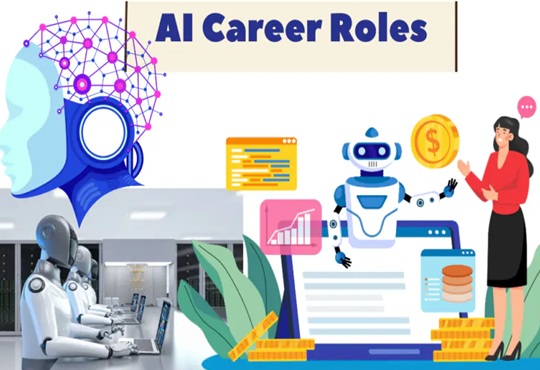 This is the newest and fastest-growing category on the list, and it barely existed three years ago. Prompt engineering, AI product management, and digital marketing are the three fastest-growing non-coding tech careers in India right now, and AI jobs including prompt engineering and AI content strategy are accessible through short courses lasting just four to twelve weeks. Because the field is so new, there is effectively no ‘traditional’ degree path anyway everyone working in it today is, by definition, largely self-taught.
- Realistic path in: Master one or two AI tools deeply, document real use-cases and workflows you've built, and pitch that documented expertise directly to businesses still figuring the technology out.
Content Creation - Copywriting, and Video Editing Low Barrier, Real Money
 These remain the most accessible entry points for anyone starting from zero, particularly outside India's metro cities. Content Writing and Copywriting, Social Media Management, Video Editing, and Virtual Assistance are all explicitly listed as freelancing careers accessible after 12th from any stream, require no programming, and are fully remote-compatible, letting students in Tier 2 and Tier 3 cities earn at metro-equivalent rates.
- Realistic path in: Choose one format writing, video, or social content build a small public portfolio, and pitch directly to small businesses that don't yet have anyone handling this work.
The Global Trades Still Quietly Minting Six-Figure Earners
It isn't only ‘digital’ careers driving this shift. Skilled trades, boosted by infrastructure demand and labour shortages, remain some of the highest and steadiest earners on any no-degree list, particularly in markets like the United States and the pattern is instructive for how the whole no-degree economy works.
Elevator and escalator installers top several of these rankings, with a median annual salary of $106,580 and top 10 percent of earners crossing $149,250, typically requiring only a high school diploma. Commercial pilots follow closely, with a median annual salary of $121,430 and top earners at major cargo or charter operations clearing $200,000, entering the field through FAA certification rather than a university classroom. Air traffic controllers post the highest median of all, at $144,580 with top 10 percent earnings over $190,000, through a role that requires FAA training and is age-gated, with candidates needing to start at the FAA Academy by age 31. Electrical power-line installers and repairers earn a median of $92,560, while detectives and criminal investigators earn a median of $77,270, with top earners at $120,460, typically starting with a high school diploma and completing an agency's own training academy.
What connects every one of these roles trade or digital is the same underlying mechanism: a licence, certification, apprenticeship, or portfolio replaces the degree as proof of competence. The ‘no degree’ jobs that pay the most are rarely ‘no training’ jobs. They simply swap a four-year classroom commitment for a faster, more targeted, more practical one.
Also Read: 10 Career Fairs: Singapore Creates Powerful Pathways to Success
What This Shift Actually Demands From You
None of this is a shortcut to easy money, and any article that tells you otherwise is lying to you. Behind almost every high earner in this list is a consistent pattern: they picked one skill, went deep on it, built a portfolio or certification that proved their competence, and kept showing up after the first few clients or employers said no.
The honest requirements look like this:
- A narrow starting focus. Trying to learn digital marketing, coding, and design all at once is the single most common reason people give up. Pick one lane first.
- Proof over promises. A portfolio, a certification, or a track record of delivered results carries more weight in this market than any statement of intent ever will.
- Consistency over intensity. Most professionals earning six figures without a degree didn't get there in six months they built client relationships, referrals, and reputation over two to four years of steady work.
Willingness to freelance first. Many of the highest earners on this list from digital marketers to UX designers to writers built their income through freelance platforms before landing salaried roles or starting their own agencies.
Why This Matters More in the Next Few Years
Skeptics will point out that ‘skills-based hiring’ has been a buzzword before, and that companies still quietly favour degree holders when résumés pile up. That's a fair caution degree bias hasn't disappeared entirely. But the data trend line is not ambiguous: employability metrics are rising even as degree requirements loosen, IT hiring is shifting decisively toward skills over pedigree, and entire categories of high-paying work prompt engineering, AI content strategy, no-code data analytics didn't exist long enough for anyone to hold a formal degree in them even if they wanted to.
The practical takeaway for anyone reading this in India today is simple: the ceiling on a ‘no degree’ career is no longer capped at modest wages. It now stretches into the same six-figure and even seven-figure income brackets in rupee terms, Rs 20 lakh, Rs 30 lakh, and beyond that were once considered the exclusive territory of engineering and MBA graduates.
At The End!
The degree isn't dead. But it has, unmistakably, stopped being the only door into a high-paying career and for a growing number of ambitious, self-taught professionals across India's digital economy, that's the real story of 2026.
🍪 Do you like Cookies?
We use cookies to ensure you get the best experience on our website. Read more...