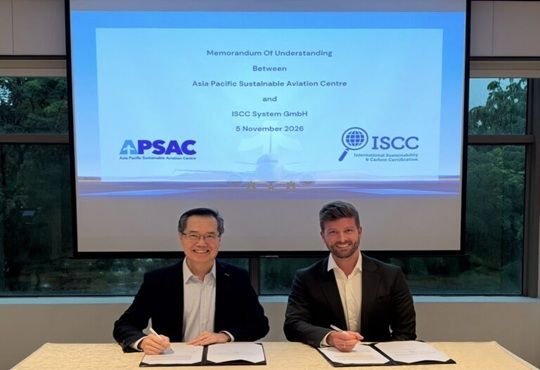
The Asia Pacific Sustainable Aviation Centre (APSAC) and ISCC have signed a three-year memorandum of understanding (MoU) to strengthen sustainable aviation fuel (SAF) certification, industry education and supply chain development across the Asia-Pacific region.
The partnership aims to support the development of certified SAF supply chains by improving regional stakeholders' understanding of sustainability certification requirements, promoting industry knowledge and encouraging collaboration among key participants in the aviation and renewable fuels sectors.
The MoU was exchanged in Singapore between Philip Goh, Chief Executive Officer of APSAC, and Adam Kirby, Head of Aviation & Maritime at ISCC. The signing took place on the sidelines of APSAC's Growing Aviation Sustainably training programme.
The agreement comes as Asia-Pacific, one of the world's fastest-growing aviation markets, is expected to experience a significant increase in demand for sustainable aviation fuel over the coming years. Against this backdrop, both organisations have highlighted the importance of establishing robust sustainability certification and traceability systems to build market confidence and maintain the environmental integrity of SAF supply chains.
Under the three-year agreement, APSAC and ISCC will undertake several collaborative initiatives focused on capacity building and technical knowledge exchange. These activities will include workshops, training programmes and technical exchanges designed to improve stakeholders' understanding of SAF certification requirements.
The collaboration will also address the certification of sustainable feedstock pathways and support preparations for scaling up SAF production and adoption across the region. By strengthening awareness of certification processes, the partners aim to help industry participants better understand the requirements associated with developing sustainable aviation fuel supply chains.
Another important component of the partnership will be cooperation on policy and regulatory frameworks. APSAC and ISCC will exchange expertise to support the development of frameworks that can enable the growth of certified SAF supply chains throughout Asia-Pacific.
The organisations will also participate jointly in industry events and stakeholder dialogues. In addition, they plan to develop publications, guidance materials, case studies and other educational resources to increase awareness of sustainability certification practices and their importance in the SAF industry.
Commenting on the partnership, Dr Norbert Schmitz, Managing Director of ISCC, emphasised the role of certification in building trust in sustainable aviation fuel markets.
"Certification builds the trust that SAF markets need to grow," he said.
Schmitz also highlighted Asia-Pacific's potential in sustainable feedstocks and SAF production, expressing ISCC's interest in working with APSAC to strengthen regional knowledge and capacity.
Philip Goh said the partnership would help stakeholders prepare for the development of certified SAF supply chains as demand for sustainable aviation fuel increases across Asia-Pacific.
He noted that airlines, fuel producers and regulators require assurance that the fuel being purchased, supplied and regulated meets sustainability and traceability expectations. Building a stronger understanding of sustainability certification, he added, is essential to expanding SAF supply and adoption.
Also Read: Pre-Fab Training: How Simulation & AI Prepare Semiconductor Engineers
The partnership reflects a shared focus on addressing the knowledge and certification requirements associated with the development of sustainable aviation fuel markets. Through training, technical exchanges, educational resources and stakeholder engagement, APSAC and ISCC intend to support regional preparedness for certified SAF supply chains.
As the Asia-Pacific aviation sector prepares for rising SAF demand, the agreement establishes a framework for cooperation between the two organisations, with certification knowledge, traceability and capacity building forming its central areas of focus.