
-
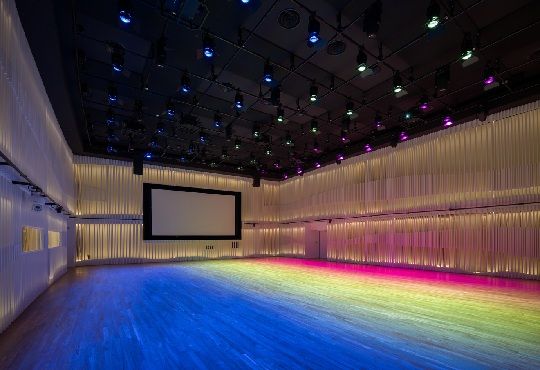
The National University of Singapore’s Yong Siew Toh Conservatory of Music has officially opened the YST Cube, a striking transformation of its former Orchestra Hall into a highly flexible, reconfigurable arts space designed for 21st-century music education, creation and performance.
Unveiled today by NUS President Professor Tan Eng Chye during the opening ceremony of Performers(’) Present, YST’s triennial international artistic research symposium, the Cube marks a significant evolution in how the conservatory supports artistic practice. The event took place on 22 October 2026, exactly two decades after the Conservatory building first opened its doors.
“The YST Cube will create new and exciting possibilities for students and faculty to experiment and push the boundaries of artistic practice,” Professor Tan said. “It will also be a convening space for visiting artists, educators and researchers from around the world to converge, create and showcase.”
Spanning 254 square metres, the Cube functions much like a professional black-box theatre. Its open floor plan, integrated lighting and multi-projection systems, and variable acoustic technology allow the space to shift seamlessly between conventional recital formats, 360-degree arena-style setups and immersive multimedia environments. Audiences can surround performers, projections can transform walls and floors, and the room’s acoustic response can be adjusted to suit everything from intimate chamber music to experimental sound installations.
This adaptability addresses a clear shift in music education. Students increasingly seek ownership of their creative processes and explore formats that move beyond traditional concert-hall presentations. The Cube responds by giving them a professional-grade environment in which to test ideas, collaborate across disciplines and present work in ways that mirror real-world contemporary practice.
Professor Peter Tornquist, Dean of YST, emphasised the pedagogical intent behind the redesign. “As music education evolves, we need spaces that allow students to move beyond fixed performance formats and encourage students to rethink how music can be created, presented and experienced,” he said. “The Cube brings these possibilities together under one roof, giving students the freedom and flexibility to experiment with new ways of learning, collaborating and performing, while preparing them to navigate and shape the future of music.”
The transformation prioritised adaptive reuse. Key structural elements of the original Orchestra Hall were retained while new technical infrastructure was introduced, improving both functionality and operational efficiency. The result is a future-ready venue that can evolve alongside changing artistic and educational needs without requiring major structural overhauls.
For students, the Cube functions as both laboratory and stage. State-of-the-art audio, visual and lighting systems bring professional production capabilities directly into the learning environment. Learners can experiment with different acoustic conditions, spatial arrangements and modes of presentation, gaining practical insight into how technical and spatial choices shape artistic outcomes. This hands-on approach aligns with YST’s growing emphasis on student-led projects and collaborative music-making.
Assistant Professor Jonathan Shin described the space in vivid terms: “The Cube allows for different modes of learning it gives students a playground to dream in, a laboratory to try practical and creative ways to bring their dreams to life, and a space to learn through the process.”
An adjoining pre-function area extends the Cube’s versatility. Designed as an intimate extension of the main space, it can operate independently for smaller events, workshops or informal gatherings, further expanding programming options.
Beyond serving music students, the Cube strengthens National University of Singapore’s Arts for All framework by broadening the range of artistic experiences available on campus. Public performances, presentations and interdisciplinary activities will welcome the wider university community, creating new points of connection between music and other fields of study.
Professor Tan underscored this broader ambition: “The arts is a deeply fascinating and enriching discipline, and we want every student, whatever their discipline may be, to discover and learn about the arts. They stretch our imagination, give us new lenses to see the world, and deepen our understanding of the human experience.”
Also Read: NUS establishes AI Institute to Boost Frontier Research
The venue also opens outward to Singapore’s professional arts sector. Arts organisations and external hirers will be able to use the Cube for performances, rehearsals, residencies and collaborative projects, fostering exchange between the conservatory and the local creative community. Together with YST’s existing Concert Hall and Recital Studio, the Cube expands the Conservatory’s capacity to support artistic activity at multiple scales and in diverse formats.
By hosting the Performers(’) Present symposium within the newly opened space, YST immediately demonstrates the Cube’s potential. The event brings international artists, educators and researchers into direct contact with students, embedding professional practice and cutting-edge research within the daily learning environment.
In reimagining a familiar rehearsal hall as a dynamic, multi-purpose Cube, the Yong Siew Toh Conservatory has created more than an upgraded venue. It has established a flexible platform that equips students to lead the next chapter of musical practice while enriching the cultural life of NUS and Singapore’s wider arts ecosystem.
🍪 Do you like Cookies?
We use cookies to ensure you get the best experience on our website. Read more...