
-
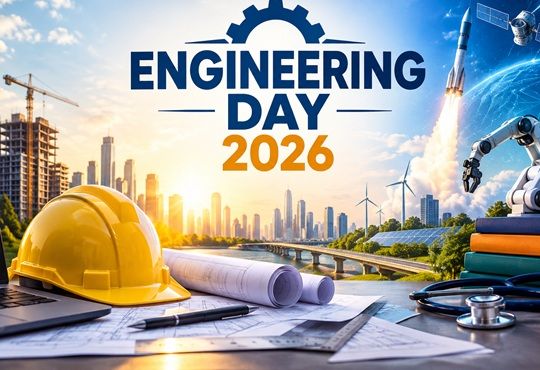
India marks Engineers' Day every year on 15 September, the birth anniversary of Sir Mokshagundam Visvesvaraya, the civil engineer and statesman behind projects such as the Krishna Raja Sagara Dam, who was posthumously honoured as the 'Father of Indian Engineering'. India has observed the day since 1968, and Sri Lanka and Tanzania mark the same date in his memory. This year's observance falls at a moment when Asia's engineering profession is being reshaped faster than at almost any point since Visvesvaraya's own era of dam-building and industrialisation by the clean-energy transition, the semiconductor and AI buildout, expanding healthcare investment, and a renewed regional space race.
For students and working professionals across India and hubs such as the UAE, Singapore and China, this transformation means the traditional four pillars of engineering civil, mechanical, electrical and computer science are no longer the only entry points into a stable, well-paid career. A wave of interdisciplinary and specialised programmes has emerged, and this Engineers' Day is a fitting occasion to map out seven of them, alongside a closer look at where Indian students are studying civil engineering abroad, why pharmaceutical engineering is booming, which specialisations offer the strongest job security, the best online routes into robotics, and how aerospace engineering actually differs from space science.
Krishna Khandelwal, Head of Operations, ZEISS Industrial Quality Solutions, India, says, "Engineering today is more than designing machines or developing processes, it is about solving complex challenges with precision, innovation, and purpose. As India advances toward becoming a global manufacturing and technology hub, engineers are central to this transformation: raising productivity, enabling smarter operations, and building technologically advanced and resilient systems. At ZEISS, engineering excellence means advancing metrology, driving digital manufacturing, optimizing processes, and upholding uncompromising quality.
Engineers’ Day is an opportunity for all of us to recognize the value of engineering in shaping more efficient, sustainable, and technology-driven industries while creating solutions that address the evolving needs of society".Seven Unique Engineering Courses for Future Careers
Rapid urbanisation, mega-infrastructure projects, expanding healthcare needs, space ambitions and Industry 4.0 automation are together creating sustained, specialised demand across Asia. Seven courses stand out for their growth trajectory and relevance to the region:
- Artificial Intelligence and Machine Learning Engineering: AI/ML engineers design algorithms, train models and deploy intelligent systems across technology, healthcare, finance, manufacturing and autonomous vehicles. India, China and Singapore have all positioned themselves as regional AI hubs through national strategies and start-up investment. Core skills include Python, deep-learning frameworks, data pipelines and applied statistics, with graduates moving into AI engineer, machine-learning specialist and data scientist roles.
- Robotics and Automation Engineering: This field fuses mechanical systems, electronics, software and AI into machines that can sense, decide and act automating tasks across manufacturing, logistics, healthcare and agriculture. Asia's manufacturing powerhouses, from China and Japan to India, South Korea and Vietnam, alongside a booming logistics sector, make this one of the region's highest-priority engineering fields. Career paths span robotics engineer, automation specialist and systems integrator roles.
- Pharmaceutical and Biopharmaceutical Engineering: Covered in depth further below, this applies engineering principles to drug design, process scale-up, manufacturing and quality systems, with India and China's dominance in generics, APIs and biologics manufacturing driving strong regional demand.
- Renewable and Sustainable Energy Engineering: This covers solar, wind, hydrogen, energy storage, smart grids and waste-to-energy systems. Climate commitments and energy-security concerns across India, China, Southeast Asia and the Gulf are sustaining long-term demand for engineers in project design, development and grid integration.
- Environmental and Civil Infrastructure Engineering: This goes beyond traditional civil work into water resources, waste management, climate-resilient infrastructure and green building design. Rapid urbanisation across India and Southeast Asia, together with the UAE and Saudi Arabia's mega-projects, keeps this specialisation in sustained demand industry trend reports covering 2026 continue to flag civil and structural engineers among the roles most needed for resilient infrastructure globally.
- Aerospace and Space Systems Engineering: Covered in a dedicated section below, this spans aircraft, spacecraft, satellites and propulsion systems, buoyed by India's expanding space economy the Indian Space Research Organisation (ISRO) alongside a growing base of private space start-ups following the sector's opening to private players and regional aviation growth.
- Biomedical and Healthcare Technology Engineering: This combines engineering with biology and medicine to design medical devices, diagnostics, prosthetics and health-monitoring systems. India's medical device industry currently ranks fourth in Asia and among the top 30 globally, with the country's medical technology market projected to approach the $50-billion mark, a trajectory supported by production-linked incentive schemes and dedicated device-manufacturing clusters such as the one at Nalagarh in Himachal Pradesh.
Across all seven, the common thread is depth of applied, digitally literate skill continuous learning in software tools and data methods, industry certifications, and increasingly a master's-level specialisation amplified in Asia by proximity to manufacturing, large domestic markets and targeted government initiatives such as India's production-linked incentive schemes, China's push for technological self-reliance, and the UAE's economic diversification strategy.
Top Civil Engineering Courses in the UAE for Indian Students
Civil engineering remains one of the most portable disciplines for Indian engineers seeking regional experience and stronger earnings, and the UAE's construction pipeline smart cities, transport networks, sustainable developments and Expo-legacy projects keeps demand steady for structural, geotechnical, transportation, water-resources and construction-management expertise. Digital-construction skills such as Building Information Modelling (BIM), Civil 3D and Revit meaningfully improve employability in this market.
Notable civil engineering programmes for Indian students in the UAE include: Heriot-Watt University's Dubai campus, whose BEng in Civil Engineering carries UK accreditation recognised by professional bodies such as the Institution of Civil Engineers; the University of Wollongong in Dubai; the American University of Sharjah and Khalifa University of Science and Technology, both known for research strength and internationally benchmarked accreditation; the United Arab Emirates University; Manipal Academy of Higher Education Dubai and BITS Pilani Dubai, both popular with Indian students for comparatively accessible fees and a familiar academic culture; and Abu Dhabi University, the University of Sharjah and Ajman University.
Annual fees for bachelor's programmes at these institutions are commonly reported in the range of roughly AED 40,000 to AED 90,000 or more, depending on the university, with several offering merit-based scholarships. Entry typically requires strong mathematics and physics performance (Indian board scores are generally accepted) plus an English-proficiency score, with IELTS the most commonly requested test though applicants should always verify current entry criteria and accreditation status directly with each university, since requirements and fee structures change between intakes.
For working professionals rather than fresh graduates, short courses and certifications in Autodesk Civil 3D, BIM coordination and management, structural design software such as STAAD.Pro and ETABS, and project management credentials like the PMP are valued by employers in both Dubai and Abu Dhabi. Indian civil engineers with several years of experience are commonly reported to secure tax-free packages in the UAE that exceed equivalent domestic salaries, particularly in project management, structural design and infrastructure delivery roles, with employer-sponsored visa processes that are relatively straightforward compared with several Western destinations. Broader Gulf opportunities most notably Saudi Arabia's Vision 2030 developments, including the NEOM project further widen the regional market for experienced Indian civil and construction professionals.
Pharmaceutical Engineering: A Growing Career Path in Healthcare Innovation
Pharmaceutical engineering applies chemical, mechanical, process and systems engineering to the discovery, development, scale-up, manufacturing and regulatory compliance of medicines and biologics. Professionals in this field work on process design, validation, quality systems, continuous manufacturing, single-use technologies and, increasingly, data-driven formulation optimisation.
India's own institutions illustrate how the discipline has matured. BITS Pilani's Department of Pharmacy now offers a four-year interdisciplinary Bachelor of Engineering in Pharmaceutical Engineering that combines drug formulation and delivery systems, bioprocess engineering, GMP-standard pharmaceutical manufacturing and regulatory science with core engineering training, alongside electives spanning scale-up and technology transfer, reactor design, machine learning, microfluidics and mechatronics and automation reflecting just how digitised modern drug manufacturing has become. The more established route remains a Bachelor of Pharmacy followed by a Master of Pharmacy, with admission typically running through entrance tests such as GPAT or GATE at institutions including Manipal College of Pharmaceutical Sciences, Jamia Hamdard, Nirma University's Institute of Pharmacy and the Bombay College of Pharmacy.
Asia's role in this field is particularly dynamic. India remains a global leader in generics, vaccines and active pharmaceutical ingredients and is investing to move up the value chain into complex generics, biosimilars and innovative biologics. China has rapidly expanded its own innovative drug pipeline and clinical-trial capacity, while South Korea and Singapore host advanced biologics manufacturing and research hubs. Regional growth is driven by ageing populations, a rising chronic-disease burden, expanding insurance coverage and government support for domestic manufacturing and innovation.
Career outcomes vary by specialisation. Entry-level pharmacologist roles in India have historically paid in the region of roughly Rs 3-8 lakh a year, while more specialised toxicology positions within the pharmaceutical sector can pay considerably more for experienced professionals, reflecting the premium placed on regulatory and quality-assurance expertise as global approval standards tighten. Beyond pharmacology, roles include process engineer, validation engineer, manufacturing scientist and R&D process-development specialist, with substantial domestic opportunity concentrated in India's pharma clusters Hyderabad, Bengaluru and Ahmedabad chief among them alongside multinational companies and contract development and manufacturing organisations operating across Asia.
Six Engineering Fields Where Specialisation Offers Strong Job Security
No engineering field is fully insulated from economic cycles, but six specialisations combine structural demand, resistance to outsourcing or automation, and close alignment with long-term regional trends:
- AI/ML and Data Engineering: Nearly every industry is integrating intelligent systems into its core operations, keeping demand broad-based rather than sector-specific.
- Cybersecurity Engineering: Expanding digital infrastructure across finance, healthcare, aviation and government, combined with rising threat levels, sustains persistent need for security-trained engineers.
- Robotics, Automation and Controls Engineering: Manufacturing modernisation and logistics automation across Asia's industrial economies continue to widen this field.
- Renewable Energy and Power Systems Engineering: The energy transition and large-scale grid modernisation projects across the region show no sign of slowing.
- Civil and Infrastructure Engineering with digital and sustainability skills: Engineers who pair traditional structural training with BIM proficiency and resilient-design expertise are positioned for both government and private mega-projects.
- Biomedical and Pharmaceutical Process Engineering: Healthcare innovation and manufacturing scale-up keep this specialisation resilient even during broader hiring slowdowns.
These fields benefit further from narrow specialisation cloud-native AI deployment, industrial cybersecurity, process analytical technology in biopharma, or renewable grid integration, for instance and from continuous upskilling and hands-on domain experience. In Asia specifically, government industrial policy and the sheer scale of domestic markets provide an additional buffer against the volatility that affects more purely cyclical engineering sectors.
Top Online Robotics Courses You Can Study From Home
Robotics education has become considerably more accessible through online programmes that combine theoretical grounding with simulation-based and software-heavy practical work, particularly around the Robot Operating System (ROS). Several options stand out:
- Modern Robotics: Mechanics, Planning, and Control (Northwestern University, on Coursera) a rigorous specialisation covering spatial motion and rigid-body dynamics through screw theory and the product-of-exponentials formula, widely regarded as a strong foundational track for students with a freshman-level engineering background.
- Robotics Specialization (University of Pennsylvania, on Coursera and edX) covers aerial robotics, perception, estimation and other core robotics domains, and is frequently recommended alongside Penn's separate Columbia University and edX robotics and ROS offerings.
- ROS-focused courses, ranging from beginner to intermediate levels on platforms such as Udemy, which build the practical software skills robot modelling, navigation, perception and manipulation that employers look for beyond classroom theory.
- Newer bootcamp-style "robotics developer" programmes, built around ROS2, which pair remote access to real robot labs with a structured, multi-phase, few-months curriculum covering mobile manipulators, environment perception and object manipulation a useful pivot route for engineering graduates from adjacent branches such as mechanical or electrical engineering.
- University and OpenCourseWare offerings on edX and similar platforms, including foundational robotics and AI courses from institutions such as Delft and Federico II Naples, plus classic university course materials such as Stanford's introductory robotics content, useful for building theoretical grounding around kinematics, dynamics and control before moving to applied projects.
- Many of these courses are self-paced and simulation-based, meaning expensive hardware is not required to get started, and most offer a certificate on completion. They work well either alongside a formal engineering degree or as targeted upskilling for mechanical, electrical or computer-engineering graduates aiming to move into automation-heavy roles across Asia's manufacturing and logistics sectors — a sector where, for context, Singapore's own engineering workforce grew at roughly 3.2 percent year-on-year through 2026, with particular strength reported in digital infrastructure and automation-linked green-technology roles.
- BTech Aerospace Engineering vs Space Science and Engineering: Career Prospects
- Few branches of engineering generate as much confusion among students as the distinction between aerospace engineering and the more specialised field of space science and engineering.
- Aerospace engineering is the broader, engineering-centric discipline: it covers the design, development, testing and production of aircraft, spacecraft, satellites, missiles and unmanned aerial vehicles, spanning aerodynamics, structures, propulsion, flight mechanics and systems integration. Graduates are trained to build and improve the machines themselves, across both atmospheric and space flight.
- Space science and engineering (sometimes offered as space technology or astronautical engineering) leans more toward scientific objectives mission design, payload development, remote sensing, orbital mechanics from a research perspective, and satellite data analysis with engineering work in support of those scientific goals rather than as the end in itself.
In India, the clearest institutional expression of this split sits at the Indian Institute of Space Science and Technology (IIST) in Thiruvananthapuram, where admission runs through JEE Advanced scores. IIST offers undergraduate tracks in aerospace engineering, avionics and physical sciences, alongside integrated postgraduate programmes in astronomy and astrophysics, earth system science and optical engineering effectively letting students choose between the aircraft-and-launch-vehicle track and the deeper space-science track from the outset. Other well-regarded aerospace programmes run at IIT Bombay, IIT Kharagpur and the Manipal Institute of Technology.
The career paths diverge meaningfully after graduation. Aerospace graduates typically access a broader spread of industry roles aviation, defence organisations such as Hindustan Aeronautics Limited and the Defence Research and Development Organisation, aircraft manufacturing, and a growing base of private aerospace and space start-ups with entry-level salaries in India commonly cited in the roughly Rs 4.5–10 lakh range, rising with experience and employer, generally higher at private multinationals or in specialised design roles.
ISRO itself recruits aerospace and avionics engineers through its own competitive entrance examination, with starting salaries reported in the Rs 6-10 lakh band for freshers. Space science and engineering paths, by contrast, tend to be more research- or agency-oriented mission analysis, payload specialisation, satellite operations and remote-sensing applications and can be highly rewarding but often call for additional specialisation, internships or postgraduate study, with research-oriented ISRO roles generally favouring candidates holding postgraduate qualifications in areas such as aerospace propulsion, space engineering systems or astronautics.
India's space economy is expanding rapidly through both ISRO's mission cadence and a fast-growing private sector spanning launch vehicles, satellites and Earth observation, and both tracks stand to benefit aerospace engineering by offering wider industry placement options, and space science by suiting those drawn specifically to research and scientific mission work. Increasingly, hybrid skills a strong core engineering foundation combined with domain knowledge in orbital mechanics or remote sensing are what employers on both sides of this divide are looking for.
Also Read: Explore Engineering an AUS campaign has been selected a finalist in Times Higher Education
Engineering Day 2026: The Strategic Takeaway
Sir M. Visvesvaraya built his reputation on dams, flood-control systems and the industrialisation of princely Mysore using the tools of his era; the engineers being trained across Asia today are being asked to master an equally wide span of tools, just newer ones machine learning, BIM, bioprocess design, chip verification and orbital mechanics among them. Success in these fields depends less on chasing a single "hot" branch and more on building genuine depth in applied, digitally literate skills, seeking out relevant projects and internships early, and staying adaptable as the underlying technology shifts.
For Indian students specifically, strong domestic institutions the IITs, NITs and specialised institutes such as IIST continue to provide excellent foundations, while UAE and other Gulf programmes offer valuable regional experience and tax-free earnings for those willing to study or work abroad. Online certifications, particularly in robotics, AI, BIM and pharmaceutical process engineering, offer a faster route for engineers already in the workforce who want to pivot into these growth areas without restarting a degree.
The Final Note!
Asia's combination of large-scale infrastructure needs, manufacturing strength, healthcare expansion and space ambitions creates a genuinely favourable environment for engineers who specialise thoughtfully a fitting note on which to mark this year's Engineers' Day. As with any fast-growing specialisation, though, prospective students and professionals should verify programme details, accreditation, fees and visa requirements directly with institutions, and weigh personal aptitude against real-time market conditions before committing to a path.
🍪 Do you like Cookies?
We use cookies to ensure you get the best experience on our website. Read more...