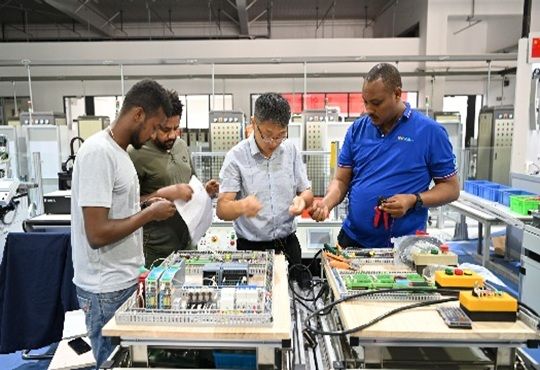
China has announced plans to train 10,000 engineers from developing countries over the next five years as part of its efforts to strengthen global engineering capabilities, expand international professional cooperation and increase its participation in global engineering governance. The initiative is outlined in the 2026-2030 road map released by the Chinese Society of Engineers (CSE).
The road map was presented and approved during the CSE's second council inaugural meeting held in Beijing on Tuesday. It focuses on developing a larger pool of highly skilled engineers and making China's engineering expertise more accessible internationally under the framework of the Global Development Initiative.
Alongside the target of training 10,000 engineers from developing nations, the five-year plan includes assessing 7,000 engineers in accordance with the General Requirements for Engineering Competence Assessment. It also proposes establishing 80 overseas Dayu engineering hubs to serve as practical training centres for engineering professionals.
Named after Yu the Great, an ancient figure renowned for his flood-control engineering efforts, the Dayu workshops are initiatives launched by the CSE. They are designed to provide practical training opportunities for local engineers and organize study tours to China, enabling participants to gain exposure to engineering practices and technical expertise.
The initiative builds on China's recent efforts to strengthen its position in international engineering education and professional standards. Hao Tongliang, vice-chairperson of the China Engineering Education Accreditation Association, said the new commitment follows progress achieved over the previous five years and represents a shift in China's role in global engineering education.
Hao also highlighted China's participation in international engineering accreditation frameworks. China passed a periodic review under the Washington Accord in 2023. Initiated by the International Engineering Alliance, the agreement brings together organizations responsible for accrediting engineering degree programmes and supports the international recognition of accredited qualifications.
China is also leading the development of the Shanghai Accord, a China-initiated framework intended to address gaps in the recognition of graduate-level engineering education. According to Hao, its working texts have received support from the International Engineering Alliance.
The CSE meeting also introduced updated editions of the General Requirements for Engineering Competence Assessment and the Engineering Ethics Code. These documents are intended to establish measurable competency standards for Chinese engineers and provide a common ethical foundation for professional engineering practice across national borders.
Tu Shandong, a member of the Chinese Academy of Engineering and professor at East China University of Science and Technology, emphasized the importance of strengthening international recognition of engineering qualifications. He noted that China's significant contribution to global manufacturing has not been matched by the international reach of its professional standards, ethics frameworks and talent certification systems.
China accounts for approximately 32 percent of global manufacturing value added, according to Tu. He argued that as the country's engineering and manufacturing capabilities expand internationally, its professional standards and qualification systems also need greater international recognition.
Also Read: Why Hands-On Learning Matters in Modern Engineering Education
Tu also outlined the changing capabilities expected of engineers by 2035. These include AI-native operators, cross-domain integrators, sustainable-value creators and participants in global governance. His remarks highlighted the growing importance of combining engineering knowledge with artificial intelligence, interdisciplinary expertise and ethical decision-making.
Addressing the impact of artificial intelligence, Tu compared the rapid expansion of AI capabilities with the slower growth of human cognitive labour. While technology is increasingly supporting complex tasks, he stressed that value judgments and ethical decisions must continue to remain human responsibilities.
The five-year initiative reflects China's broader ambition to contribute to international engineering education, professional development and qualification recognition. Through overseas training hubs, competency assessments and international accreditation frameworks, the CSE aims to strengthen engineering cooperation with developing countries and support the development of skilled professionals.
The plan also highlights the increasing importance of internationally recognized engineering qualifications as technological advancements reshape professional requirements. By combining practical training, common competency benchmarks and ethical standards, China intends to expand its contribution to global engineering education and governance over the coming years.