
-
The South China Morning Post has signed a memorandum of understanding with Nazarbayev University, Central Asia’s top-ranked higher education institution, to strengthen knowledge exchange between East and Central Asia and expand Hong Kong’s media presence in the region.
The agreement was formalised on Monday in Astana, just ahead of the SCMP’s China Conference: Central Asia 2026, a flagship event making its debut in the region. The partnership aims to foster academic dialogue, promote knowledge-sharing, and connect Hong Kong’s capital and media reach with Central Asia’s growing technology and resource ecosystem.
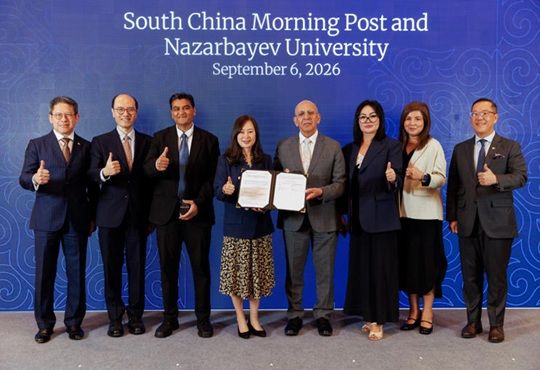
SCMP publisher Tammy Tam and Professor Waqar Ahmad, representing Nazarbayev University, held the signed MOU during a group photo with other executives in the Kazakh capital. The deal formalises institutional links between the Hong Kong-based media organisation and the leading Kazakh university, creating a structured platform for collaboration.
According to the agreement, the strategic partnership will encourage the exchange of expertise, support joint initiatives in media and academia, and help bridge the two regions at a time of increasing economic and diplomatic engagement. By linking Hong Kong’s established media platform with Nazarbayev University’s academic strengths, the collaboration seeks to deepen mutual understanding and create new channels for information flow and talent development.
The timing of the signing underscores the growing importance both sides attach to Central Asia. Hong Kong has been actively expanding its ties with the region in recent years, positioning itself as a gateway between China and countries along the Belt and Road. Kazakhstan, as the largest economy in Central Asia and a key player in regional connectivity, has emerged as a natural partner for such engagement.
Nazarbayev University holds the position of the highest-ranked higher education institution in Central Asia. Its research capacity, international faculty, and focus on innovation make it a valuable counterpart for a media organisation seeking deeper regional insight. The university’s location in Astana further anchors the partnership in the political and economic heart of Kazakhstan.
For the South China Morning Post, the MOU represents a concrete step in extending its presence beyond traditional markets. The China Conference: Central Asia 2026 marks the first time the SCMP has staged this major event in the region. Hosting the conference in Astana signals a deliberate effort to engage local policymakers, business leaders, academics and media professionals while raising the profile of Hong Kong’s independent journalism in Central Asia.
The partnership is expected to facilitate academic dialogue on topics of mutual interest, including economic connectivity, technology development, resource management and people-to-people exchanges. Knowledge-sharing activities could take the form of joint research, expert briefings, student and faculty engagement, or collaborative content projects that bring Central Asian perspectives to a wider international audience.
Officials involved in the agreement highlighted the complementary strengths of the two institutions. The SCMP brings decades of experience covering China and Asia, a strong digital and print platform, and an established reputation for independent reporting. Nazarbayev University contributes academic rigour, regional expertise and access to networks across Central Asia’s higher-education and research communities.
The broader context for the deal is the steady expansion of Hong Kong–Central Asia relations. In recent years, both sides have explored opportunities in trade, investment, education and logistics. Hong Kong’s role as an international financial centre and its experience in connecting mainland China with global markets align with Central Asia’s ambitions to diversify economies and strengthen external partnerships.
By formalising ties with a leading university, the SCMP is positioning itself to contribute to this process through informed coverage and structured collaboration. The MOU also supports the newspaper’s wider strategy of building long-term relationships in emerging regions rather than relying solely on event-based engagement.
Also Read: Kazakh PM Reviews Breakthroughs at Nazarbayev University Technopark
Looking ahead, the partnership is likely to generate concrete activities around the China Conference and beyond. These may include specialised forums, research collaborations, or media-academic exchanges that keep the conversation active after the conference concludes. Both sides have indicated that the agreement provides a flexible framework that can evolve according to shared priorities.
The signing comes at a moment when Central Asia is attracting increased attention from major economies seeking new supply chains, energy partnerships and investment destinations. For Hong Kong, maintaining a strong information and institutional presence in the region helps ensure that its businesses, professionals and policymakers remain well-informed and well-connected.
Professor Waqar Ahmad and Tammy Tam’s joint appearance with the signed document underlined the institutional commitment behind the deal. The presence of other executives from both organisations further signalled that the partnership is intended to be operational rather than purely ceremonial.
As the SCMP prepares to host its first major conference in Central Asia, the MOU with Nazarbayev University provides an academic and knowledge-based foundation for the event and for future work in the region. The agreement reflects a practical approach to deepening ties: pairing media reach with academic expertise to create lasting channels of exchange between Hong Kong and Central Asia.
In an era when geopolitical and economic realignments are reshaping global connections, partnerships of this kind help ensure that information, ideas and talent continue to flow across regions. The SCMP–Nazarbayev University MOU is one such step, grounded in mutual interest and timed to coincide with a significant regional gathering.
🍪 Do you like Cookies?
We use cookies to ensure you get the best experience on our website. Read more...