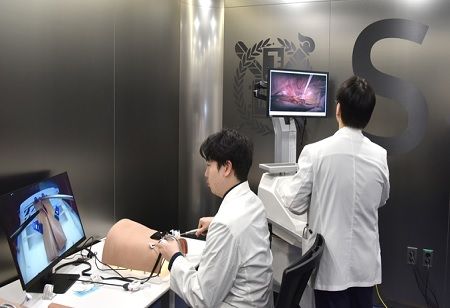
- Korea’s first single-department surgical simulation center launched, creating a dedicated space for focused, technology-driven surgical education.
- Hands-on, simulation-based training to strengthen surgeon skills and job readiness, helping trainees gain confidence before entering real operating rooms.
- Strong focus on patient safety through structured pre-surgery practice, reducing risks by allowing repeated training in real-life surgical environments.
Seoul National University Hospital (SNUH) has launched a state-of-the-art Surgical Simulation & Innovation Laboratory (SSIL), marking a major step forward in surgical education in Korea. The new facility aims to strengthen practical skills, improve job preparedness, and raise safety standards through advanced, simulation-based training.
Located on the 5th floor of the Medical Life Research Institute, the center is Korea’s first technology-focused education facility dedicated to a single surgical department. It allows surgeons, residents, and medical staff to train repeatedly in an environment that closely mirrors real operating rooms.
The lab features robotic surgery consoles, laparoscopic and endoscopic simulators, ultrasound systems, and vascular suturing training tools. These technologies enable trainees to practice key procedures before operating on real patients. By learning through repetition and structured evaluation, surgeons can build confidence and precision at an early stage of their careers.
Unlike traditional training centers, SSIL focuses strongly on hands-on teaching. Senior faculty guide trainees directly, using a standardized curriculum and step-by-step assessment system. This approach helps measure individual skill levels and ensures consistent training quality across all learners.
The education program starts with basic surgical skills and gradually moves to advanced procedures. Over time, SNUH plans to expand training beyond residents to include full-time doctors and specialists. This expansion will support continuous skill upgrades and help medical professionals adapt to new surgical technologies.
Also Read: Bournemouth University Expands STEM Education via China Partnership
Doctors using the center have welcomed the initiative. Many say the realistic training environment makes pre-surgery preparation more structured and effective, while immediate feedback helps speed up skill improvement.
According to the hospital’s surgery leadership, the center will play a key role in shaping future surgeons by improving skills, supporting career growth, and enhancing patient safety. Built with support from donors, SSIL reflects SNUH’s long-term commitment to education, innovation, and workforce development in healthcare.