
-
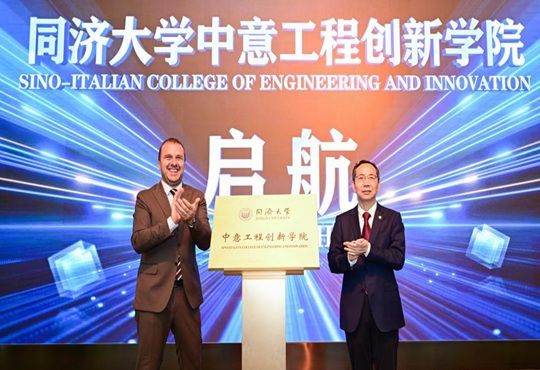
Tongji University marked the 20th anniversary of its Sino-Italian Campus by inaugurating the Sino-Italian College of Engineering and Innovation, a new joint institution designed to deepen educational and research collaboration between China and Italy.
The college, co-established by Tongji University and the Polytechnic University of Turin, aims to tackle two of the most pressing global challenges of the decade: sustainable development and the rapid transformation brought by artificial intelligence. Officials described the launch as a natural evolution of two decades of partnership that has already produced generations of engineers and researchers with dual cultural and technical perspectives.
At the heart of the new college is an interdisciplinary model that deliberately blends artificial intelligence, green development principles and design thinking. University leaders said the goal is to train a new type of engineering innovator professionals who are fluent in science and technology, skilled in engineering practice, sensitive to design and arts, and capable of operating effectively in international settings.
The first cohort of 86 master’s students was formally welcomed during the inauguration ceremony. These students will pursue specialized tracks in three key areas: climate change and carbon neutrality; systems design and intelligent innovation; and information and communications technology paired with embodied intelligence. The curriculum is structured to move beyond traditional siloed engineering education, encouraging students to work across disciplines from the outset.
University representatives emphasized that the college’s approach reflects the shared priorities of both China and Italy. Sustainable development has long been a policy focus in both countries, while artificial intelligence is reshaping industries, cities and daily life at unprecedented speed. By combining Italian strengths in design and systems engineering with Chinese advances in AI applications and large-scale implementation, the partners hope to generate solutions that are both technically robust and socially relevant.
The Sino-Italian Campus itself has served as a bridge between the two higher-education systems since its establishment 20 years ago. Over that period, joint programs, faculty exchanges and research projects have created a steady flow of knowledge and talent. The new college builds on that foundation by creating a dedicated institutional home for advanced, challenge-oriented postgraduate education.
Organizers noted that the college will not only deliver degree programs but also function as a platform for collaborative research. Faculty from both Tongji and the Polytechnic University of Turin are expected to work together on projects that address real-world problems — from low-carbon urban systems to intelligent manufacturing and AI-driven environmental monitoring. Students will be encouraged to participate in these projects, gaining practical experience alongside theoretical training.
The emphasis on “engineering innovations that benefit humanity” was repeated throughout the ceremony. Planners said the college deliberately rejects a narrow view of technological progress and instead seeks solutions that improve quality of life, reduce environmental impact and remain accessible across different societies. This orientation is intended to prepare graduates for careers in industry, government, research institutions and international organizations.
The timing of the inauguration is significant. As both China and Europe accelerate efforts to meet climate targets and harness AI for economic growth, demand for professionals who understand both domains is rising. The new college positions itself as a response to that demand, offering a structured pathway for students who want to work at the intersection of technology, sustainability and design.
Also Read: Tsinghua University Plans New School to Cultivate AI-Integrated Talent
In practical terms, the program will expose students to teaching methods and research cultures from both institutions. Courses are expected to incorporate case studies from Chinese and Italian contexts, joint supervision by faculty from the two universities, and opportunities for short-term mobility between Shanghai and Turin. Language support and intercultural training will also form part of the student experience, reflecting the international character of the partnership.
Beyond the classroom, the college is expected to strengthen broader Sino-Italian educational ties. Officials expressed hope that successful collaboration at the master’s level could later expand into doctoral training, executive education and industry partnerships. The presence of the first 86 students was presented as the beginning of a longer process rather than an isolated event.
Observers of China-Italy relations noted that educational cooperation has remained one of the most stable and productive channels between the two countries even as global geopolitical conditions fluctuate. Joint campuses and dual-degree programs have proven relatively resilient and continue to attract students who value international exposure. The new engineering college fits this pattern while updating the partnership for contemporary technological challenges.
Tongji University, long recognized for its strengths in civil engineering, architecture and urban planning, brings complementary expertise to the collaboration. The Polytechnic University of Turin contributes its established reputation in mechanical, automotive and systems engineering, as well as a strong design tradition. Together, the partners aim to create an educational environment that is greater than the sum of its parts.
As the ceremony concluded, university leaders reiterated their commitment to the college’s dual mission: producing highly capable graduates and generating knowledge that serves society. The 86 master’s students now beginning their studies will be the first to test that ambition in practice. Their progress over the coming years will help determine how effectively the Sino-Italian College of Engineering and Innovation can translate high-level cooperation into tangible educational and technological outcomes.
The inauguration of the college on the same day as the campus’s 20th anniversary celebrations underscored continuity and renewal. Two decades of partnership have created the institutional trust and shared experience needed for more ambitious joint ventures. The new college represents the next chapter in that relationship one focused on the defining technological and environmental questions of the present decade.
🍪 Do you like Cookies?
We use cookies to ensure you get the best experience on our website. Read more...