
-
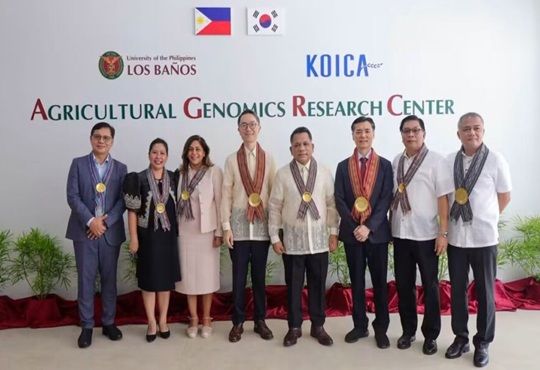
The University of the Philippines Los Baños has formally opened the Agricultural Genomics Research Center, marking the establishment of the Philippines’ first dedicated agricultural genomics facility. The centre was inaugurated earlier this week at the UPLB campus and is expected to strengthen the country’s capacity for advanced research in crop and livestock genetics while expanding training and regional collaboration opportunities for students, researchers and higher education institutions.
The Agricultural Genomics Research Center was established through a partnership between UPLB, the Republic of Korea via the Korea International Cooperation Agency, and the International Rice Research Institute. The facility forms part of a broader national agricultural initiative designed to build long-term scientific capability in agricultural genomics. According to UPLB, the centre is envisioned to lay the foundation for the genetic identification and improvement of Philippine crops and livestock through research, training, capacity building and regional cooperation.
The launch brought together senior representatives from the Philippine higher education and agriculture sectors. Among those present were UP Vice President for Research and Innovation Jose Joseph Marciano, Department of Agriculture–High Value Crops Development Program Undersecretary Cheryll Marie Natividad-Caballero, and Commission on Higher Education Commissioner Ricmar Aquino. South Korea was represented by Ambassador Lee Dong-gy, National Scientist Dolores Ramirez, UPLB Chancellor Jose Camacho Jr., and KOICA Country Director Jung Youngsun.
Beyond its research mandate, the centre is designed as a platform for international academic collaboration. UPLB noted that the facility will further cooperation between Philippine and South Korean institutions, creating additional opportunities for joint training, research exchanges and knowledge sharing in agricultural genomics. This international dimension is expected to benefit both early-career researchers and established scientists seeking access to advanced tools and collaborative networks.
The centre has also received support from the Department of Science and Technology. Laboratory equipment was provided through the Philippine Council for Agriculture, Aquatic, and Natural Resources Research and Development, as well as the Philippine Council for Health Research and Development. These contributions have helped equip the facility with the tools required for modern omics research.
UPLB described the Agricultural Genomics Research Center as a state-of-the-art hub primarily focused on agricultural omics. The research scope extends beyond traditional gene and DNA analysis to include genomics, transcriptomics, proteomics and metabolomics. This multi-level approach will allow scientists to study agricultural systems more comprehensively, generating insights that can inform breeding programmes, disease resistance strategies and productivity improvements suited to Philippine conditions.
In addition to laboratory research spaces, the centre includes a tissue culture facility and two screenhouses dedicated to micropropagation. These facilities will support the multiplication and conservation of plant materials, enabling researchers to link molecular findings with practical agricultural applications. By integrating laboratory analysis with controlled growing environments, the centre aims to accelerate the translation of genomic discoveries into usable outcomes for farmers and the wider agriculture sector.
Education and capacity building form a core part of the centre’s mission. In partnership with collaborators under the Korea-Philippine Omics Partnership Network, including faculty and staff from UPLB and partner higher education institutions, the centre will conduct both formal and nonformal training programmes in agricultural omics. These programmes are expected to help develop a new generation of researchers equipped with specialised skills that are increasingly important in modern agricultural science.
The centre will also offer analytical services to the public, extending its impact beyond the university community. By providing access to advanced genomic and omics testing, the facility can support external researchers, government agencies and private sector partners working on agricultural improvement projects. This service-oriented role positions the centre as a national resource rather than a purely institutional laboratory.
For Philippine higher education, the opening of the Agricultural Genomics Research Center represents a significant investment in research infrastructure linked to national development priorities. Agriculture remains a vital sector for food security, rural livelihoods and economic growth. Strengthening scientific capacity in genomics and related fields can help address challenges such as climate resilience, pest and disease pressure, and the need for higher-yielding, more nutritious crops and livestock.
International partnerships of this kind also illustrate how universities can leverage external expertise and funding to accelerate capability building. Collaboration with KOICA and IRRI brings not only technical resources but also opportunities for Philippine researchers to engage with global standards and networks in agricultural science. Over time, such partnerships can help retain talent, attract further research investment and position local institutions as more active contributors to regional scientific progress.
Also Read: Building Risk-Ready Leaders for the Future of Food and Agribusiness
The centre’s emphasis on training is particularly relevant for students and early-career scientists. Access to specialised facilities and structured learning programmes can improve the quality of graduate research, support thesis and dissertation work in advanced biological sciences, and prepare graduates for roles in research institutes, government agencies, agribusiness and international organisations. By embedding education within a functioning research environment, UPLB aims to create a continuous pipeline of skilled professionals in a strategically important field.
As the Agricultural Genomics Research Center begins operations, its success will depend on sustained collaboration, effective use of the new facilities, and the ability to translate research outputs into practical benefits for Philippine agriculture. The combination of modern infrastructure, international partnership and a clear focus on capacity building positions the centre as an important addition to the country’s higher education and research landscape.
🍪 Do you like Cookies?
We use cookies to ensure you get the best experience on our website. Read more...