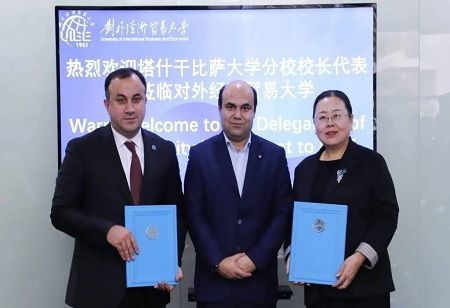
- Representatives from the Tashkent branch of the University of Pisa, JSC Uzbekistan Technological Metals Complex, and China’s UIBE met to deepen cooperation in higher education and industry-aligned learning.
- Discussions centred on advanced teaching methods, joint academic programmes, faculty development, and aligning curricula with real-world industry needs.
- A new International Trade and Business Management programme will see students study one year in Tashkent and three years at UIBE in China, combining European academic foundations with Asia-focused business exposure.
Representatives of the Tashkent branch of the University of Pisa and JSC Uzbekistan Technological Metals Complex recently held a meeting at the University of International Business and Economics (UIBE) in China, marking another step forward in strengthening international academic and industry collaboration. The discussions centred on expanding cooperation in higher education, introducing advanced teaching methodologies, and creating joint academic programmes that align global education with real-world industry needs.
According to information shared by the Ministry of Mining Industry and Geology, the meeting brought together academic leaders and industry representatives who expressed a shared commitment to deepening partnerships that go beyond conventional exchanges. The participants discussed ways to integrate modern educational technologies into teaching frameworks and to design programmes that equip students with both theoretical knowledge and practical skills required in a rapidly evolving global economy.
Officials from the Tashkent branch of the University of Pisa said the collaboration reflects the institution’s focus on internationalisation and academic mobility. They emphasised that partnerships with leading universities and industry bodies are essential to preparing students for global careers, particularly in fields such as international trade, business management, and technology-driven industries. Representatives noted that exposure to diverse academic environments helps students develop broader perspectives and stronger professional competencies.
JSC Uzbekistan Technological Metals Complex highlighted the importance of aligning academic training with industry demands. Company representatives said that cooperation with universities allows industry to contribute to curriculum development and talent nurturing, ensuring graduates are better prepared to meet sector-specific challenges. They also underlined the value of professional development programmes for teaching staff, which would enable educators to stay updated with the latest industry practices and technological advancements.
Also Read: Maharashtra education commission starts Teacher recruitment in 13 districts
A key outcome of the meeting was the agreement to launch a joint '1+3' educational programme in International Trade and Business Management. Under this initiative, students will complete their first year of studies at the Tashkent branch of the University of Pisa. The remaining three years will be spent at UIBE in China, where students will gain in-depth academic training alongside practical exposure in an international business environment. Academic representatives said this structure is designed to combine European academic foundations with Asia-focused business and trade expertise.
Officials from UIBE welcomed the initiative, describing it as a meaningful step toward building a more interconnected global education ecosystem. They said hosting international students and collaborating with foreign universities enriches the campus environment and promotes cross-cultural understanding. The university also expressed readiness to support joint research activities and faculty exchange programmes as the partnership evolves.
All parties reiterated their willingness to share expertise, jointly develop professional training programmes for faculty members, and explore additional areas of cooperation in the future. They said the agreement reflects a shared vision of education as a bridge between countries, cultures, and industries, ultimately benefiting students, institutions, and the broader economic landscape.