
-
In August 2026, a short video recorded by a high school teacher during his lunch break spread rapidly across social media and news platforms, and by the time it stopped circulating, it had done something few viral education clips manage, it forced a genuinely global conversation about a problem many teachers had already quietly been living with for years.
Darius Williams, a teacher at Wheatley High School in the Houston Independent School District, appeared visibly distressed as he described an experience in his senior English class. He explained that his 17- and 18-year-old students had been given a model, sentence starters, and guided annotation for a basic writing task. Despite this scaffolding, many could not complete a simple sentence. "These are 17- and 18-year-old kids," Williams said, "and they couldn't fill in four words. Four words."
The video captured more than one teacher's frustration in a single classroom on a single day. It became a focal point for a much wider reckoning with the state of literacy among high school graduates.
Educators, parents, and observers began asking difficult, uncomfortable questions:
How did students reach the final year of secondary school without mastering foundational writing skills?
What role has technology, particularly generative artificial intelligence, played in that outcome?
And what does this mean, practically, for the students themselves as they prepare for college, work, and adult life?
This piece examines the incident, the broader patterns it reflects, the contributing factors researchers and educators have identified, and the implications for education systems well beyond Houston. Every claim below is drawn from publicly reported accounts of the video and the discussions that followed in August 2026, with no fabricated statistics, invented quotes, or unverified claims included.
Dr Stephen Hodges, CEO, Efekta Education Group, says, "Language is a practical skill. No one learns to swim by reading a book about swimming, they must enter the water, attempt the strokes, and receive guidance on what they are doing wrong".
The Viral Moment and the Immediate Reaction
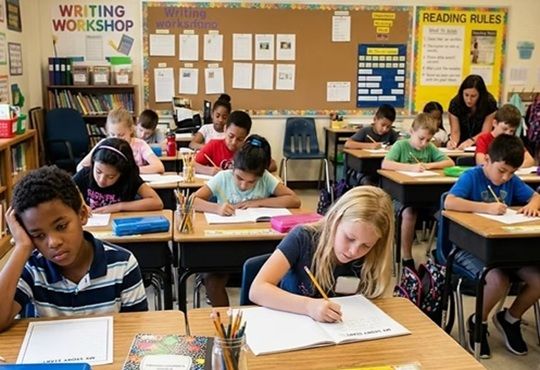
Williams' video was recorded at Wheatley High School in Houston. In it, he recounted attempting to guide seniors through a short writing exercise. Students had been provided with a scenario, collaborative annotation, and explicit modeling of the expected response, the kind of layered instructional support that, in theory, should have made the task achievable for nearly any student at that grade level.
Even with those scaffolds in place, many struggled to produce a complete sentence of their own. Williams expressed both concern and evident emotional exhaustion in the video, noting that the difficulty appeared specifically in written expression rather than in the students' ability to discuss ideas verbally.
The clip quickly circulated well beyond Houston, and educators in other regions and countries responded, not always in agreement about what it meant. One Canadian teacher argued publicly that the video should prompt careful, measured discussion rather than sweeping claims that an entire generation 'cannot read or write'. Provincial data from Ontario, cited in coverage of the ensuing debate, showed that in the 2024-25 school year, 74 percent of English-language Grade 3 students met the reading standard and 65 percent met the writing standard.
By Grade 6, those figures rose to 86 percent for reading and 85 percent for writing. Those numbers matter because they complicate a simple, panic-driven reading of the Houston video: many students clearly do meet literacy benchmarks at earlier stages of their education. The genuine concern is not that literacy instruction fails universally from the start, but that something appears to happen to the trajectory of those skills as students move into the later years of high school.
Williams' video was also not an isolated cultural moment. Similar clips have surfaced repeatedly in recent years and drawn significant attention each time. One earlier example, from a Philadelphia charter school, circulated widely after it showed students encountering genuine difficulty with vocabulary such as 'silhouette' and 'extraordinary', words that would typically be considered standard for their grade level.
Separate clips have featured teachers announcing publicly that they were leaving the profession entirely after encountering students who struggled with independent reading, writing, and critical thinking at a scale that felt unsustainable to manage. Taken together, these recurring episodes suggest that Williams' experience in Houston was not an aberration, but rather one more visible data point in a pattern that had already been building quietly across multiple school systems.
Patterns That Extend Beyond a Single Classroom
Reports emerging from higher education have added another important layer to this discussion. Professors at various universities have described incoming students who arrive on campus without having completed a single full book during their entire high school career. In response, some institutions have adjusted their first-year academic expectations or introduced additional remedial support courses specifically designed to close gaps that, historically, would have been addressed well before college admission. The widening gap between secondary school preparation and the actual demands of college-level academic work has become a recurring, persistent theme in education coverage well beyond this single viral incident.
At the same time, data on technology use inside schools points to a genuinely significant shift in how students approach academic assignments, one that runs on a timeline suspiciously parallel to growing literacy concerns. Coverage in 2026 noted that a strikingly high percentage of students reported using generative artificial intelligence tools for assessments. One figure cited repeatedly in this discussion was that 88 percent of students had used generative AI for coursework within the previous year, a sharp increase from 53 percent just one year earlier.
A separate report found that 72 percent of high school students used AI to complete assignments without fully engaging with the underlying material the assignment was actually designed to teach. Compounding the issue, only a small proportion of schools were reported to have clear, enforceable guidelines governing how AI could or could not be used for coursework.
These patterns do not, on their own, prove that AI use directly causes literacy difficulties; correlation across a single year of rapidly shifting technology adoption is not the same as a demonstrated causal mechanism. They do, however, raise legitimate and pressing questions about the relationship between highly convenient digital tools and the slower, more effortful process of developing foundational writing skills.
When students can generate fluent-sounding text in seconds, the incentive to practice the underlying, often frustrating work of constructing original sentences, organizing ideas logically, and revising drafts for clarity may diminish substantially, even without any conscious decision by the student to disengage. Teachers involved in this broader conversation have observed a specific and telling pattern: some students can discuss complex concepts verbally with genuine confidence and nuance, yet effectively freeze when asked to translate those same ideas into written form on a blank page.
Prof. Susanna Siu-sze Yeung, Associate Vice President (Quality Assurance), highlights, "The Education University of Hong KongAI is not positioned as a replacement for teachers, parents, or human judgment, but as a tool whose value depends entirely on design quality and the strength of human guidance surrounding it".
The Contributing Factors Identified in Public Discussion
Several interrelated factors have been raised repeatedly across the public discussion that followed the Houston video, and none of them, taken alone, fully explains what is happening.
The first is the fundamentally cumulative nature of skill development. Williams himself noted directly in his video that students do not suddenly lose the ability to write in their final year of high school; that framing would misunderstand how literacy actually develops. Difficulties typically build gradually over time, grade by grade, often in ways that remain individually manageable and easy to overlook in any single academic year.
Gaps that seem minor and correctable in third or fourth grade can compound quietly as academic demands increase in complexity, until they become genuinely consequential by the time a student reaches their senior year, at which point there is comparatively little instructional runway left to address them.
The second factor is the uneven implementation of reading and writing instruction as students progress through the education system. While many elementary students meet proficiency standards, as the Ontario data referenced above illustrates, the transition into more complex, analytical writing during middle and high school appears to leave a meaningful subset of learners behind.
Curriculum pressure driven by standardized testing timelines, persistently large class sizes, and competing instructional priorities can all limit the amount of time realistically available for sustained writing practice paired with the kind of detailed, individualized feedback that actually builds writing competence over time.
The third factor is the rapid, largely unregulated integration of generative AI into everyday student work. Tools capable of producing fluent, coherent text on demand offer undeniable advantages in terms of efficiency, and it would be dishonest to pretend otherwise. But that same efficiency carries a real risk of short-circuiting the cognitive effort that writing proficiency has always required to develop.
When the practical goal for a student shifts from learning the process of writing to simply producing an acceptable final product, the actual opportunities for meaningful practice shrink correspondingly, even if the volume of completed assignments does not decrease. Educators involved in this discussion have specifically pointed out that students may continue to demonstrate strong oral reasoning skills while simultaneously lacking the written fluency that formal education, standardized testing, and most professional workplaces still explicitly require.
The fourth factor is the broader cultural and digital environment shaping how young people engage with sustained attention generally. Attention patterns shaped by constant exposure to short-form video, near-continuous notifications, and algorithm-driven content feeds can make sustained reading and careful, deliberate writing feel considerably more effortful by comparison.
This does not mean that young people are somehow incapable of deep focus; many demonstrate genuinely remarkable concentration and persistence in specific areas that hold their personal interest. It does mean, however, that schools now face a measurably steeper challenge in deliberately cultivating the habits of extended reading and careful written composition that were once more organically reinforced by a media environment with fewer competing demands on attention.
The Human Cost of a Growing Literacy Gap
Behind the viral clip, the cited statistics, and the resulting policy debate are individual students who are genuinely preparing to leave secondary school in the coming months and years. Those who struggle with basic written expression face real, practical barriers that extend well beyond a single classroom assignment. College applications, scholarship essays, workplace communication, and professional documentation of nearly every kind all depend fundamentally on the ability to convey ideas clearly and correctly in writing. Students who can articulate sophisticated thoughts in conversation but genuinely cannot translate those same thoughts onto the page may find doors closing that their actual intelligence and potential would otherwise have opened for them.
Teachers carry a significant portion of this burden as well, often quietly and without public visibility until a moment like Williams' video breaks through. His visible distress in that clip reflected what appeared to be years of accumulated effort meeting students exactly where they are academically, while still being held formally accountable for outcomes that, in many cases, were shaped by gaps formed long before those students ever entered his specific classroom.
Many educators who responded publicly to the video described remarkably similar experiences of working intensively with learners who arrive with significant, pre-existing skill gaps that a single course, however well taught, cannot realistically close on its own. The emotional toll of watching capable, intelligent students leave high school genuinely underprepared for what follows has been mentioned repeatedly and consistently across the broader discussion that followed.
Parents and wider communities are affected by this dynamic as well, often without realizing it until it is considerably harder to address. Families who reasonably assumed that steady progression through the school system's grade levels guaranteed genuine readiness for the next academic stage may only discover, often quite late, that foundational writing skills remain meaningfully incomplete. That discovery frequently arrives at precisely the point when remediation becomes both more difficult to implement and more time-constrained, whether that point is the college application process, a first year of university coursework, or an entry-level job requiring basic written communication.
Also Read: Talent Gap: How Singapore Is Rewiring Work for the AI Age
Understanding the Real Literacy Challenge
Not every reaction to the viral video has trended toward alarm, and that measured pushback has been an important, necessary part of the broader conversation. Some educators have specifically stressed the importance of context before drawing sweeping conclusions. The Canadian commentary referenced earlier explicitly urged against concluding that an entire generation of students lacks basic literacy, pointing directly to provincial assessment data showing that substantial majorities of students do, in fact, meet literacy standards at multiple grade levels. Measurable progress continues to exist within the system, even as genuine, serious challenges persist elsewhere within it.
Others involved in the discussion have called for clearer, more precise distinctions between fundamentally different kinds of literacy difficulty, rather than treating 'students can't write' as a single, undifferentiated problem. Some students genuinely struggle with basic decoding and reading fluency itself. Others can read and comprehend material perfectly well but have had limited structured practice actually constructing extended written arguments of their own. Still others may perform entirely adequately on structured, scaffolded tasks, yet falter noticeably when asked to generate original written text independently, without that same scaffolding present.
Effective, targeted responses to any of these distinct problems depend heavily on accurate diagnosis of which specific difficulty a given student or cohort is actually experiencing, rather than a single blanket intervention applied uniformly.
There is also broad recognition within this discussion that schools themselves operate under genuine, often severe structural constraints that limit what any individual teacher can realistically accomplish. Large class sizes, extremely limited lesson-planning time, high-stakes standardized testing regimes that shape curriculum priorities, and the ongoing, legitimate need to address students' social and emotional needs alongside pure academic instruction all meaningfully shape what is actually achievable within any given classroom in a given school year.
No single teacher, however skilled or dedicated, can realistically be expected to single-handedly reverse literacy gaps that have accumulated silently across multiple years of a student's education within the confines of one senior-year English course.
Rebuilding Literacy: Practical Steps to Strengthen Student Writing
The public discussion that followed Williams' video has pointed toward several practical directions forward, none of which are presented as simple or immediate fixes to a genuinely complex, multi-causal problem.
One direction involves earlier and considerably more consistent attention to writing instruction across the entire curriculum, rather than confining it narrowly to English classes alone. When writing is treated as a skill developed exclusively within one subject area, the total opportunities available for meaningful practice across a student's school day remain artificially limited. Embedding frequent, genuinely low-stakes writing tasks into science, history, and other subjects can meaningfully build overall fluency over time, distributing the practice load across a student's entire academic experience rather than concentrating it in a single class period.
A second direction involves more deliberate, explicit instruction in the actual writing process itself, meaning planning, drafting, revising, and editing as distinct stages, rather than an exclusive focus on evaluating only final, submitted products. Students need repeated, guided experience actively shaping raw ideas into coherent sentences and paragraphs, supported by real feedback at each stage of that process, rather than only receiving a grade once the entire process is already complete and largely invisible to the instructor.
A third and increasingly urgent direction involves genuinely thoughtful, well-considered policy on generative AI use within schools. Blanket prohibitions are notoriously difficult to enforce in practice and risk ignoring legitimately useful applications of these same tools for feedback and idea generation. Clear, specific guidelines that meaningfully distinguish between appropriate AI-assisted support and outright substitution for a student's own learning process represent one promising approach currently under active discussion among educators and policymakers. Teaching students explicitly how to use AI tools for structured feedback or early idea generation, while still firmly requiring them to produce and personally revise their own original writing, is one specific model gaining increased attention as a workable middle path.
A fourth direction involves considerably greater transparency with families regarding a student's actual skill development over time. Regular, specific communication about a student's genuine progress in reading and writing, extending meaningfully beyond a single overall course grade, can allow for the kind of earlier intervention that becomes progressively harder to implement the longer a genuine skill gap goes unaddressed and unnoticed by the people best positioned to help.
Finally, there is clear value in deliberately protecting classroom time for sustained reading of complete texts, a practice that appears to have eroded significantly based on the higher education reports referenced earlier in this discussion. Students who have rarely, if ever, finished a complete book by the end of high school enter both higher education and the professional workplace at a genuine, measurable disadvantage relative to peers who have. Schools that consciously prioritize extended, sustained reading alongside targeted skill instruction give their students a meaningfully stronger overall foundation heading into whatever comes next.
Conclusion!
The video recorded by Darius Williams at Wheatley High School in Houston did not create a literacy crisis from nothing. It made visible, suddenly and publicly, difficulties that many teachers had already been quietly encountering for years, and that higher education faculty had already independently begun reporting through their own channels well before this particular clip went viral.
The struggle of some high school seniors to complete a basic, four-word sentence, even with substantial instructional support directly in front of them, points to genuinely cumulative gaps in skill development, the complex and still-unfolding influence of rapidly adopted new technologies, and the ongoing, unresolved challenge of adequately preparing all students for the practical demands that follow graduation, regardless of their academic track.
The conversation that followed the video has proven valuable precisely because it moved meaningfully beyond a single classroom and a single viral clip. It has prompted genuine examination of assessment data across multiple regions, close attention to actual patterns of AI use among students, honest scrutiny of current instructional practices, and serious consideration of the real, tangible consequences facing young people as they leave secondary education.
Meaningful solutions will not be found in either panic or denial, the two easiest and least useful responses available. They will instead require sustained, patient attention to the genuine fundamentals of reading and writing instruction, an honest, ongoing assessment of exactly how new technology is reshaping student learning habits in real time, and practical, adequately resourced support for the teachers who work directly with these students, every single day, often with far fewer resources than the scale of the challenge actually requires.
Literacy remains a foundational human capability, not merely an academic checkbox. The ability to understand complex texts and to express one's own ideas clearly and correctly in writing continues to matter profoundly for education, employment, civic participation, and personal agency well beyond the classroom walls. The students who left Williams' classroom in 2026, and the students who will follow directly behind them in the years ahead, deserve instruction and educational systems genuinely equipped to give them these skills, rather than systems that simply assume those skills have already been acquired somewhere earlier along the way.
The viral moment of August 2026 served, ultimately, as an uncomfortable but necessary reminder that this particular work remains unfinished, and that the stakes involved remain genuinely high for an entire generation of students now moving through the system.
🍪 Do you like Cookies?
We use cookies to ensure you get the best experience on our website. Read more...