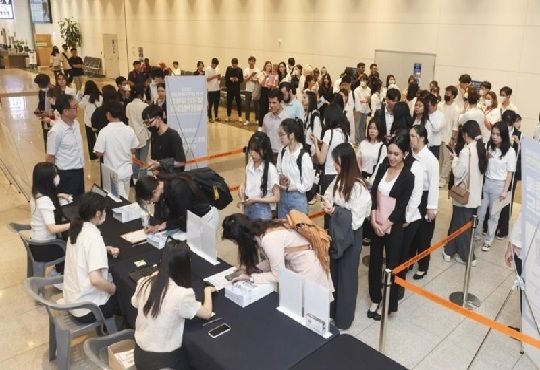
The number of international students at South Korean colleges and universities has exceeded 300,000, reaching the government’s target of attracting 300,000 foreign students by 2027 one year ahead of schedule. According to education data released Sunday, South Korea recorded approximately 307,000 international students this year.
The sharp rise comes as universities and junior colleges across the country have intensified efforts to recruit students from overseas amid a steadily declining domestic school-age population. While overall enrollment growth is significant, officials and analysts note that high dropout rates in certain regions and heavy reliance on students from a limited number of countries remain pressing concerns.
Between 2017 and 2025, the number of international students enrolled at four-year general and industrial universities increased 70.4 percent, rising from 90,095 to 153,477. The expansion was even more dramatic at junior colleges, where international enrollment surged 504.6 percent over the same eight-year period, climbing from 6,163 to 37,260 students.
The composition of international students’ countries of origin has also shifted notably. At four-year general and industrial universities, the share of students from China fell from 59.9 percent in 2017 to 29.2 percent last year. In contrast, the proportion of Vietnamese students rose from 10.9 percent to 28.7 percent. Students from Uzbekistan, Mongolia, Nepal and Myanmar together accounted for 20.8 percent of international enrollment last year, up from 6.4 percent in 2017.
Junior colleges, however, have become increasingly dependent on students from Vietnam. Last year, 22,342 Vietnamese students were enrolled at South Korean junior colleges, representing 60 percent of their total international student population. In Gangwon province, Vietnamese students made up 87.3 percent of international enrollment at junior colleges, underscoring the concentration of students from a single country in certain regions.
Despite the rapid growth in numbers, retention has shown overall improvement. At four-year general and industrial universities, the international student dropout rate declined from 6.85 percent in 2023 to 5.60 percent last year. At junior colleges, the rate fell from 10.02 percent to 7.23 percent over the same period.
Regional disparities remain significant. In the Seoul metropolitan area, the dropout rate among international students at four-year universities edged upward from 5.9 percent in 2023 to 6.2 percent in 2025. By contrast, institutions in southwestern South Korea and Jeju saw a sharp decline, with the rate dropping from 9.5 percent to 4.8 percent.
Also Read: How Asia Built the World's Best Schools
The situation is particularly challenging at junior colleges in Gangwon province, where the international student dropout rate reached 19.5 percent last year meaning roughly one in five foreign students discontinued their studies. That figure was more than 1.5 times the overall student dropout rate of 12.7 percent at those institutions.
The findings have prompted calls for more targeted support programs tailored to the specific needs of individual institutions. Analysts point out that while regional universities have successfully expanded overseas recruitment to offset shrinking domestic enrollment, growth in student numbers must be matched by adequate academic, linguistic and living support if retention is to improve further.
The Korean Educational Development Institute attributed the overall improvement in international student retention to several factors. These include stronger education internationalization certification standards, tighter visa management, and expanded Korean-language instruction and living support offered by universities. The data appear in the 17th edition of Reading Our Education Through Data, published jointly by the Ministry of Education and the Korean Educational Development Institute.
As South Korea enters an era with more than 300,000 international students, policymakers and university administrators are expected to place greater emphasis on diversifying students’ countries of origin and strengthening retention measures. Such efforts are viewed as increasingly important to the long-term competitiveness of regional universities, many of which now depend heavily on foreign enrollment to maintain student numbers.
The rapid rise in international students reflects both opportunity and challenge. On one hand, South Korea has met its national recruitment target early and has broadened the geographic mix of students at many four-year institutions. On the other, concentrated reliance on students from particular countries especially at junior colleges and persistently high dropout rates in certain regions highlight the need for more comprehensive support systems.
Education officials and researchers stress that sustained success will depend not only on attracting greater numbers of foreign students but also on ensuring those students receive the academic and practical assistance required to complete their studies successfully.