
-
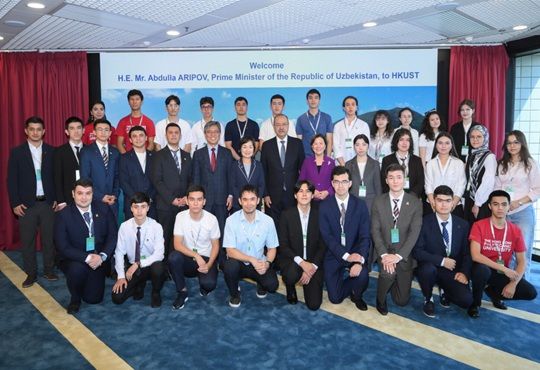
The Hong Kong University of Science and Technology became the sole university stop on the Hong Kong itinerary of Uzbekistan’s Prime Minister Abdulla Nigmatovich Aripov when he and a 24-member delegation visited the campus on 10 September 2026.
The high-level meeting underscored growing interest in academic and research cooperation between Uzbekistan and Hong Kong, with particular emphasis on artificial intelligence, talent development and the commercialisation of research. Aripov was received by Hong Kong’s Secretary for Education Dr Choi Yuk-lin, HKUST Council Chairman Professor Harry Shum, President Professor Nancy Ip and senior university leaders.
In discussions with the university’s leadership, the two sides examined higher-education development, technological innovation, student and faculty mobility, and ways to support Uzbekistan’s push toward a knowledge-based economy. Both countries mark 35th anniversaries this year, a coincidence that several participants described as symbolically useful for launching longer-term collaboration.
Prime Minister Aripov said his delegation was impressed by HKUST’s ability to turn research into practical applications. “With over 7,000 Uzbek students pursuing higher education across China, we see tremendous potential to strengthen our academic ties with Hong Kong and prioritize HKUST as a key destination for our students,” he stated. He framed the partnership as a way to expand educational excellence and global reach for both sides.
Professor Shum welcomed the visit, which coincided with the Belt and Road Summit. He noted that HKUST, a relatively young institution, already draws students from more than 80 nationalities and has an existing relationship with Uzbekistan’s El-Yurt Umidi Foundation. The meeting, he said, represented a step toward deeper ties between Hong Kong and Central Asia and new opportunities for youth development along the Belt and Road.
President Ip highlighted the alignment between Uzbekistan’s stated priorities in artificial intelligence, robotics, fintech and cybersecurity and HKUST’s research strengths. She identified AI and medical science as especially promising starting points for joint work. “Beyond educational exchanges, we see tremendous opportunities to deepen cooperation in research, innovation, talent development and knowledge transfer,” Ip said. She added that HKUST looked forward to reciprocal visits to Uzbekistan.
The visit produced a concrete outcome: a Memorandum of Understanding between HKUST and Uzbekistan’s Ministry of Higher Education, Science and Innovation. Signed by President Ip and Deputy Minister Salomov Uktam Rahimovich in the presence of the Prime Minister, Dr Choi and Professor Shum, the document establishes a framework for collaboration in teaching, learning and research.
After the formal talks, the delegation toured the HKUST Von Neumann Institute. There they were briefed on the university’s work in next-generation multimodal AI systems, robotic intelligence, AI-driven 3D understanding and generation, and large-scale healthcare models. Officials presented the technologies as tools that could address both societal and industrial challenges.
The Prime Minister and his team also met 31 Uzbek students currently studying in Hong Kong, including 14 undergraduates enrolled at HKUST. The conversation focused on their academic experiences and daily life in the city, giving the visitors a direct sense of the student perspective.
HKUST has positioned itself in recent rankings as a strong performer in computer science and related fields. Its computer science discipline, which includes artificial intelligence and machine learning, has been ranked first in Hong Kong for ten consecutive years in one major subject ranking. Broader institutional rankings place the university among the top 40 globally and high in Asia. University leaders routinely cite these results when discussing partnerships with governments seeking rapid advances in technology and innovation.
For Uzbekistan the engagement fits a broader pattern of looking eastward for higher-education and technology partners. With thousands of its students already studying in China, the government has signalled interest in concentrating more of that mobility on institutions that combine strong research with industry links. Hong Kong’s role as a “super-connector” between mainland China, the rest of Asia and international networks was repeatedly referenced during the visit.
Observers note that successful academic partnerships of this kind usually require follow-through on mobility programmes, joint research projects and practical mechanisms for knowledge transfer. The newly signed MoU provides an initial structure; the test will be whether concrete initiatives in AI, medical science or other priority areas materialise in the coming academic years.
Also Read: HKUST and Guangzhou Government Sign Deal to Boost Innovation
The timing of the visit during a major regional summit and in a year of dual anniversaries gave the event added visibility. Both sides left emphasising mutual interest rather than fixed timelines. President Ip’s stated intention to travel to Uzbekistan and the presence of senior education officials from both governments suggest that further discussions are already under consideration.
In the meantime, the 14 Uzbek undergraduates at HKUST and the wider cohort of Uzbek students in Hong Kong serve as an existing human bridge. Their experiences, shared directly with the Prime Minister, offered a ground-level counterpoint to the high-level strategic conversation.
The episode illustrates how universities in Hong Kong continue to function as soft-power and knowledge platforms for Central Asian governments seeking partners in science, technology and higher education. Whether the new framework yields sustained collaboration will depend on the practical programmes that follow the ceremony and the campus tour.
🍪 Do you like Cookies?
We use cookies to ensure you get the best experience on our website. Read more...