Ho Chi Minh City is accelerating efforts to establish English as a second language across its school system, building on nearly three decades of pioneering programs. Officials aim to create natural English-speaking environments, improve teaching quality, and expand bilingual instruction with a clear vision extending to 2045.
The southern metropolis launched Vietnam’s first intensive English program in 1998 and has steadily expanded it. In 2014 it introduced an integrated English-Vietnamese curriculum under Project 5695, enabling public-school students to study mathematics and science in English alongside the national curriculum. Results have been encouraging: students gain both subject knowledge and practical language skills, using English more naturally in daily learning.
English education now reaches every level. More than 206,800 preschool children over half of those enrolled in early childhood institutions take part in English familiarization programs. At the general education level, English follows the 2018 national curriculum, while more than 90 percent of public schools offer enhanced or bilingual programs. Many continue teaching math and science in English through Project 5695 or partnerships that bring in native-speaking teachers. A growing number of schools also pilot other subjects in English, helping students build confidence through everyday classroom use.
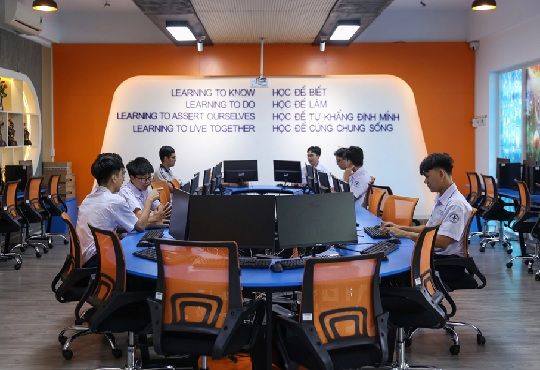
Marie Curie High School illustrates the approach. Principal Nguyen Tran Khanh Bao notes that bilingual signs, administrative documents, and school forms allow teachers and students to encounter English daily. With more than 3,400 students in 80 classes, the school has expanded English clubs and international exchanges while assessing proficiency to guide training plans.
Progress is uneven. The municipal Department of Education and Training acknowledges gaps in infrastructure, digital facilities, access to English environments, and resource mobilization across districts. At the preschool level, programs still rely heavily on socialized services, and some public preschools lack full-time English teachers.
Teacher preparation has advanced significantly. Surveys show more than 80 percent of primary and secondary English teachers have reached at least Level 4 on Vietnam’s foreign-language competency framework. Over half of high-school English teachers have attained Levels 5 or 6. The city has assessed proficiency across public schools to support long-term recruitment and training plans.
Yet the shortage of qualified teachers remains the biggest obstacle. Teachers capable of delivering subjects in English are insufficient in both number and quality. Proficiency among school administrators and teachers of other subjects also needs improvement, and policies on recruitment, professional development, and incentives require refinement.
Also Read: Vietnam University First Globally to Offer UTS Program
While the Ministry of Education and Training finalizes national standards, Ho Chi Minh City is completing its own project on English as a second language with a vision to 2045. The roadmap has three phases. From 2026 to 2030 the focus is on foundations: 40 percent of educational institutions should establish English-speaking environments and 20 percent should teach selected subjects in English.
Between 2031 and 2035 the city aims for all education personnel to meet English proficiency standards and for half of schools to deliver programming in English. By 2045 the target rises to 60–70 percent of institutions implementing integrated English programs.
To reach these goals, the city plans special mechanisms to attract high-quality English teachers and native-speaking educators, promote public-private partnerships, modernize teaching materials, expand digital learning resources, and accelerate the use of digital technologies and artificial intelligence. The objective is a learning environment in which English functions increasingly as a natural second language.
Related national efforts underscore the scale of the ambition. Hanoi has identified 20 schools for trials of English as a second language. The Ministry of Education and Training estimates Vietnam will need 22,000 additional English teachers by 2030. Ho Chi Minh City has already required teachers to self-assess their English skills, and the National Economics University has announced plans to make English its institutional second language by the end of the decade the first Vietnamese university to do so.
Challenges persist, particularly the uneven distribution of resources and the shortage of teachers able to instruct non-language subjects in English. Yet the city’s long track record, systematic assessment of its workforce, and phased targets to 2045 position it as a leader in Vietnam’s broader push to elevate English proficiency in education. Success will depend on sustained investment in teachers, infrastructure, and immersive environments that turn English from a school subject into a practical second language.