The Rise of International K-12 Schools Across Asia in 2025

-
- Asia’s K-12 Boom- Rapid growth driven by bilingual schools and rising middle-class demand.
- Experiential, AI-driven, and culturally hybrid curricula enhance skills.
- Top institutions foster holistic development, global citizenship, and future readiness.
As 2025 draws to a close, the landscape of K-12 education in Asia stands transformed, propelled by a surge in international schools that blend global standards with local contexts. These institutions, now numbering over 8,600 across the continent representing 58 percent of the world's total 14,833 international schools have become beacons of innovation amid rapid urbanization, economic shifts, and a post-pandemic emphasis on holistic development.
Enrollment has skyrocketed by 13 percent since 2020, generating an annual fee income of $67.3 billion globally, with Asia's share driving a 22 percent increase in this revenue stream. This growth isn't merely numerical, it's a response to middle-class aspirations for future-proof skills, where bilingual proficiency and experiential learning emerge as cornerstones, intertwined with technology, sustainability, and cultural fusion.
Yet, the story extends beyond these trends, encompassing equity challenges, regulatory evolutions, and the integration of AI-driven personalization that redefines classroom boundaries.
Dr John Lodewijks, Academic President, SP Jain School Of Global Management, says, "Today there is no need for more education, but we need a higher level of education, a higher level of knowledge and understanding of ourselves and the world we live in".
Asia’s K-12 Expansion Story
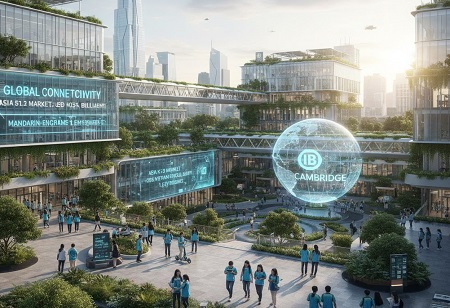
The year 2025 represents a phenomenal rise in the international market of K-12 education in Asia due to increased population, intrusion of foreign investments and a superior thirst to learn all over the world. Southeast Asia became a leader, and at never before seen rates, new campuses blossomed, surpassing growth in other areas.
Among the world international schools, the number of which expanded by 8 percent between 2020 and 2025, a disproportionate number were located in Asia, where countries such as China, Vietnam, and Indonesia were opening hundreds of new schools to serve the families of expatriates and wealthy locals.
Post-2021 policy loosening in China increased the emergence of the private bilingual schools, Mandarin-English programs today teach more than 1.5 million students. The economic push factor was also a contributing factor, the K-12 international sector in Asia-Pacific is estimated to be USD 51.9 billion in 2025, with a 2033 CAGR of 5.6.
In the urban part of Vietnam, there was an increase of 25% in the number of students enrolled in international schools, which behavior was a sign of the development of the middle class and collaboration with the IB and Cambridge education programs.
However, there are still difficulties, tuition fee escalates inequality leading to the introduction of subsidies in Malaysia and Thailand. In the case of Kazakhstan and southeast Asia, regulatory incentives are used to attract operators, with sustainability and eco-curricula being considered in relation to climate issues. Students have become more globally mobile, cross-culturally resilient, and interconnected world ready.
Asia’s 2025 K-12 Pedagogical Breakthroughs
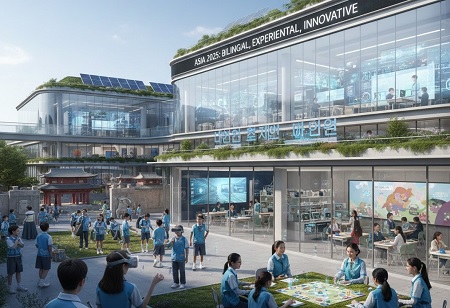
The year 2025 heralded a bold curricular transformation across Asia’s international K-12 sector, where bilingualism, experiential learning, and digital innovation collided to redefine education. More than 70 percent of new schools opened used multilingual tracks, which were fluidly combined English with Mandarin, Korean or Bahasa Indonesia. This is an interactive process that goes beyond the rote learning, this method boosts the cognitive abilities and according to research conducted by UNESCO bilingual students have better critical thinking skills than their monolingual peers by 15 percent.
Experience learning extended way beyond the classroom and made real world problem-solving core in it. VR history sim, rural community projects, and micro-enterprise incubators forced students to transform ideas into reality.
In Singapore and South Korea, the AI-driven platforms tailored learning experiences and customized bootcamp modules to cultural interactions. Innovation was stimulated by the 2035 Education Plan in China, and schools such as BASIS included STEM laboratories that addressed issues related to climate modelling, biotech research and global problems.
Pedagogy was altered post-pandemic with the incorporation of mental health in form of mindfulness expeditions and hybrid experiential models. The Vietnamese schools were unparalleled in weaving folklore into the bilingual classes and the Indonesian schools gamed the ecology studies and increased the retention by 20 percent. Such cultural crossbreeds promote linguistic skillfulness, real-world intelligence and international dexterity, making the students prepared to survive in a multipolar, globalized world where flexibility and creativity outshine standardized measurements.
Also Read: Top 10 Colleges In Asia Offering Extensive Study & Job Options
Asia’s Top 5 International Schools and Their Future Impact
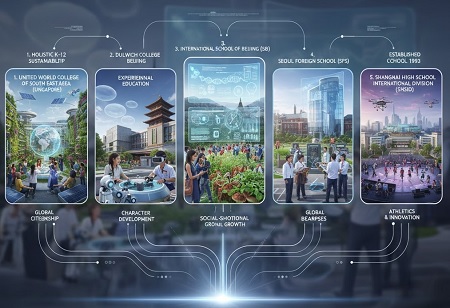
Leading Asia’s 2025 K-12 education renaissance are institutions setting new benchmarks in holistic learning, innovation, and global citizenship.
1. United World College of South East Asia (UWCSEA), Singapore
UWCSEA unites diverse students through a holistic K-12 education, fostering academic excellence, sustainability, and global citizenship, empowering learners to embrace challenges, build peace, and shape a better world.
2. Dulwich College Beijing
Offering experiential education from early years to IBDP, Dulwich College nurtures academic excellence, wellbeing, and character development, guiding students to discover potential, embrace challenges, and craft a purposeful global future.
3. International School of Beijing (ISB)
ISB provides research-based holistic learning from early years to grade 12, fostering academic achievement, social-emotional growth, global citizenship, and purpose, preparing students to excel, lead, and impact the world.
4. Seoul Foreign School (SFS)
Founded in 1912, SFS combines IB and national curricula, promoting academic excellence, creativity, character, and service, guiding 1,600 students from 55 nationalities to realize their full potential.
5. Shanghai High School International Division (SHSID)
Established in 1993, SHSID delivers IB and international programs across four campuses, fostering academic excellence, creativity, athletics, and global citizenship for 3,300+ students, preparing them for a rapidly evolving world.
Wrapping It Up!
Asia’s international schools are not only producing students but also developing strong and multilingual innovators. With scholarships, AI-based personalised learning and ASEAN partnerships, these institutions are spearheading a kind of cultural and economic shift that will equip young people to succeed in a fast-changing world.
🍪 Do you like Cookies?
We use cookies to ensure you get the best experience on our website. Read more...