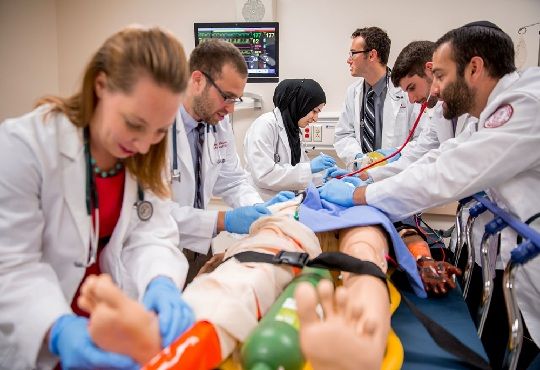
The National Medical Commission (NMC) is set to make structured simulation-based training and competency certification a formal part of undergraduate medical education across India.
NMC Chairman Dr Abhijat Chandrakant Sheth made this announcement while speaking at SimuVerse 2026, a three-day national conference on simulation-based medical education organised by Baba Farid University of Health Sciences (BFUHS) in Faridkot. He emphasised that as India continues to increase the number of medical seats, maintaining and improving the quality of education has become equally important.
Dr Sheth stated that the Commission is actively working to introduce competency assessment and certification through structured simulation training before students appear for their university examinations. He added that digital learning, simulation, and artificial intelligence will be used to strengthen, rather than replace, conventional clinical teaching.
The announcement came on the second day of the conference, which brought together policymakers, medical educators, and healthcare professionals to discuss key topics including competency-based medical education, simulation training, and patient safety.
Indian Medical Association (IMA) National President Dr Anil Kumar J Nayak highlighted the need for medical education to evolve with technological advancements. He stressed that while embracing new tools, the focus must remain on practical skills, compassion, and ethical practice. Dr Nayak also urged medical professionals to pay attention to their own physical and mental well-being.
Dr Yagna Umesh Shukla, Chairman of the National Commission for Allied and Healthcare Professions (NCAHP), explained the value of simulation-based learning. She noted that it allows healthcare professionals to practise complex procedures in a controlled environment before performing them on real patients. Dr Shukla added that NCAHP is also implementing competency-based curriculum reforms for allied healthcare programmes to enhance quality and standardisation.
During the event, Baba Farid University of Health Sciences signed three Memoranda of Understanding (MoUs) with the Indian Academy of Pediatrics (IAP), the Consortium of Accredited Healthcare Organisations (CAHO), and Laerdal Medical India along with Addison Educational Services. These collaborations aim to boost simulation training infrastructure and resources in medical education.
This initiative by the NMC represents a major shift in how future doctors will be trained in India. Simulation-based training provides students with repeated, risk-free opportunities to master clinical skills, decision-making, and emergency responses. It is expected to significantly improve the preparedness of medical graduates and contribute to better patient safety outcomes.
Also Read: Thai-New Zealand MoUs encompass Education and Aviation
Experts believe that integrating simulation and competency certification will help address gaps in traditional medical training methods. With a growing focus on practical competence, the reforms aim to produce doctors who are not only knowledgeable but also confident and ready for real-world clinical challenges.
The move comes at a time when medical education in India is undergoing rapid expansion. By combining technology with traditional teaching, the NMC hopes to set a new benchmark for quality in undergraduate medical programmes nationwide.
The SimuVerse 2026 conference continues to serve as an important platform for stakeholders to exchange ideas and shape the future direction of healthcare education in the country. With strong support from regulatory bodies, medical associations, and industry partners, simulation-based training is poised to become a cornerstone of medical learning in India.