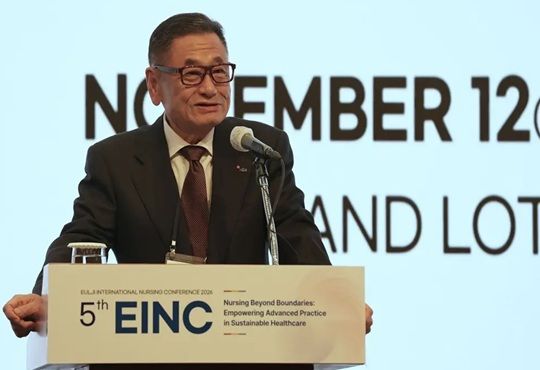
Nursing experts from South Korea and abroad gathered in Seoul to discuss ways to expand nurses’ roles and strengthen their professional capabilities amid growing challenges in the healthcare sector. Eulji University’s College of Nursing held the 5th International Nursing Conference at the Crystal Ballroom of Lotte Hotel Seoul on November 12 and 13 to mark the 70th anniversary of Eulji Medical Center. Approximately 1,000 nursing specialists from South Korea, the United States, Japan, Taiwan and other countries attended the event.
The conference was organized under the theme “Nursing Beyond Boundaries: Strengthening Advanced Nursing Practice for Sustainable Healthcare.” Park Jun Young, chairman of the Eulji Foundation, delivered opening remarks. He noted that the importance of expanding the role of nurses has come into sharper focus amid ongoing tensions between the medical and political communities. “As nursing has become a key pillar of patient care, I hope this conference will serve as an opportunity to establish systematic guidelines and standards for training advanced practice nurses and to take nursing professionalism to the next level,” Park said.
Also Read: RENKEI Workshop at Keio University Focuses on Health & Longevity
Professor Linda H. Yoder of the School of Nursing at the University of Texas at Austin gave the first keynote lecture. Speaking on “Opportunities and Challenges in Advanced Nursing Practice,” she outlined the development of advanced practice nursing in the United States and the roles of advanced practice nurses. Yoder stressed the need to clearly distinguish the responsibilities of advanced practice nurses (APNs) from those of physician assistants (PAs). She also highlighted the importance of institutional support and objective performance evaluations in strengthening professionalism. “The U.S. system is not perfect in every respect and has undergone many trial-and-error experiences,” she said. “South Korea should draw on the U.S. experience to clearly establish the roles of advanced practice nurses and their education system.”
Choi Su Jeong, president of the Korean Association of Advanced Practice Nurses, delivered the second keynote address. She presented directions for advancing South Korea’s advanced practice nurse system. According to Choi, systematic training and promotion of the system require standardized curricula and competency evaluation frameworks, clearly defined scopes of practice grounded in professionalism, and institutional support including appropriate compensation structures. “Advanced practice nurses must establish themselves as key personnel who demonstrate their professionalism through clinical outcomes and contribute to improving the quality of healthcare services,” she stated.
Professor Suzuki Miho of Keio University then introduced Japan’s advanced practice nurse (NP) system, covering its current operation and education structure under the theme “The Structure and Roles of Nursing Practice in Japan.” She shared practical examples in which NPs engage in clinical care, including pain management for terminal cancer patients and intravenous fluid therapy during home-visit nursing. Suzuki emphasized that expanding nurses’ clinical autonomy is essential to address aging populations and shortages of medical personnel, while close cooperation among healthcare professionals remains important.
Hengshin Teng, president of the Taiwan Association of Advanced Practice Nurses, presented Taiwan’s advanced practice nurse system. She detailed its operational status, qualification and certification processes, and key work outcomes under the theme “Development of Taiwan’s Advanced Practice Nursing System.” Teng explained that Taiwan actively links advanced practice nurses’ capabilities with education and compensation frameworks. Working under physician supervision and collaborative protocols, these nurses perform tasks such as patient history-taking and differential diagnosis, contributing to higher patient satisfaction and improved quality of healthcare services.
On the second day, participants focused on ways to enhance education systems that strengthen the professionalism and capabilities of clinical support nurses in South Korea. Jeong Eun Hee, director of nursing at Seoul National University Hospital, noted that clinical support nurses often perform highly complex and high-risk duties. She called for curricula that are precisely designed around their specific job characteristics and urged national-level support so that these nurses can carry out their responsibilities safely while developing professionalism and leadership.
In closing remarks, Lim Sook Bin, dean of the College of Nursing at Eulji University, underscored the broader significance of the discussions. “For a sustainable healthcare system, it is important to systematically develop advanced practice nurses and dedicated clinical support nurses and strengthen their capabilities,” she said. “This conference was an opportunity for nursing experts from South Korea and abroad to share their knowledge and experience and explore directions for the development of future nursing and possibilities for cooperation.”
The two-day gathering provided a platform for international exchange on advanced nursing practice models, education standards, role clarification and institutional support needed to elevate nursing professionalism in the context of evolving healthcare demands.