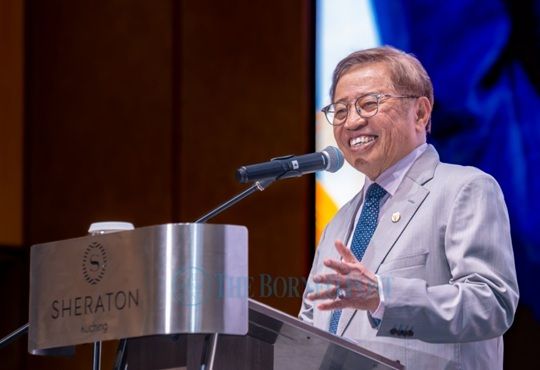
Sarawak is prioritizing the development of talent across communities in its education approach, with caretaker Premier Datuk Patinggi Tan Sri Abang Johari Tun Openg saying the state’s recognition of the Unified Examination Certificate (UEC) reflects the need to prepare its people for a technology-driven economy.
Speaking at the Federation of Chinese Associations of Sarawak installation ceremony for its 2025–2028 office bearers in Kuching, Abang Johari said the state wanted people from all communities to participate in the opportunities emerging from economic and technological change. He said the recognition of the UEC was part of an approach focused on knowledge and talent rather than racial considerations.
“We don’t play race here because we want everybody to participate in the new era. So, we recognize UEC,” he said, adding that students who had studied through the qualification could contribute to Sarawak’s development. He also noted that the UEC was recognized by foreign universities.
Abang Johari said education was essential not only to building a skilled workforce but also to addressing poverty. He argued that supporting children and families through education was a way to break the cycle of poverty, rather than relying solely on conventional approaches to poverty reduction.
“The only way is to give education to the family, the family’s children. That will break what we call the poverty cycle,” he said.
The caretaker premier linked the state’s education priorities to its economic ambitions. Sarawak, with a population of about 2.6 million, is targeting gross domestic product (GDP) of RM282 billion by 2030, compared with approximately RM160 billion currently. Abang Johari said the state had resources but needed to develop the talent required to make full use of them.
“We’ve got the resources, but we need the talent,” he said.
He said this would require an education system that equips Sarawakians with knowledge and skills relevant to emerging technologies, including artificial intelligence (AI). As AI reshapes the modern economy, he indicated that education and talent development would be important to ensuring the state’s workforce could respond to changing industry requirements.
Abang Johari also highlighted Mandarin language proficiency as a practical economic skill. He said the ability to communicate in Mandarin could support Sarawak’s expanding trade and business engagement with China, whose population he put at about 1.4 billion.
He noted that Mandarin could be useful to Sarawakians irrespective of ethnicity, pointing to the growing number of Bumiputera students attending Chinese-medium schools and learning the language. Such proficiency, he said, could help them communicate with Mandarin-speaking business partners and explore opportunities in international markets.
The remarks placed language learning alongside broader efforts to develop a workforce equipped for a changing economy. Abang Johari’s comments also connected educational access with the state’s plans to strengthen its human capital and pursue its 2030 economic target.
Also Read: Sarawak's Free Tertiary Education Scheme to Build Skilled Workforce
He further said Sarawak’s relations among its diverse communities had helped maintain political stability and allowed the government to concentrate on development. He contrasted the state’s approach with racial controversies elsewhere in the country, referring to disputes over cultural practices, including the use of chopsticks.
Abang Johari said such issues should not distract Sarawak from its development priorities. He emphasized that the state needed to preserve its multiracial harmony and maintain a sound system that enabled people from different backgrounds to contribute.
“For Sarawak, thank God, we’ve got no differences among all communities,” he said, adding that the state should oppose divisive attitudes and focus on creating opportunities for its people.
His comments underline the role the Sarawak government sees for education in addressing social and economic priorities. Recognition of different educational pathways, stronger language capabilities and preparation for technologies such as AI were presented as elements of building the talent base needed by the state.
With its 2030 GDP ambition, Sarawak faces the task of turning its natural and economic resources into sustained growth through a skilled workforce. Abang Johari’s message was that achieving that goal depends on widening participation in education and ensuring that talent from all communities can contribute to the state’s future.