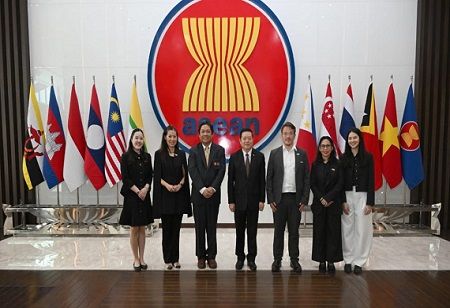
Kao Kim Hourn, Secretary-General of ASEAN, recently welcomed a delegation from the ASEAN University Network (AUN) Secretariat at the ASEAN Headquarters in Jakarta, Indonesia, in a move aimed at deepening collaboration in higher education and strengthening the region’s knowledge economy. The delegation was led by Thanapan Laiprakobsup, Executive Director of AUN, and the discussions emphasized the network’s pivotal role in fostering cooperation among universities across the ASEAN region.
During the meeting, both sides highlighted the importance of academic partnerships, research collaboration, and institutional linkages in driving innovation and regional development. AUN’s programs were acknowledged for their contribution to building a dynamic knowledge ecosystem, enabling meaningful engagement between academia, industry, and policymakers. By connecting universities across the region, the network plays a vital role in enhancing cross-border academic mobility and creating platforms for knowledge sharing.
Also Read: How Asia Gen Z Explodes in AI Self-Skilling Beyond Formal Systems
The dialogue also explored opportunities to strengthen frameworks that support talent development, research excellence, and collaborative initiatives among ASEAN member states. Both ASEAN and AUN reaffirmed their commitment to leveraging higher education as a cornerstone for building a more innovative, interconnected, and resilient regional community.
This engagement underscores ASEAN’s broader vision of enhancing education cooperation to drive sustainable growth and regional competitiveness. By nurturing stronger links between universities and fostering international collaboration, initiatives like AUN are helping to equip students and researchers with the skills and experiences necessary to thrive in a rapidly evolving global landscape. The partnership also signals ASEAN’s dedication to advancing the knowledge economy, positioning the region as a hub for innovation, research, and talent development.
With these discussions, ASEAN and AUN are not only reinforcing existing educational ties but also laying the groundwork for future academic collaboration, ensuring that higher education continues to be a driver of progress, creativity, and inclusive development across Southeast Asia.