
-
Fujairah has formalised a series of academic and cultural partnerships with University of Cambridge colleges and related institutions focused on Islamic research, arts education and knowledge exchange.
Sheikh Mohammed bin Hamad Al Sharqi, Crown Prince of Fujairah, travelled to Cambridge to attend the signing of four agreements at Newnham College. The deals involve the School of Calligraphy and Ornamentation of Fujairah, known as Soco, and the Al Bader Initiative, a cultural programme under the Crown Prince’s leadership that promotes Islamic values through books, festivals and related activities.
The agreements follow Fujairah’s support for the inaugural Cambridge Festival of Islamic Arts. The festival opened with a programme of music, calligraphy, poetry and exhibitions drawn from across the Islamic world. Organisers plan to hold the event annually in the university city in collaboration with Fujairah. The occasion marks fifty years since adviser Ahmad Keeler staged the first World of Islam Festival in the United Kingdom.
At the signing ceremony, Sheikh Mohammed emphasised Fujairah’s ambition to establish itself as a centre for knowledge and creativity while increasing the emirate’s presence in international cultural forums. A statement from the Crown Prince’s office described the collaboration as a means to strengthen academic and knowledge-based partnerships and to expand cooperation in education, culture and the arts.
Representatives from Cambridge University Press, Cambridge Islamic College and the Cambridge Festival of Islamic Arts signed the agreements. Under the arrangements, Cambridge researchers will gain access to Soco’s collection of manuscripts. Officials also expect artistic and academic exchanges between the institutions.
Dr Esra Alhamal, managing director of Soco, said the agreements open new horizons for collaboration with distinguished academic and cultural institutions. She noted that the partnerships aim to advance scholarly research in the arts of Islamic manuscripts, connect historical heritage with contemporary artistic practices, and further strengthen Fujairah’s position as a hub of knowledge and creativity in this field.
Dr Eisa Younes Al Baloushi, secretary general of the Al Bader Initiative, stated that the agreements are linked to clearly defined outcomes. These include exchanges and joint events, research and the development of artistic and creative programmes, and the production of digital educational content. He added that the parties look forward to the agreements opening new pathways for knowledge creation and exchange.
The cooperation will also cover career development opportunities for teachers, improvements to curriculum design, and assessments of the impact of educational programmes.
The Cambridge Festival of Islamic Arts is positioned as a recurring platform that brings together performers, scholars and artists. Its inaugural edition featured a broad programme reflecting traditions from different regions of the Islamic world. Fujairah’s involvement is intended to support continuity and to create ongoing links between the emirate’s cultural institutions and Cambridge’s academic community.
Soco’s manuscript holdings form a central element of the research component. Access for Cambridge scholars is expected to facilitate joint studies that examine historical techniques of calligraphy and ornamentation while exploring their relevance to present-day practice. Parallel artistic exchanges are planned to allow practitioners and students from both sides to share methods and present work in each other’s settings.
The Al Bader Initiative’s focus on books and festivals aligns with the educational and public-engagement goals of the partnership. Joint events and publications are among the anticipated outputs, alongside digital resources designed for wider educational use. Curriculum-related work will examine how Islamic arts and manuscript studies can be integrated into teaching programmes, supported by professional development for educators and systematic evaluation of programme effectiveness.
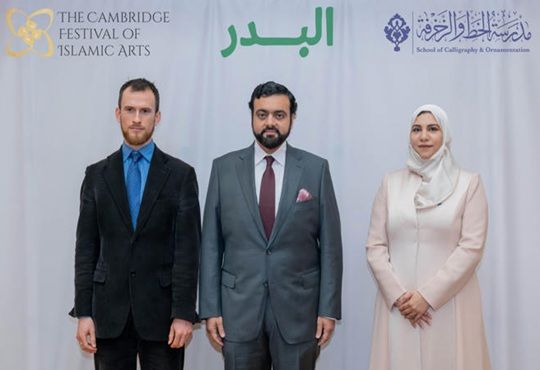
Officials present at the Newnham College ceremony included Luke Wilkinson, director of the Cambridge Festival of Islamic Arts, and Dr Esra Alhamal of Soco. Photographs released by the Fujairah Crown Prince Media Office show the Crown Prince with festival and Soco representatives during the visit.
The partnerships sit within a broader effort by Fujairah to raise its profile in international cultural and academic circles. By combining manuscript research, artistic practice, teacher development and public festivals, the agreements seek to create sustained channels of exchange rather than one-off projects.
Cambridge University Press and Cambridge Islamic College bring publishing and specialist academic capacity to the collaboration. Their participation is expected to support the production and dissemination of research outputs and educational materials arising from the joint work.
The annual festival is intended to serve as a visible platform for the partnership, presenting performances and exhibitions while providing opportunities for scholars and artists to meet. Fujairah’s support for the first edition and its commitment to future editions underline the long-term character of the relationship.
Also Read: Cambridge Welcomes South Asia Schools for Regional Education Summit
Taken together, the four agreements cover research access, artistic exchange, educational programme development and public cultural events. Each element is linked to specific institutional partners on both sides, with defined areas of activity ranging from manuscript study to curriculum improvement and digital content creation.
The Crown Prince’s presence at the signing underscored the priority Fujairah attaches to these fields. Statements from both Soco and the Al Bader Initiative stress the practical outcomes expected: measurable exchanges, joint research, new educational resources and continued festival activity in Cambridge.
As the partnerships move from formal agreements into operational stages, the institutions involved will need to coordinate access arrangements, schedule exchanges, design joint programmes and plan successive festival editions. The framework established in Cambridge provides the institutional basis for that work.
🍪 Do you like Cookies?
We use cookies to ensure you get the best experience on our website. Read more...