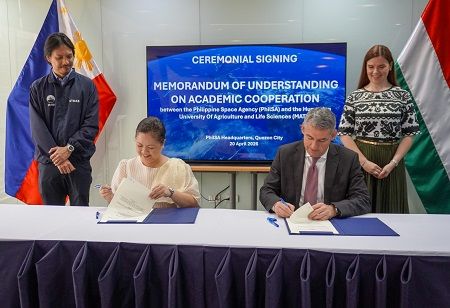
- The Philippine Space Agency and Hungarian University of Agriculture and Life Sciences signed an MoU to collaborate on agricultural research using space technology.
- The partnership will promote student exchanges, joint training, and satellite-based agricultural monitoring projects in both countries.
- Led by Gay Jane P. Perez and Csaba Gyuricza, the initiative aims to boost innovation in food security and climate-resilient agriculture.
The Philippine Space Agency and the Hungarian University of Agriculture and Life Sciences have signed a Memorandum of Understanding (MOU) to strengthen cooperation in agricultural research and education through the use of space science and technology applications (SSTA). The agreement was formalized on April 20, 2026, by PhilSA Ad Interim Director General Gay Jane P. Perez and MATE Rector Csaba Gyuricza.
The partnership aims to advance international education collaboration and promote the integration of satellite technology in agriculture. It will facilitate student exchange programs, researcher mobility, and joint training initiatives, while also supporting the sharing of academic publications and technical resources.
Under the agreement, both institutions will collaborate on the development and application of models for agricultural mapping, monitoring, and assessment using satellite data. The cooperation will also explore pilot projects focused on agricultural monitoring systems in the Philippines and Hungary, contributing to improved data-driven decision-making in the sector.
Also Read: How is Higher Education Landscape Preparing for Rebuilding of Travel & Tourism Sector?
Officials from both sides emphasized the role of academia in driving innovation and addressing global challenges such as food security and climate change. The collaboration is expected to strengthen higher education in agriculture and technology, while providing students with access to cutting-edge research opportunities and international exposure.
The signing ceremony was attended by Titanilla Toth and representatives from the Department of Foreign Affairs Office of European Affairs, highlighting the importance of global academic partnerships in advancing innovation.
The MOU reflects a broader trend of integrating space science in education and research, positioning both institutions to contribute to sustainable agriculture and digital innovation through cross-border collaboration.