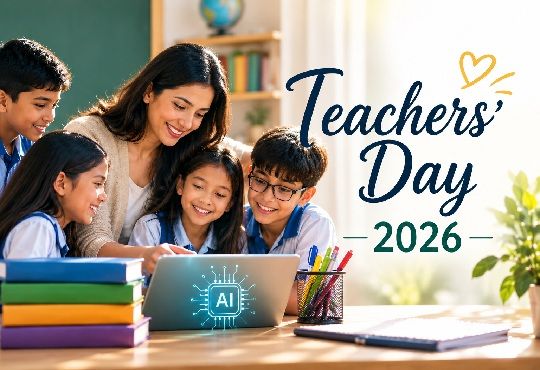
Teachers Day 2026: How AI Is Quietly Making Great Teachers Even Better

-
Asia may be the most education-obsessed continent on earth, and nowhere is that clearer than in how many different days it sets aside just to say thank you to teachers. India marks Teachers' Day on September 5 a Saturday in 2026 in tribute to Dr Sarvepalli Radhakrishnan. This year that includes the National Teachers' Awards, where President Droupadi Murmu is set to felicitate 48 outstanding school teachers drawn from 27 states, 7 Union Territories, and 6 central government organisations, at a ceremony in New Delhi. China observes its own Teachers' Day on September 10, a date fixed in 1985 to align with the school calendar.
The Philippines stretches the celebration into an entire National Teachers' Month, from September 5 through October 5, when it converges with World Teachers' Day whose 2026 global theme, set by UNESCO, is "Teachers: leading in crisis, reimagining the future". Malaysia held its own National-Level Teachers' Day Celebration in May 2026, themed around teachers as nation-builders. Singapore celebrates on the first Friday of September, South Korea on May 15, chosen in honour of the mentor of King Sejong, the monarch credited with creating the Korean alphabet. Thailand marked its 70th Teacher's Day in January 2026, rooted in the Wan Kru tradition of students offering flowers and a respectful wai to their teachers.
The dates differ. The spirit does not. And this year, that spirit of appreciation coincides with something genuinely new: across nearly every one of these countries, teachers are being handed a fresh set of tools built on artificial intelligence designed to make their hardest, most time-consuming work lighter. This piece looks, country by country, at what that actually looks like on the ground, and why it's worth paying attention to.
India: From Survey Data to the Classroom Floor
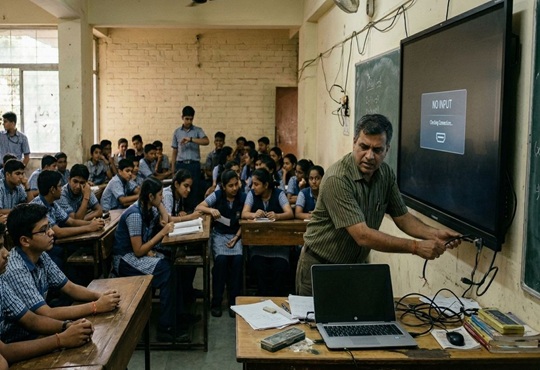 India offers some of the clearest evidence anywhere in Asia that AI adoption among teachers has moved from novelty to norm. A nationwide survey by the Centre for Teacher Accreditation, covering more than 5,000 educators, found that more than 70 percent of Indian teachers are already using AI tools in their classrooms, with lesson planning identified as the most common application. Adoption was notably higher among teachers with more than three years of experience a reassuring sign that this is being driven by experienced educators recognising genuine value, not just novelty-seeking among newcomers.
The tools themselves are increasingly specific to the Indian classroom. Ed-tech platforms such as Embibe use AI to help unpack complex maths and science concepts a student can scan a passage from a textbook with a phone, and the app generates 3-D visualisations to make abstract ideas concrete. The same technology is being used to flag early warning signs in student performance, giving teachers a chance to step in before a struggling student falls further behind, rather than after.
What makes the Indian story particularly encouraging is where the National Teachers' Awards land this year squarely alongside this AI conversation. Honouring 48 teachers from across the length and breadth of the country, from metropolitan schools to institutions in far smaller towns, is a reminder that the ultimate goal of any classroom technology is the same one India has always centred on Teachers' Day: recognising the educators doing the hardest, most transformative work, and giving them better tools to keep doing it.
Devish Gala, President, Educational Books Division, Navneet Education Limited., says, “Education is never just about passing on information, it’s about shaping character. Long after the lessons end, a teacher’s guidance stays with us for life. The best learning still begins with curiosity, encouragement and someone who believes in you. This Teachers’ Day, we celebrate the teachers who make classrooms more than just places to learn, they make them the child’s second home".
China: Scale, Speed, and a Narrowing Gap
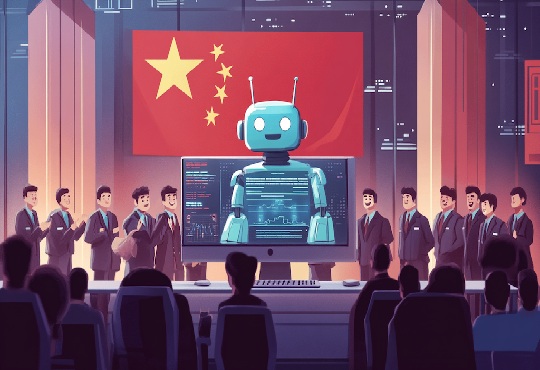
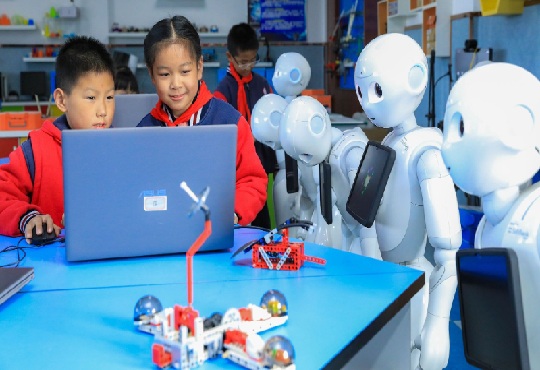 If India's story is about depth of adoption, China's is about scale. A landmark assessment of teacher digital literacy, covering 530,000 educators across 19 provincial-level regions and released at the 2026 World Digital Education Conference in Hangzhou, found that AI has moved well past the experimental phase in Chinese classrooms. Nearly 15 percent of teachers now use AI tools every day, and only around 3 percent have never used them at all. More strikingly, over 85% of teachers said AI helps expand their teaching resources, and 81 percent said it saves them meaningful lesson-preparation time. Smart teaching platforms with built-in AI features are the most widely used category, followed closely by general-purpose AI models.
Perhaps the most important finding in that report is the one that gets the least attention: the digital-skills gap between urban and rural teachers is narrowing, not widening, as AI becomes embedded into everyday teaching platforms. In a country as vast and geographically varied as China, that's not a minor statistic it suggests that, done well, AI adoption in education can be a genuine equaliser rather than another advantage that concentrates in wealthier, better-resourced schools.
The Philippines: Training First, Tools Second
 The Philippines offers perhaps the most deliberate, well-sequenced example of AI adoption in education anywhere in the region. In early 2026, the Department of Education launched Project AGAP.AI Accelerating Governance and Adaptive Pedagogy through Artificial Intelligence a nationwide initiative built around a simple but important principle: train people before you hand them the tools, not after. The programme combines nationwide AI training for teachers, the introduction of AI literacy into the curriculum itself, and clear guidelines for ethical and safe use in classrooms, with a target of building AI skills among more than 1.5 million educators and students as it rolls out through the year.
This sequencing matters. It reflects a growing consensus among the countries getting AI adoption right: the technology itself is rarely the bottleneck. Confidence, training, and clear guardrails are. By tackling all three at once, the Philippines is positioning its extended Teachers' Month that full stretch from September 5 to October 5 as more than a celebration. It becomes a genuine checkpoint for a national rollout that is still very much in motion.
Singapore: Building AI Literacy Into Teacher Training Itself
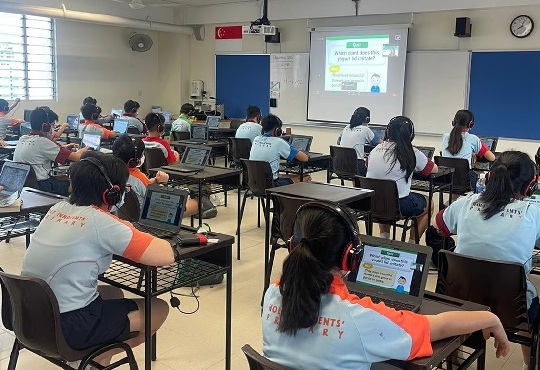
 Singapore has taken a characteristically systemic approach: rather than treating AI as an add-on, its National Institute of Education has folded AI training directly into how new teachers are prepared and how current teachers develop professionally, under a multi-year plan known as AI@NIE. The goal is for undergraduate and graduate teaching candidates, alongside in-service teachers, to understand not just how to use AI tools but how to apply them meaningfully to track student progress and personalise learning.
That systemic thinking is visible in how Singapore's education technology researchers talk about the work. Recent workshops for school leaders and subject heads have focused on the intentional design of AI-powered simulation tools for classroom use with an explicit philosophy summed up neatly in the title of one widely attended session for educators, 'Pedagogy First- Teaching With, Not By, AI'. It's a small phrase that captures the throughline running across nearly every thoughtful AI-in-education initiative in Asia: the technology supports the lesson; it does not replace the teacher who designs it.
Singapore's approach has also become something of a regional reference point. Delegations of teachers and education supervisors from South Korea's Busan and Gyeonggi education offices have travelled to Singapore specifically to study its AI pedagogical models, a sign of how quickly good practice is being shared across borders in this region.
Also Read: ECAE Launches 'Seeds That Shape Futures' on World Teachers' Day
South Korea: Weaving AI Into the National Curriculum
 South Korea has taken the boldest structural step of any country in the region: building AI coursework directly into the national curriculum, starting with high school and expanding across grade levels. The Ministry of Education's technology unit, KERIS, has been designing and piloting extensive AI-focused professional development for teachers to support that shift recognising that curriculum change on this scale only works if teachers themselves are given real time and training to adapt alongside it.
That investment is visible in the steady stream of South Korean education delegations visiting international partners to benchmark best practice from Busan's supervisors and teachers studying Singapore's AI pedagogical models, to Gyeonggi province's superintendent holding direct dialogues on AI-driven learning and administrative innovation. It's the sign of an education system treating this transition with the seriousness it deserves: not rushing to deploy technology for its own sake, but deliberately building the teacher capacity to use it well.
Malaysia and Thailand: Marking the Day, Investing in the Tools
Malaysia's National-Level Teachers' Day Celebration in
 May 2026 paired recognition with tangible investment: alongside honouring educators as nation-builders, the government announced an allocation of RM169 million to supply digital devices to schools, continued free Google Certified Educator training for teachers, and the abolition of the manual co-curricular recording system in favour of giving schools autonomy over digital record-keeping. It's a useful example of a Teachers' Day celebration doing double duty as both a moment of appreciation and a platform for announcing concrete support.
Thailand, meanwhile, marked its 70th Teacher's Day in January 2026, honouring the legacy of Her Majesty Queen Sirikit, the Queen Mother, in a ceremony that leaned into the country's deep cultural tradition of respect for educators as moral and spiritual guides, not just academic instructors. It's a reminder that even as AI reshapes the practical side of teaching across the region, the underlying reverence for the profession expressed differently in every country, but felt everywhere remains the constant.
What Ties These Stories Together
Read side by side, these country stories point to a few shared lessons worth highlighting, because they offer a genuinely useful template for any school or system still finding its footing with these tools.
Time saved is the clearest, most consistent benefit. Whether it's Indian teachers using AI for lesson planning or Chinese teachers citing hours saved in preparation, the single most reported gain across every country is time time redirected toward the parts of teaching that require real human judgement and presence.
Training has to come with the tools, not after them. The Philippines' Project AGAP.AI and Singapore's AI@NIE both treat teacher training as inseparable from technology rollout. Countries getting this right are not just distributing software; they're building capability.
Adoption works best when it strengthens experienced teachers, not sidesteps them. India's data showing higher AI use among more experienced teachers, and Singapore's explicit "teaching with, not by AI" philosophy, both point to the same conclusion: these tools amplify good pedagogy, they don't substitute for it.
Good rollout narrows gaps rather than widening them. China's finding that AI adoption is helping close the urban-rural digital-skills gap among teachers is perhaps the most quietly important data point in this entire story a sign that, with the right approach, these tools can make quality teaching more equitable, not less.
Recognition and investment go hand in hand. From India's National Teachers' Awards to Malaysia's device funding announced at its own Teachers' Day celebration, the countries doing this well are pairing appreciation with tangible, ongoing support treating September's gratitude as a starting point, not the whole story.
Winding It Up!
There's something quite fitting about all of this unfolding alongside Teachers' Day season across Asia. The occasion has always been about recognising the effort behind the scenes the lesson plans written late at night, the feedback painstakingly written in the margins, the sheer volume of small, invisible work behind every well-run classroom. Across India, China, the Philippines, Singapore, South Korea, Malaysia, and Thailand, AI is starting to lighten exactly that load, in ways shaped by each country's own priorities and traditions.
None of it makes the teacher any less essential. If anything, it sharpens what makes them irreplaceable. The technology can draft a worksheet, sort a set of practice questions, or flag a student who might need extra support. It cannot notice that a normally chatty student has gone quiet, cannot offer encouragement at exactly the right moment, and cannot build the kind of trust that convinces a child they're capable of more than they think. That part of the job the part every Teachers' Day across Asia ultimately celebrates remains entirely, irreplaceably human.
The throughline across every country in this story is worth holding onto: the goal was never AI teaching better. It was always AI helping teachers teach better giving them back the time and energy to do the work only they can do. Across a continent that has always taken education seriously, that's a genuinely useful story, and this Teachers' Day, it's one worth telling in full.
🍪 Do you like Cookies?
We use cookies to ensure you get the best experience on our website. Read more...