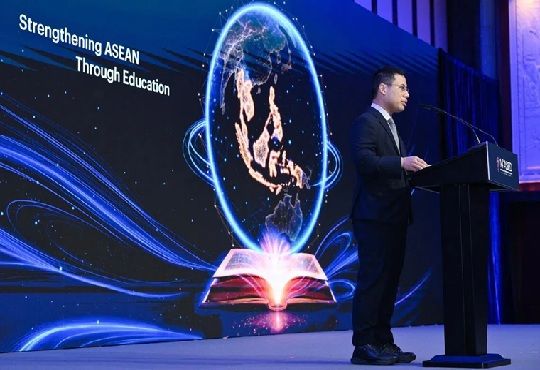
Singapore has taken a significant step toward shaping the future of education across Southeast Asia by unveiling a new five-year ASEAN education strategy centered on artificial intelligence (AI), STEM education, and holistic student development. The ASEAN Work Plan on Education 2026-2030, launched on July 22 during the 14th ASEAN Education Ministers' Meeting in Singapore, reflects the region's collective ambition to prepare learners for a rapidly evolving technological and economic landscape.
The work plan was officially introduced by Singapore's Minister for Education Desmond Lee, alongside education ministers from ASEAN member states. The initiative outlines a shared commitment to building inclusive, resilient, and future-ready education systems while ensuring equitable access to quality learning opportunities for students across the region.
Speaking at the meeting, Lee emphasized that education systems must evolve in response to technological disruption and changing global dynamics. He highlighted that the impact of AI is already transforming industries and societies, making it essential for schools and higher education institutions to adapt their curricula, teaching methods, and assessment models without delay.
Artificial intelligence has emerged as one of the plan's primary priorities. ASEAN aims to encourage the responsible and ethical use of AI in classrooms while equipping students with the digital competencies needed to thrive in future workplaces. Rather than viewing AI solely as a technological tool, the strategy positions it as an integral component of modern education that can enhance learning experiences, improve teaching practices, and strengthen workforce readiness.
Alongside AI, the work plan places a strong emphasis on Science, Technology, Engineering, and Mathematics (STEM) education. ASEAN leaders believe strengthening STEM capabilities will help prepare students for emerging industries and technological innovation while supporting the region's long-term economic growth. By encouraging greater participation in STEM disciplines, member countries aim to cultivate a highly skilled workforce capable of meeting the demands of an increasingly digital economy.
Recognizing that academic excellence alone is insufficient, the strategy also prioritizes holistic student development. The education ministers stressed the importance of nurturing qualities such as resilience, empathy, ethical judgment, teamwork, and adaptability. These human-centered competencies are expected to become even more valuable as AI becomes deeply integrated into everyday life and professional environments.
The ASEAN Work Plan establishes six broad objectives that will guide regional education efforts through 2030. These include expanding equitable access to education throughout life, ensuring learning remains relevant to future economic needs, improving student learning outcomes and well-being, strengthening education governance and policymaking, promoting collaboration among ASEAN member states, and fostering a stronger sense of shared regional identity.
To translate these objectives into action, Singapore announced several regional initiatives that will be introduced during its tenure as ASEAN Education Chair from 2026 to 2027. One of the flagship programs is the ASEAN Plus Three STEM Camp for Youth, scheduled for May 2027. The camp will bring together students from ASEAN member countries and international schools to collaborate on STEM-related challenges while applying scientific knowledge to real-world problems.
Also Read: Vietnam's STEM Revolution: Can It Power the Nation's Next Tech Boom?
Another major initiative is the ASEAN Student Adventure Camp, planned for November 2027 in Singapore. The program is designed to strengthen resilience, teamwork, leadership, and adaptability among young participants through experiential learning activities.
Singapore will also establish a new regional educator network through its Centre for Character and Citizenship Education. The network will connect education officials and practitioners from across ASEAN to exchange best practices in values education and holistic student development, reinforcing the region's commitment to nurturing responsible global citizens.
The launch of the new education work plan coincided with Singapore hosting the 8th ASEAN Plus Three Education Ministers' Meeting and the 8th East Asia Summit Education Ministers' Meeting, bringing together representatives from ASEAN, China, Japan, South Korea, Australia, India, New Zealand, Russia, and the United States. The gatherings underscore ASEAN's growing focus on international collaboration to strengthen education systems and address shared challenges.
As digital transformation continues to reshape societies worldwide, ASEAN's latest education roadmap signals a unified regional effort to ensure students are equipped with both advanced technological skills and essential human values. By combining AI readiness, stronger STEM education, and holistic development, the 2026-2030 work plan aims to prepare the next generation of learners to succeed in an increasingly interconnected and innovation-driven world.