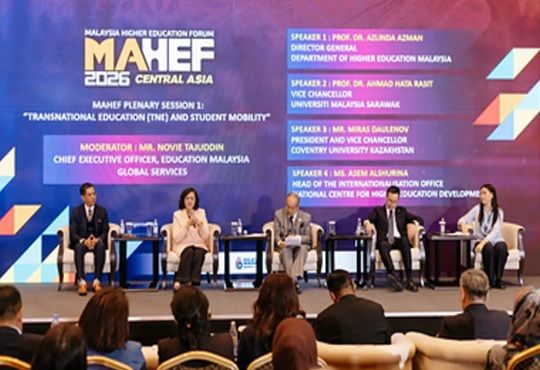
Education Malaysia Global Services (EMGS) convened more than 200 participants in Astana for the Malaysia and Central Asia Higher Education Forum 2026 (MAHEF2026), creating a focused platform for Malaysian universities to deepen ties with institutions across Central Asia. The gathering brought together representatives from 18 Malaysian universities alongside counterparts from Kazakhstan, Kyrgyzstan, Tajikistan, Turkmenistan and Uzbekistan.
The Malaysian delegation included senior officials from the Ministry of Higher Education and vice-chancellors of leading institutions. Among those present were YBhg. Datuk Professor Dr. Azlinda Azman, Director General of Higher Education; Dr. Shamsuri Abdullah, Director General of the Department of Polytechnic and Community College Education; and YBhg. Prof Dato’ Dr. Mohammad Shatar Bin Sabran, Chief Executive Officer of the Malaysian Qualifications Agency (MQA).
The forum builds directly on high-level ministerial discussions held in Astana on 26 September. Malaysia’s Minister of Higher Education, Y.B. Dato’ Seri Diraja Dr. Zambry Abd Kadir, and Kazakhstan’s Minister of Science and Higher Education, H.E. Sayasat Nurbek, had earlier underlined the potential for closer collaboration between the two countries’ higher education systems. MAHEF2026 translates that political direction into practical engagement among universities.
Under the theme “Advancing Malaysia and Central Asia Higher Education Transformation,” the forum places policymakers and institutional leaders in the same room to identify concrete opportunities for students, academics and researchers. Participants are examining joint and dual degree programmes, credit transfer arrangements, scholarships and two-way student mobility. Discussions also cover transnational education models and research partnerships that play to the complementary strengths of Malaysian and Central Asian institutions.
Datuk Professor Dr. Azlinda Azman emphasised the importance of moving from ministerial vision to institutional action. “Ministerial engagement has given us a clear direction. MAHEF brings that conversation to the universities, where programmes are designed, research partnerships are built and opportunities for students take shape,” she said. “With 18 Malaysian universities in Astana, we have an opportunity to identify where our strengths meet those of Central Asia. The value of this forum will be seen in the work our institutions take forward together.”
The programme features plenary sessions on transnational education and student mobility, as well as cooperation in technical and vocational education and training (TVET) and digital skills. An experts session addresses quality assurance, mutual recognition and accreditation critical foundations for any cross-border programme or student exchange. A formal document exchange between universities is scheduled, followed by dedicated time for institutions to explore potential partnerships in detail.
The presence of both policy leaders and university heads reflects a deliberate effort to align national priorities with institutional capacity. Malaysia brings established experience in international student recruitment, quality frameworks and industry-linked programmes. Central Asian universities offer growing research capacity, regional networks and expanding demand for internationally recognised qualifications. The forum aims to convert these complementary assets into workable collaborations.
Student mobility sits at the centre of the agenda. Both regions recognise that two-way movement of students strengthens academic quality, builds cultural understanding and creates long-term professional networks. Credit transfer mechanisms and joint programmes are being examined as practical tools to make mobility smoother and more attractive. Scholarships and targeted support packages are also under discussion to reduce financial barriers.
Also Read: ASEAN's Growing Skills Crisis: Why Graduates Struggle to Secure Jobs
Quality assurance remains a recurring theme. Mutual recognition of qualifications and alignment of accreditation standards are essential if degrees and credits are to travel across borders with confidence. The participation of the Malaysian Qualifications Agency signals the seriousness with which these technical questions are being treated.
Beyond formal sessions, the forum provides space for bilateral conversations that often determine whether partnerships move from intention to implementation. University leaders are expected to identify specific areas of complementarity whether in engineering, digital technology, agriculture, health sciences or teacher education and to begin mapping the next steps.
MAHEF2026 positions Malaysia as an active partner in the higher education transformation of Central Asia while opening new pathways for Malaysian institutions to expand their international footprint. The test of success will not be the number of speeches delivered in Astana, but the number of joint programmes launched, students exchanged and research collaborations formalised in the months ahead.
By bringing 18 Malaysian universities into direct conversation with Central Asian counterparts, the forum creates the conditions for sustained institutional relationships. If those relationships deliver tangible outcomes in student mobility, joint degrees and research, the event will mark a meaningful step in connecting two regions that share growing ambitions in higher education.