
-
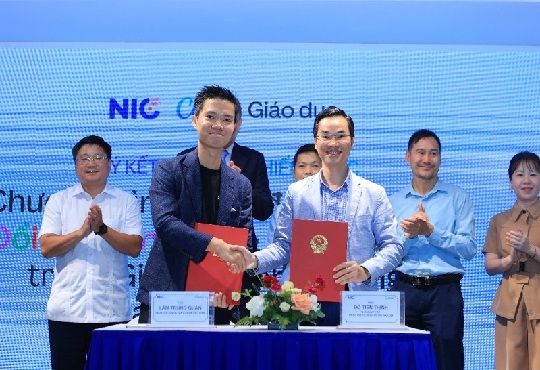
The National Innovation Center (NIC) and Canva have signed a strategic partnership aimed at advancing digital and AI skills across Vietnam’s education system, positioning the collaboration as a practical step toward building a stronger digital workforce for teachers and students nationwide.
Under the agreement, the NIC becomes Canva’s key partner in Vietnam for digital workforce development in education. Officials outlined three core priorities: promoting the practical and effective use of digital creativity, design thinking and artificial intelligence in classrooms; expanding free access to modern digital tools for teachers and students regardless of location; and establishing a public-private cooperation framework that aligns with Vietnam’s broader digital workforce development strategy.
Do Tien Thinh, deputy director of the National Innovation Center (NIC), described the deal as the starting point for a broad, practical and long-term programme. “We see this as the starting point for a broad, practical and long-term programme that can have a meaningful impact on Vietnam’s digital workforce, particularly teachers and students,” he said. Thinh emphasised that digital transformation in education should create more creative and personalised approaches to teaching and learning while expanding access to knowledge. “Ultimately, the goal of applying AI in education is for technology to help teachers teach better and learners learn better,” he added. “That is the spirit that the NIC and Canva Education hope to promote through this partnership.”
Lam Trung Quan, country director of Canva Vietnam, pointed to existing classroom realities that the partnership seeks to address. He noted that AI has already begun entering Vietnamese classrooms, with 64 per cent of teachers reporting that they use AI in teaching. At the same time, 71 per cent said their schools still lack adequate digital infrastructure and tools, while 60 per cent of teachers who have yet to use AI cited insufficient skills as a key barrier.
“This means the question is how we can enable teachers to use AI simply and effectively,” Quan said. “We see enormous potential in the market and a clear responsibility for Canva to take a more proactive role in supporting Vietnam and contributing to the country’s digital transformation and digital creativity in education.”
Following the signing, the NIC will work with Canva on communications and connectivity efforts to make free Canva for Education accounts available to schools, teachers and students from kindergarten through upper secondary education nationwide. The partnership will also support a training programme designed to equip 30,000 teachers with practical technology and AI skills so they can innovate their teaching methods.
In September and October, the two sides will organise six national webinars for education administrators and school leaders. These sessions will introduce Canva’s platform and explore ways to use AI to support innovative and creative teaching methods. The programme is also intended to promote design thinking and digital creativity among key decision-makers in schools.
Another major initiative is the Canva Creative Challenge 2026, a creative competition for K-12 students at primary, lower secondary and upper secondary levels. The competition is expected to be launched in September 2026 across northern, central and southern Vietnam, with the national final scheduled for January 2027. Organisers aim to engage around 3,000 students nationwide, helping them develop essential design skills, foster creativity and strengthen digital capabilities.
Canva will also be integrated into the NIC’s existing STEM ecosystem and training programmes, further expanding opportunities for students and educators to access digital creativity and AI tools. Officials said the approach is deliberately grounded in everyday classroom needs rather than abstract concepts. “The most meaningful thing is that Canva is not entering Vietnamese education through some distant or abstract concept. It is happening naturally, through teachers who want to make their lessons more engaging, students who want to present their ideas more vividly, and countless small but very real moments in the classroom,” Quan said. “If Canva can help create more of those moments in classrooms across Vietnam, I believe that would be something truly meaningful.”
The partnership arrives at a time when Vietnam continues to prioritise digital transformation across sectors, including education. By combining Canva’s design and AI tools with the NIC’s national reach and policy alignment, the initiative seeks to lower barriers that currently limit teachers and students. Free access to the education platform is expected to help schools that have struggled with infrastructure gaps, while structured training aims to address the skills shortfall reported by many educators.
Also Read: Canva, DepEd Launch Nationwide Canva Education in Classrooms
The partners met in one sentence to finalise details and present with a shared roadmap for teacher training, student competitions and nationwide tool access. Implementation will begin with the upcoming webinars and account rollout, followed by the teacher upskilling programme and the 2026 creative challenge. Integration into STEM activities is planned to run in parallel, giving students additional pathways to apply design and AI skills in project-based learning.
Observers note that success will depend on sustained coordination between the public and private sides, consistent outreach to schools in both urban and rural areas, and measurable uptake by teachers. If the free accounts, training and competition attract the intended participation, the partnership could serve as a model for other digital education collaborations in the region.
The agreement underscores a shift toward practical, classroom-level digital support rather than top-down technology mandates. By focusing on tools that teachers can adopt quickly and students can use to express ideas more effectively, the NIC and Canva aim to make digital creativity a routine part of Vietnamese education rather than an occasional experiment. Further details on webinar registration, teacher training schedules and competition guidelines are expected to be released in the coming weeks as the two organisations move from signing to delivery.
🍪 Do you like Cookies?
We use cookies to ensure you get the best experience on our website. Read more...