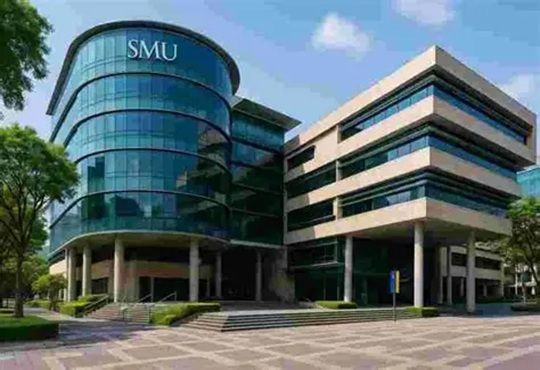
Singapore Management University’s School of Accountancy has launched a new Applied Artificial Intelligence Track within its Master of Science in Accounting programme, positioning the next generation of accountants and finance professionals to work alongside advanced AI systems rather than merely operate them.
The track responds to a clear shift already underway in the profession. Artificial intelligence is now routinely used to review documents, analyse financial data, flag anomalies and support audit procedures. As these tools handle more routine tasks, the critical professional responsibility moves upstream: deciding whether AI-generated outputs are accurate, appropriate and reliable enough to support real business decisions.
Unlike programmes that treat AI primarily as a computer-science or data-science subject, the new specialisation begins with the professional contexts in which accounting judgement still matters. Students will gain practical exposure to Generative AI, large language models, retrieval-augmented generation and Agentic AI. They will learn not only how these technologies can be applied to accounting and finance workflows, but also how to assess their reliability and limitations, design human-in-the-loop processes, and establish the controls required before relying on machine outputs.
Professor Zhang Liandong, Dean and Lee Kong Chian Professor of Accounting at SMU School of Accountancy, framed the rationale clearly: “We designed the Applied AI Track around how AI is entering accounting and finance work. The question is not simply whether a tool can perform a task, but whether professionals understand its limitations, can evaluate its output and know what controls are needed before relying on it.”
The emergence of Agentic AI intensifies those questions. These systems can coordinate and execute multi-step workflows rather than simply generate text or analysis. For accountants and finance teams this raises practical issues of supervision, escalation points and ultimate accountability. The track therefore treats governance and human oversight as core competencies rather than afterthoughts.
The Applied AI specialisation comprises four course units selected from five specialist offerings: Agentic AI for Accounting; AI Governance, Evaluation and Ethics; Modern AI Applications in Business; Blockchain and AI for Decentralised Intelligence; and the Innovation and Technology Capstone (SMU-X). These sit alongside the MSA’s existing accounting core and foundational training in programming, data management, statistics, forecasting, visual analytics and machine learning. Through the SMU-X capstone, students apply AI, analytics and digital tools to real problems in partnership with industry.
The programme rests on a deliberate premise: AI should augment professional expertise, not replace it. Graduates are expected to leave with the ability to apply AI across audit, assurance, financial analysis and finance transformation; evaluate outputs for errors, inappropriate assumptions or limitations; design supervised workflows with clear human review points; assess risks around privacy, cybersecurity, model risk, bias, explainability and regulatory compliance; and translate AI-generated insights into decisions that remain subject to professional accountability.
Also Read: ASEAN's Growing Skills Crisis: Why Graduates Struggle to Secure Jobs
Industry practitioners already see the need. Ms Irene Liu, Managing Director and Risk, Regulatory and Compliance Lead for Southeast Asia at Accenture, noted that firms are embedding AI in reconciliations, detection of reporting issues, journal corrections and complex valuations. “As AI becomes embedded in finance systems and workflows, accountants increasingly need to understand how to interact with these AI tools, validate their outputs, identify exceptions and exercise professional judgement over when and how those outputs should be used.”
The timing aligns with national policy. Singapore’s Budget 2026 identified accountancy as one of the professions where AI can automate routine work and free professionals for higher-value judgement. The government has signalled support for practical AI capability-building, beginning with accountancy and legal services. SMU’s new track is therefore both a response to technological change and a contribution to the wider workforce transition.
The Master of Science in Accounting itself remains a 15-course-unit programme: eight core courses, four track electives, two open electives and one postgraduate professional development course. Students may use open electives for internships, other SMU master’s modules or overseas immersion. The Applied AI Track builds directly on the programme’s established strength in data and analytics while adding the evaluation and governance layer that the profession now requires.
As AI absorbs more of the work traditionally performed by junior and mid-level staff, the accountant’s role continues to evolve. Technical proficiency with AI tools will matter. Equally important will be the capacity to question those tools, recognise when not to rely on them, and retain clear accountability for the decisions that follow. SMU’s Applied AI Track is designed to produce professionals who can do both.