
-
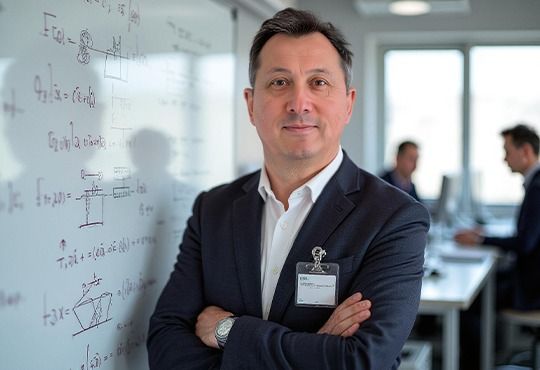
With a distinguished career spanning academia, consulting, and education technology, Dr Stephen Hodges has guided Efekta Education Group’s mission to transform learning through artificial intelligence since 2022. Under his leadership, Efekta has become a global leader in AI-driven education, serving 4 million high school students and 25,000 teachers worldwide. The company’s breakthroughs have earned high-profile recognition, including the 2024 App Store Cultural Impact Award and a place on Fast Company’s Next Big Things in Tech list in 2025.
Before joining Efekta, he spent 16 years as President of Hult International Business School, from 2006 to 2022, leading its evolution into a top-ranked, globally recognized institution with campuses across several continents. In 2018, Hult became the only U.S. business school to achieve the prestigious triple accreditation status. Dr Hodges began his career at McKinsey & Company. He holds a PhD in Computer Science and is the inventor on several patents.
In an interaction with M R Yuvatha, Editor, Asia Education Review, Dr Hodges lays out how AI is genuinely changing language education, not by teaching faster, but by teaching differently for every single learner, at a scale no classroom model could ever match.
In an era where artificial intelligence is reshaping education, the true test of technology lies not in engagement metrics but in genuine fluency. AI-powered speaking, writing, and feedback tools now make it possible to deliver the kind of personalized instruction once limited to private tutors at scale for millions of students.
By adapting pace to each learner’s first language, providing consistent correction without fatigue, and focusing on real production rather than passive recognition, these systems address long-standing gaps in classroom teaching. The result is a practical path toward measurable language competence that moves beyond gamified progress to lasting communicative ability.
What does 'personalization at scale' actually mean in language learning, and how is that different from simply giving every student the same lesson faster through an app?
Personalization at scale means delivering to every student the kind of tailored instruction that a private tutor would provide precise feedback, adjusted pacing, and relevant content while doing so for millions of learners at a fraction of the traditional cost. We are already achieving this today with more than five million students across multiple countries.
The term 'personalization' is often used loosely, so it is important to define it clearly. For us it consists of three essential components.
The first is feedback. Language is a practical skill. No one learns to swim by reading a book about swimming; they must enter the water, attempt the strokes, and receive guidance on what they are doing wrong. The same principle applies to language. Students need repeated opportunities to speak, listen, read, and write, followed by specific feedback on their actual performance. Confidence and competence develop only through this cycle of practice and correction. Without it, learners remain passive consumers of information rather than active users of the language.
The second component is pace. Students progress at different speeds. Some move quickly; others need more time. In language learning this variation is strongly influenced by a student’s first language. English is relatively accessible for many European learners because of shared vocabulary, similar grammatical structures, and a common alphabet. For many Asian learners, the distance from their mother tongue is far greater, making the same material objectively more demanding. Effective teaching must reflect these differences. Where English maps onto knowledge a student already possesses, instruction can accelerate. Where the overlap is minimal, the system deliberately slows down and provides additional support. One uniform pace cannot serve both groups equally well.
The third element is content. Material becomes far more engaging when it connects to a student’s own interests, daily life, and future goals. Relevance increases motivation and makes practice feel purposeful rather than abstract.
None of these three elements is achieved by simply delivering the same lesson faster through an app. Speed alone still leaves every student with identical content, identical pacing, identical examples, and feedback that only indicates right or wrong. True personalization changes what each learner receives, when they receive it, and how deeply they understand their own performance.
Language is a practical skill. No one learns to swim by reading a book about swimming, they must enter the water, attempt the strokes, and receive guidance on what they are doing wrong.
Speaking and writing feedback have traditionally required a human instructor’s judgment. What can AI genuinely replicate in that process, and where does it still fall meaningfully short?
In a typical classroom, no language school can effectively teach thirty or forty students at once. The practical maximum is usually around fifteen, for a clear reason: beyond that number, a teacher cannot listen to every student speak and provide individual correction. There simply is not enough time.
Across much of Asia the constraint is even more severe. There are not enough qualified English teachers to meet demand. Education systems are attempting to teach English to every child with only a fraction of the specialist teachers required. That shortage is not closing quickly, and countries cannot train their way out of it at the necessary speed.
As a result, most state systems focus on what can be taught and assessed at scale: vocabulary and grammar. The outcome is predictable. Students often leave school stronger in reading and listening than in speaking and writing. They know a great deal about English yet struggle to hold a conversation. This is not a failure of individual teachers; it is the logical consequence of placing forty students in a room with one instructor.
Against this background, AI can make a substantial contribution. It gives every student the opportunity to practice speaking and writing and to receive immediate, specific feedback. An important additional benefit is the absence of peer judgment. Students can make mistakes without an audience of classmates watching, which is one of the key advantages of private tuition and a major source of growing confidence.
In practice, AI feedback is often more consistent than human feedback. Not because the technology is more intelligent than a skilled teacher, but because humans become fatigued. The quality of comments on the fortieth essay is rarely the same as on the first. A machine does not tire. The hundredth student receives the same thorough attention as the first.
Where AI remains significantly weaker is in motivation. Inspiring a student to learn, sustaining effort through difficulty, and convincing someone that they are capable these are among the hardest aspects of teaching, and current AI systems are nowhere near matching a good teacher in this domain. A machine can identify what a student said; a teacher often understands what the student intended to say and how best to respond emotionally and pedagogically.
The division of labour is therefore straightforward. AI handles the repetitive, high-volume work of correction, assessment, and structured practice. Teachers focus on the uniquely human elements of motivation, encouragement, and professional judgment. Our platform shows teachers how each student is using the system, where they are struggling, and how they are progressing, and teachers can override the AI whenever they believe it has misjudged the situation.
How should language education providers balance the efficiency of AI-generated feedback with the risk of learners becoming overly dependent on automated correction rather than developing their own instinct for the language?
We believe AI chatbots have very limited value in serious language education, for two fundamental reasons.
First, chatbots are designed to be helpful. Helpfulness usually means providing the answer. Genuine learning, however, requires productive struggle. If a student can simply ask a chatbot to write the sentence for them, they never develop the ability to construct that sentence themselves.
Second, a chatbot lacks meaningful context. It does not know the individual learner, the curriculum objectives, or the specific errors the student made in previous sessions. Without that knowledge it cannot decide when to assist and when to withhold help so that the learner works through the difficulty.
That judgment keeping a student in the productive zone of difficulty long enough to learn without allowing frustration to become demotivating is central to good teaching. Experienced teachers make this decision constantly. It is one of the most sophisticated skills in the profession.
Efekta is a spin-out from EF Education First, an organisation that has spent sixty years training tens of thousands of teachers to make exactly these judgments. Our AI systems are trained on the same pedagogical principles. That shared foundation is the only reason the technology comes close to striking the right balance.
In practice, students on our platform are required to produce language. Learning companions place them in conversational situations and require them to speak, write, and respond in English. They are not offered multiple-choice options or one-click corrections. They receive clear information about what they got wrong and are then asked to try again. The goal is active production and gradual internalisation of the language, not passive dependence on automated fixes.
As AI-powered language platforms scale across different countries and cultures, what challenges emerge in keeping feedback linguistically and culturally accurate rather than generically 'correct'?
Two distinct issues sit inside this question: what counts as correct English, and what counts as relevant content.
On the question of correctness, we teach international English rather than a specifically American or British variety. The majority of English used in the world today occurs between people who do not speak it as a first language for example, a Vietnamese engineer communicating with a Brazilian client. That is the real-world use case for which we prepare students. We do not penalise learners for failing to sound like a native speaker from London or New York. We assess whether they would be understood and taken seriously in the professional or academic settings they are likely to enter.
On content, the principle of personalization returns. A traditional textbook presents identical material to every student. Our content is constructed around the learner’s own context and first-language background. We understand the particular difficulties a Vietnamese speaker typically encounters in English; those difficulties differ from those faced by a Spanish speaker. The system adapts accordingly.
We also work directly with governments to align with national curricula. In Brazil, Rwanda, and the Philippines, for instance, we deliver what the relevant ministry has determined its students need, rather than exporting a product designed elsewhere and simply translating it. This approach ensures both linguistic appropriateness and cultural relevance at scale.
Also Read: Talent Gap: How Singapore Is Rewiring Work for the AI Age
What will separate the language learning platforms that genuinely improve fluency outcomes from those that simply generate the appearance of progress through gamified metrics?
The decisive factor is measurement of real outcomes rather than engagement metrics.
Gamified indicators streaks, points, levels tell you that a student opened the app. They do not tell you whether the student can use the language. It is entirely possible for a learner to maintain a hundred-day streak and still be unable to sustain a conversation. Many products are designed to make that pattern feel like meaningful progress.
Platforms that genuinely improve fluency will do three things consistently. They will require students to produce language rather than merely recognise it. They will provide accurate, specific feedback on what the student actually produced. And they will adjust pace to the individual learner. These are the same three practices that effective human teachers have always used; technology does not change the underlying requirements of skill acquisition.
The ultimate test is straightforward: can students use the language effectively after the course? We evaluate success through independent assessment rather than our own internal dashboards. In the Brazilian state of Paraná, average scores on the official state English examination rose from 39 percent to 52 percent across 750,000 students.
That examination is administered by the government, not by us. We do not teach to any particular test. The improvement results from developing underlying competence in English, and the examination scores are a consequence of that competence rather than a target we optimise for directly.
In the end, the platforms that endure will be those that treat language learning as the acquisition of a practical skill requiring production, feedback, and personalised pacing exactly as a skilled private tutor would provide, but delivered affordably and at population scale.
🍪 Do you like Cookies?
We use cookies to ensure you get the best experience on our website. Read more...