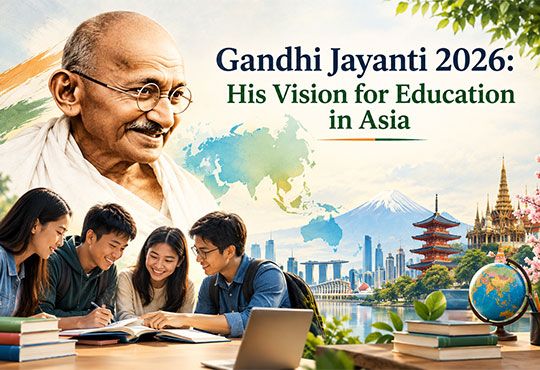
Gandhi Jayanti 2026: His Vision for Education in Asia

-
Gandhi Jayanti 2026 offers an opportunity to revisit Mahatma Gandhi’s educational ideas and examine their relevance through a contemporary Asian and international education lens. Gandhi viewed education as more than academic instruction. His approach connected learning with practical work, self-reliance, character development, social responsibility and the overall development of an individual.
These ideas continue to connect with wider discussions around education, peace, student participation and responsible citizenship. In a region as diverse as Asia, where education systems operate across different languages, cultures and social environments, these principles provide a meaningful context for understanding the broader purpose of education.
Gandhiji’s Educational Journey
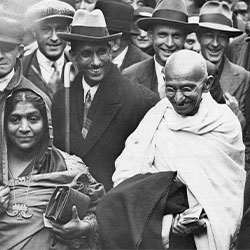 Gandhi’s own educational journey crossed geographical and cultural boundaries. He travelled to London in 1888 to study law at the Inner Temple and was called to the Bar in 1891. He later returned to India before travelling to South Africa in 1893 as a lawyer to work on a legal case for an Indian merchant.
His years in South Africa became a formative period in his life. After arriving as a lawyer, Gandhi became involved in defending the rights of the Indian community, organised campaigns against discriminatory laws and developed Satyagraha as a method of non-violent resistance. His experiences in South Africa later influenced the principles of social responsibility, non-violence and community action that became central to his public life.
During his time there, Gandhi also established communities such as Phoenix Settlement and Tolstoy Farm, where people lived and worked together. These experiences contributed to his thinking about community life, self-reliance, discipline and learning through practical activity.
This journey provides an important context for understanding his later educational philosophy. Gandhi’s ideas about learning were shaped not only by formal education but also by his experiences across different societies and communities.
Gandhiji’s Approach to Education
 Gandhi’s educational philosophy is closely associated with Nai Talim, meaning Basic Education. The approach placed productive work and practical experience at the centre of learning, with the objective of supporting holistic development rather than focusing only on academic knowledge.
Nai Talim connected education with practical activity, character development, self-reliance and social responsibility. Gandhi believed that useful work could become an important part of the learning process and that education should contribute to the intellectual, physical, moral and social development of students.
This approach gives Gandhi’s educational thought a connection with contemporary discussions around experiential and practical learning. Instead of separating knowledge from activity, the philosophy brings them together and encourages learners to understand concepts through participation and experience. The relevance of these ideas can also be seen in current discussions around hands-on learning, skills development and education that prepares students to engage with real-world situations.
Education and the Message of Non-Violence
 Gandhi’s educational thinking was also closely connected with values such as peace, dialogue and non-violence. These ideas have gained an international dimension through the United Nations’ observance of October 2 as the International Day of Non-Violence, coinciding with Gandhi’s birthday.
The international observance places Gandhi’s legacy within a wider discussion on peace, human dignity, dialogue and social cohesion. These themes are particularly relevant to education, where students from different cultural and social backgrounds interact and develop perspectives about the world around them.
“In these highly charged times, let’s summon the courage, empathy, dignity and shared humanity that Gandhi exemplified throughout his life.” — António Guterres, Secretary-General, United Nations.
The message highlights how Gandhi’s emphasis on non-violence and human understanding continues to be discussed in an international context.
Gandhiji’s Educational Legacy Beyond India
 Gandhi’s influence on education has also extended beyond India. Gujarat Vidyapith, founded by Gandhi in 1920, continues to offer academic programmes and activities connected with Gandhian thought.
The institution’s Department of Gandhian Studies has continued its international academic engagement around subjects including Gandhian philosophy and non-violence.
Its international course on Gandhian non-violence has brought students from different countries together to study the principles and applications of non-violence.Such programmes demonstrate how Gandhi’s ideas can become part of cross-cultural and international learning. Students studying these subjects can examine concepts such as peace, non-violence, social harmony and ethical responsibility within an academic environment. The international dimension is particularly relevant to Asian education, where students and institutions increasingly participate in cross-border academic programmes, exchanges and research.
Student Participation and the Social Purpose of Education
 Another important element of contemporary education is the growing emphasis on student participation. Education is increasingly viewed not simply as a process in which students receive knowledge, but as an environment where young people can participate in discussions and contribute to their communities.
UNESCO’s 2026 International Day of Education focus highlighted the changing role of young people in education and emphasised their participation in shaping educational and social change.
“Young people must be recognized not as observers but as active partners and co-creators of change at all levels.” — Dr. Stefania Giannini, President of Government Relations and Research, Efekta Education, former Assistant Director-General for Education, UNESCO.
Giannini made this statement during her tenure at UNESCO, before moving to her current role at Efekta Education in 2026. The emphasis on student agency complements the broader idea that education can contribute to social development beyond academic achievement.
His Ideas in the Asian Education Context
 Asia represents a highly diverse education landscape, encompassing countries with different languages, cultures, economies and educational traditions. Within this environment, themes such as practical learning, cultural understanding, social responsibility and peaceful coexistence have relevance across national boundaries.
Gandhi’s educational philosophy does not provide a single model for modern Asian education systems. Instead, it offers ideas that can contribute to discussions around the purpose of education.
His emphasis on learning through activity, developing character and connecting education with community life provides a perspective that can be considered alongside contemporary approaches to experiential learning, values education and student participation. International education also creates opportunities for students from different countries to encounter these ideas through courses, academic programmes, cultural exchanges and research. The continuing academic study of Gandhian philosophy and non-violence demonstrates how these ideas remain part of cross-cultural learning.Enhancing Education Through Values and Action
 Gandhi Jayanti 2026 therefore provides an opportunity to look at Gandhi’s educational ideas through a contemporary Asian and international lens. His legacy continues to highlight the role of education in developing individuals who can understand differences, engage in dialogue, respect diverse perspectives and contribute positively to their communities.
As Asia’s education systems continue to evolve, these ideas remain relevant to the wider conversation around peace, values, student participation and the social purpose of education. His emphasis on practical learning, character development, self-reliance and social responsibility continues to offer perspectives for educators and institutions seeking to connect academic learning with broader human and community development.
In this context, Gandhi Jayanti is not only a commemoration of his life and philosophy but also an opportunity to reflect on the wider purpose of education. Across Asia and beyond, the principles associated with his educational thought continue to provide a foundation for discussions on inclusive learning, peaceful coexistence, responsible citizenship and education that contributes meaningfully to society.
🍪 Do you like Cookies?
We use cookies to ensure you get the best experience on our website. Read more...