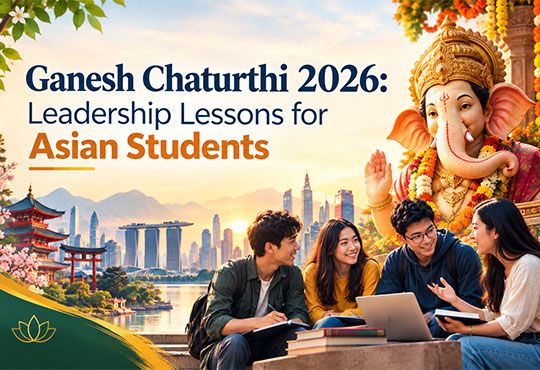
Ganesh Chaturthi 2026: Leadership Lessons for Asian Students

-
Ganesh Chaturthi is more than a festival marked by celebrations, decorations and community gatherings. For many people across India and other parts of Asia, it also represents wisdom, learning, new beginnings and the ability to overcome obstacles.
In 2026, Ganesh Chaturthi will be celebrated on September 14. The festival is traditionally associated with Lord Ganesha, who is widely regarded as a symbol of wisdom, knowledge and the removal of obstacles.
For students, the occasion can also offer an opportunity to think about leadership and personal growth.
Leadership does not always begin with a title, position or formal authority. It can begin in a classroom, a student club, a group project, a community initiative or even in the way a student responds to failure.
For Asian students preparing for increasingly global workplaces, these qualities are becoming particularly important.
Academic knowledge remains valuable, but communication, adaptability, responsibility, critical thinking and teamwork can shape a student's ability to contribute and lead.
Leadership Begins With Learning

Strong leadership starts with a willingness to learn.
Students across Asia are entering an environment shaped by artificial intelligence, digital transformation, international collaboration and rapidly changing job requirements. A degree can provide a foundation, but continuous learning can help students remain prepared for new opportunities.
Former President of India Dr. A.P.J. Abdul Kalam, Former President of India, placed strong emphasis on the connection between education and leadership.
Speaking to students at the Indian Institute of Management Kozhikode in 2003, he said:
“Management education should transform a person to a leader.” — Dr. A.P.J. Abdul Kalam , Former President of India.
The message remains relevant for students today. Education should not stop at academic achievement.
It can also help young people develop the confidence, judgment and sense of responsibility needed to lead.
For students in India, Singapore, Japan, South Korea, Indonesia, Malaysia, the Philippines and other Asian countries, this mindset can influence academic projects, internships, entrepreneurship and future careers.
 1. Think Before You Act
Good leaders do not rush into every decision.
Students today have access to more information than previous generations, but having information is different from understanding it.
Social media, short-form content and constant digital notifications can make it difficult to concentrate on deeper learning.
Students can strengthen leadership by questioning information, comparing sources, considering different viewpoints and making decisions based on evidence.
This is useful not only in education but also in the workplace. A future manager, entrepreneur, consultant, researcher or technology professional will regularly face situations where there is no immediate or obvious answer.
Taking time to think before acting can therefore become an important leadership habit.
2. Learn to Listen

Leadership is not simply about speaking confidently.
Listening can be equally important.
Asian universities bring together students from different cultures, languages, economic backgrounds and educational systems. Group projects and international programs can expose students to different opinions and working styles.
A student who listens carefully can understand a problem from another person's perspective before responding.
This skill can become especially valuable in multinational workplaces, where professionals may work with colleagues and customers across several countries.
Students can practise active listening by:
- Allowing others to finish before responding
- Asking relevant questions
- Accepting constructive feedback
- Avoiding assumptions about people from different cultures
- Summarising another person's point before presenting their own view
These simple habits can make collaboration more effective.
 3. Treat Obstacles as Learning Opportunities
Every student's journey includes setbacks.
A failed examination, rejected internship application, unsuccessful competition entry or difficult group project can feel like a major disappointment. But setbacks can also reveal areas that need improvement.
Ganesh Chaturthi is traditionally associated with overcoming obstacles. For students, that idea can be translated into a practical leadership lesson: difficulties do not always need to be viewed as reasons to stop.
A student who learns from mistakes develops resilience.
Instead of focusing only on the setback, students can examine what they learned, what they could improve and what they can do differently next time.
This mindset is particularly useful for young people interested in entrepreneurship and innovation, where experimentation and failure are often part of the learning process.
4. Build the Confidence to Work With Others

Future careers will increasingly involve collaboration.
A student may eventually work with people from India, Singapore, China, Japan, South Korea, Australia, Europe or the United States without ever leaving their home country.
That makes cultural awareness and teamwork important leadership skills.
Students can develop these abilities through group assignments, student organizations, volunteering, internships, entrepreneurship clubs and international exchange programs.
Leadership does not require a student to dominate a group. Sometimes the strongest contribution comes from helping different people work toward the same goal.
A good team member can eventually become a good team leader because they understand the challenges that other members face.
5. Stay Adaptable in a Changing Job Market

Technology is changing the skills employers value.
Artificial intelligence, automation, digital platforms and data-driven decision-making are influencing sectors ranging from finance and healthcare to manufacturing, education and consulting.
Students therefore need to remain open to learning beyond their main degree.
An engineering student may benefit from communication and business knowledge. A business student may need data and AI literacy.
A design student may need digital technology skills. A computer science student may need stronger communication and leadership abilities.
Adaptability does not mean trying to learn everything.
It means being willing to recognise changes and develop the skills needed to remain useful.
For Asian students competing in increasingly connected job markets, this attitude can become an important career advantage.
 6. Leadership Means Creating a New Path
Young people often enter the workforce with established expectations about careers, industries and professional success.
Leadership can also mean questioning those expectations and creating something new.
Students can explore emerging career paths and industries instead of limiting themselves to traditional professions.
The changing job market is creating opportunities across entrepreneurship, digital businesses, sustainability, creative industries and other emerging fields.
This idea was highlighted by Gautam Adani, Chairman, Adani Group, during his address to students at IIM Lucknow. Speaking about the future and the role of young people, he said:
“I am not here to hand you a map, but to invite you to redraw the map itself. To challenge your very definition of leadership.” — Gautam Adani , Chairman , Adani Group.
For Asian students, the message is particularly relevant as the region becomes an increasingly important centre for technology, entrepreneurship, manufacturing, finance and innovation.
Students do not necessarily need to follow a traditional career path. They can explore new industries, build businesses, create technologies, develop social enterprises or combine skills from different fields.
The important part is developing the confidence to think independently while remaining responsible for the decisions they make.
7. Lead With Responsibility

Leadership also involves responsibility toward other people.
Students can demonstrate this through volunteering, mentoring younger students, supporting campus initiatives or taking responsibility for community projects.
Leadership becomes more meaningful when it includes the voices and contributions of young people themselves.
In April 2026, António Guterres, Secretary-General, United Nations, highlighted this point while discussing youth leadership and participation:
“Youth participation must move beyond visibility toward real influence and shared responsibility.” — António Guterres , Secretary-General , United Nations.
For students, this means moving beyond simply attending events or being listed as members of an organisation. They can take active roles in planning projects, making decisions, solving problems and contributing to their communities.
Whether it is a college initiative, environmental campaign, social project or student organisation, these experiences can help young people understand what responsible leadership looks like.
Also Read : Asia's Young Talent Race: The New Education Era
 Turn Wisdom Into Action
Knowledge becomes more valuable when students put it into practice.
A student may understand the importance of teamwork but never participate in a team activity.
They may know that communication matters but avoid presenting ideas.
They may understand the value of responsibility but hesitate to take charge of a project.
Leadership develops through action.
Students can start with manageable opportunities :
- Lead a college project
- Join a student organisation
- Volunteer for a community initiative
- Participate in entrepreneurship competitions
- Mentor another student
- Present an idea publicly
- Organise an academic or cultural event
- Take responsibility for solving a problem on campus
These experiences can build confidence while teaching students to deal with real-world situations.
What Ganesh Chaturthi Can Teach the Next Generation ?

The deeper value of a festival can sometimes be found in the ideas it encourages people to reflect upon.
For students, Ganesh Chaturthi can become an opportunity to think about wisdom, learning, resilience, responsibility and service.
Leadership does not need to begin after graduation. It can begin during college, through everyday decisions and interactions.
A student who learns to listen, accepts feedback, handles setbacks, works with different people and takes responsibility is already developing leadership qualities.
For Asia's young population, these qualities matter beyond individual careers. Students will eventually become entrepreneurs, researchers, teachers, engineers, consultants, policymakers, healthcare professionals and business leaders who influence their communities and economies.
The leadership lesson is therefore simple: learn continuously, work with others, face obstacles with resilience and use knowledge to create value for people.
A Quick Leadership Check for Students

Before moving forward, students can reflect on the following questions and consider how they can improve their leadership skills:
1. Do I listen before giving my opinion?
Answer: Good leadership begins with listening. Understanding other people's ideas and concerns before responding can help students communicate better and make more thoughtful decisions.
2. Can I accept feedback without taking it personally?
Answer: Feedback can help students identify their strengths and areas for improvement. Accepting constructive feedback with an open mind can support personal and professional growth.
3. What do I do when I fail?
Answer: Failure can be treated as a learning opportunity rather than a reason to give up. Students can identify what went wrong, learn from the experience and try a better approach next time.
4. Am I willing to learn skills outside my degree?
Answer: Yes. Developing skills beyond academic subjects can help students adapt to changing career requirements. Communication, teamwork, digital skills and problem-solving can complement their academic knowledge.
5. Can I work effectively with people from different backgrounds?
Answer: Working with people from different cultures and backgrounds requires respect, communication and an open mind. Developing these qualities can prepare students for diverse workplaces.
6. Have I taken responsibility for a team or project?
Answer: Taking responsibility can help students develop confidence, decision-making and teamwork skills. Even leading a small college project or activity can provide valuable leadership experience.
7. What value can I create for other people?
Answer: Leadership is not only about personal success. Students can create value by helping others, solving problems, sharing knowledge, supporting their communities or contributing positively to a team.
Ganesh Chaturthi 2026 can therefore offer Asian students more than a cultural celebration. It can be a reminder that leadership begins with learning, grows through responsibility and becomes meaningful when it creates value for others.
🍪 Do you like Cookies?
We use cookies to ensure you get the best experience on our website. Read more...