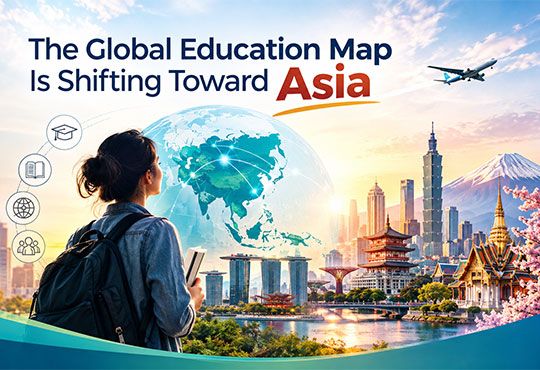
The Global Education Map Is Shifting Toward Asia

-
For decades, the global education journey followed a familiar route. Students crossed borders in search of prestigious universities, established research ecosystems and stronger career opportunities, with the United States, United Kingdom, Australia and Canada occupying much of the international spotlight. That map is becoming more diverse.
Across Asia, universities are expanding their international presence, strengthening research capabilities, developing industry partnerships and preparing students for economies increasingly shaped by technology and artificial intelligence. At the same time, international students are considering a wider range of Asian institutions.
This shift does not mean Asia is replacing established education destinations. Instead, it points to a more distributed global education system in which Asian universities are becoming increasingly important destinations for knowledge, talent and innovation.
Asia’s Role in Global Education Is Evolving
 Asia has long been central to global education, particularly as a major source of international students. Today, its role is also shaped by the growth and internationalisation of its own universities.
Institutions across Singapore, Hong Kong, China, Japan, South Korea and Malaysia are developing academic partnerships, research networks and international programmes. Universities are also becoming more connected with technology companies, research institutions, governments and employers.
As a result, Asian higher education is increasingly part of the wider global conversation—not simply a regional option for students.
The region’s economic development is closely connected with this change. As Asian markets expand across technology, finance, manufacturing, healthcare and entrepreneurship, universities have opportunities to contribute through research, skills development and talent creation.
This relationship is helping reshape how institutions, students and employers view the region’s role in global education.
International Students Are Looking at a Wider Map
 International students are weighing a broader range of factors when choosing where to study. Academic reputation remains important, but tuition costs, employment prospects, research opportunities, technology exposure, quality of life and links to growing industries can also influence decisions.
Asian destinations offer different combinations of these opportunities.
Singapore brings internationally recognised universities together with a strong business and technology environment. Japan and South Korea have established research and industrial capabilities. China has developed a large higher education system with an expanding international profile.
Hong Kong offers an internationally connected academic environment, while Malaysia has developed a significant private and transnational education sector.
Studyportals CEO and Co-Founder Edwin van Rest has been quoted as saying :
“The global centre of gravity in higher education is clearly shifting.”
The statement reflects a wider discussion about the changing geography of international education. However, the shift should not be understood as a simple movement away from Western universities. Students’ choices continue to depend on individual goals, programme quality, affordability, visa conditions and career opportunities.
Instead, Asia’s growing presence is adding more destinations and pathways to the international student experience.
Universities Are Becoming Part of the Innovation Economy
 One of the major developments in Asian higher education is the closer relationship between universities and innovation.
Universities are increasingly working with technology companies, research organisations and public institutions. Students may gain exposure to industry projects, while faculty members collaborate on applied research.
In some university environments, start-up activity and research commercialisation also connect academic work with wider economic needs.
This matters because a university’s contribution extends beyond teaching. Research impact, industry collaboration, entrepreneurship and graduate outcomes are also important parts of its role.
For Asia, stronger connections between universities and industry can create opportunities for both education and economic development. Universities can help develop talent and research, while businesses can provide practical challenges, expertise and pathways for applying new ideas.
The scale and quality of these partnerships will vary across countries and institutions. Building a globally recognised university ecosystem requires sustained investment, strong academic standards, capable faculty and effective governance—not simply more partnerships.
AI Is Changing What Future-Ready Education Means
 Artificial intelligence is adding another dimension to the transformation of higher education.
Universities are not only teaching AI-related subjects. They are also reconsidering how students learn, how assessments are designed and which capabilities graduates will need in a technology-enabled workplace.
The challenge is no longer simply whether students can use a particular tool. They also need to evaluate information, make decisions, communicate clearly, understand context and take responsibility for their work.
This makes human capabilities an important part of future-ready education.
Critical thinking, creativity, collaboration, ethical reasoning and leadership need to develop alongside digital and AI literacy. Students must learn how to work with technology while applying independent judgement.
For Asian universities, this creates both an opportunity and a responsibility. Institutions can help prepare students for changing industries, but they must also ensure that technology supports meaningful learning rather than becoming a substitute for it.
The future-focused university will need to combine technical knowledge with the ability to apply that knowledge thoughtfully.
Also Read : Asian Leaders Who Turned their Careers Into Success
Employability Is Moving Closer to the Centre
 Students increasingly want education to connect with the opportunities they may pursue after graduation. Employers, meanwhile, need graduates who can adapt to new technologies, work across disciplines and apply their knowledge in practical settings.
This is encouraging universities to strengthen their links with industry through internships, work-integrated learning, applied research, entrepreneurship programmes and employer engagement.
The need is particularly relevant across Asia’s diverse labour markets. Technology companies seek digital talent, manufacturers need expertise in automation and advanced systems, and financial institutions increasingly work with data-driven tools. Other sectors, including healthcare, also require professionals who can combine specialist knowledge with technology.
Universities can help bridge the gap between education and employment by giving students opportunities to apply what they learn.
At the same time, employability should not be reduced to immediate job placement alone. A strong education also helps students develop adaptable skills that remain useful as industries change.
Southeast Asia’s Diverse Education Landscape
 Southeast Asia illustrates how the region’s higher education development is taking place through different national models.
Malaysia has developed as a destination for private and transnational education. Singapore combines international universities with a developed research and business environment. Vietnam, Indonesia, Thailand and the Philippines have their own expanding higher education systems and workforce priorities.
Regional mobility and international partnerships can create opportunities for institutions and students to connect across borders. However, the countries differ in economic conditions, languages, demographics, institutional capacity and education priorities.
Growth alone does not guarantee international competitiveness. Universities also need academic depth, strong faculty, credible research, recognised standards and sustainable governance.
The region’s future role in global education will therefore depend not only on how many students it attracts, but also on the quality and resilience of the education systems it builds.
From University Rankings to University Ecosystems
 International rankings remain one way of comparing universities, but they do not capture every dimension of an institution’s contribution.
Research partnerships, industry connections, international networks, graduate opportunities and the ability to support innovation can also shape a university’s wider influence.
Malaysia Director at the British Council Jazreel Goh has been quoted as saying:
“The increased rankings among Asian universities are making it very, very much easier to look at quality partners and to have global expertise here in the region.”
The observation highlights how greater visibility can support international collaboration. Rankings may help institutions become more familiar to prospective partners, while meaningful partnerships depend on academic strengths, shared goals and the ability to work together.
For students, universities connected to active research and industry environments may offer learning opportunities beyond the classroom. For institutions, international recognition can bring greater visibility as well as higher expectations.
A More Connected Global Education Future
 The changing education landscape is not simply about one region replacing another. It is increasingly about a wider network of institutions, students, researchers and employers working across borders.
Students may study in one country, take part in an exchange programme elsewhere, collaborate on international research and later work for an organisation with operations across several markets. Universities can develop joint programmes, establish partnerships and connect students with employers beyond their home countries.
Technology can support these connections, although access, quality and the ability to participate remain uneven.
Asia’s growing role is being shaped by the interaction of its universities, industries, research networks and international student communities. Its long-term influence will depend on how effectively institutions turn scale and visibility into quality, innovation and global trust.
For students, a broader range of destinations can create more choices. For universities, it offers opportunities to build stronger international identities. For employers, it expands access to talent developed across different education systems.
The global education map is therefore becoming more distributed. Asia is not simply one destination among many; it is becoming an increasingly connected part of the global system through which knowledge is created, talent is developed and new ideas move across borders.
🍪 Do you like Cookies?
We use cookies to ensure you get the best experience on our website. Read more...