By Tharani Sambu, Content Writer
Asian Leaders Who Turned their Careers Into Success

-
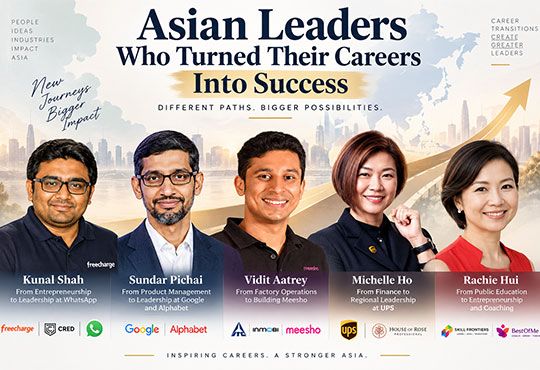
Career success is rarely defined by a single industry, job title, or professional function. Many prominent Asian business leaders have built their careers by moving across roles, industries and areas of expertise, taking on new challenges at different stages of their professional journey.The career journeys of Kunal Shah, Sundar Pichai, Vidit Aatrey, Michelle Ho and Rachie Hui reflect this diversity. Their paths span technology, finance, operations, strategy, consulting, entrepreneurship and corporate leadership. Each took a different route to reach their current position, demonstrating that professional growth can take many forms.For students and young professionals across Asia, these journeys provide a practical perspective on career development. They show the value of building transferable skills, remaining open to new opportunities and being willing to move beyond the boundaries of an initial career choice.
Kunal Shah: From Entrepreneurship to Leadership at WhatsApp
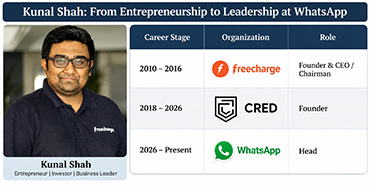 Kunal Shah’s career began long before he became known for CRED. His professional journey was centered on entrepreneurship, eventually leading him to build FreeCharge, move into investing and advisory roles, launch CRED and later take on a global leadership position at WhatsApp.Shah spent his early years building businesses before founding FreeCharge in 2010. The company focused on digital payments and became one of India’s notable consumer internet businesses. FreeCharge was acquired by Snapdeal in 2015, marking a major transition in Shah’s entrepreneurial career.Rather than immediately starting another company, Shah spent the following period investing in and advising startups. This experience exposed him to different business models, founders and industries.That experience eventually contributed to the creation of CRED in 2018. Shah founded the company around an idea of rewarding consumers for responsible credit-card payment behavior. Under his leadership, CRED expanded into a broader financial-services platform.Reflecting on his approach to entrepreneurship, Shah has said : “I believe the insight is the smallest unit of truth that is actionable.”His career demonstrates the importance he places on identifying problems and turning those observations into businesses.In 2026, Shah moved into another major chapter of his career by joining Meta to lead WhatsApp globally. He continues to remain a shareholder in CRED while taking on his new operating role.
His Success :
Kunal Shah’s journey demonstrates how entrepreneurial experience, investing exposure and product thinking can create opportunities beyond a single startup. His move from building an Indian fintech company to taking on a leadership role at a major global technology platform represents a significant career transition.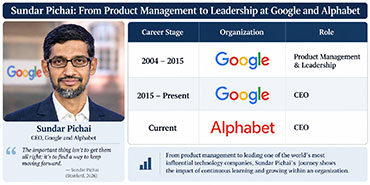 Sundar Pichai: From Product Management to Leadership at Google and AlphabetSundar Pichai’s career provides a different example of professional progression. Rather than moving repeatedly between companies, he spent more than a decade developing expertise in product management and leadership before becoming one of the most prominent technology executives in the world.Pichai joined Google in 2004, beginning a long association with the company. His early years focused on product management and leadership, where he worked across products and gradually took on increasingly important responsibilities.Over the following decade, his responsibilities expanded as he became involved with some of Google’s most important products. His ability to combine technical understanding with product strategy and leadership eventually positioned him for the company’s highest executive role.In 2015, Pichai became CEO of Google. He later became CEO of Alphabet as well, expanding his responsibility across Google’s broader corporate structure.Speaking to Stanford graduates in 2026, Pichai reflected on navigating uncertainty and setbacks :“The important thing isn’t to get them all right; it’s to find a way to keep moving forward.”That message closely reflects his own career path. His progression was not based on constantly changing direction, but on taking on greater responsibility within the same organization and developing a broad understanding of products, technology and leadership.
His Success :
Sundar Pichai’s career shows that professional growth does not always require changing industries or companies. Sometimes, it comes from continuously expanding responsibilities within one organization and developing the leadership capabilities needed for larger roles.Vidit Aatrey: From Factory Operations to Building Meesho
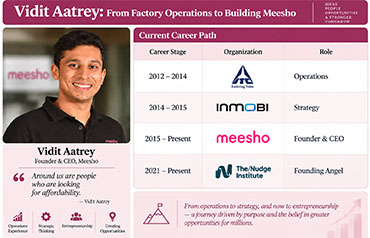 Vidit Aatrey followed a path that moved from traditional corporate operations to technology strategy and eventually entrepreneurship.His professional career began at ITC Limited in 2012, where he worked in operations in Chennai. This gave him early exposure to large-scale business operations and the practical challenges involved in running a major organization.In 2014, he moved to InMobi, taking up a strategy role in Bengaluru. The transition from operations to strategy represented an important change in his career. Instead of focusing primarily on operational responsibilities, Aatrey was now working in a technology environment and dealing with strategic business questions.The next major move came in 2015, when Aatrey became the CEO of Meesho. Together with Sanjeev Barnwal, he worked on building a platform designed to enable small businesses and individuals to participate in online commerce.The company’s early direction changed significantly after its founders spent time understanding the challenges faced by small merchants. Aatrey later recalled the importance of identifying affordability as a major market opportunity:“Around us are people who are looking for affordability.”That understanding helped Meesho develop its social-commerce model and eventually expand into a much larger e-commerce platform.Aatrey has also described the uncertainty surrounding the company’s early days:“We didn't know what to expect.”Today, Aatrey continues to serve as Founder & CEO of Meesho, while also supporting The/Nudge Institute as a founding angel.
His Success :
Vidit Aatrey’s career illustrates the value of combining operational experience with strategic thinking before moving into entrepreneurship. His transition from a large traditional company to technology strategy and then startup leadership helped shape his approach to building Meesho.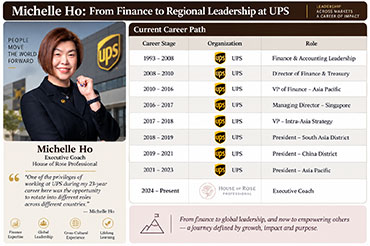 Michelle Ho: From Finance to Regional Leadership at UPSMichelle Ho’s career demonstrates the long-term value of developing expertise in one function and gradually expanding into broader leadership responsibilities.Ho began her career at UPS in 1993, working in finance and accounting as a collection supervisor. Over the following years, she moved through a series of finance roles, eventually taking on responsibilities across different markets.Her progression included positions such as Finance Manager, South Asia District Controller and China District Controller. These roles gave her exposure to different markets while strengthening her financial and operational understanding.In 2008, Ho moved into a Director of Finance and Treasury role. She later became Vice President of Finance for Asia Pacific in 2010, taking responsibility for financial planning and transformation across the region.Her career then moved beyond finance.In 2016, she became Managing Director of Singapore, where her responsibilities included operational leadership, business growth and profitability. She subsequently moved into VP – Intra-Asia Strategy, followed by leadership positions in South Asia and China.In 2019, she became President – China District, and in 2021, she reached one of the highest points of her UPS career when she became President – Asia Pacific.In an interview about her career at UPS, Ho described the value of moving between roles and countries:“One of the privileges of working at UPS during my 23-year career here was the opportunity to rotate into different roles across different countries.”After almost three decades with UPS, Ho moved into a new professional chapter. Since 2024, she has worked as an Executive Coach at House of Rose Professional, using her corporate leadership experience in coaching and professional development.
Her Success :
Michelle Ho’s career shows that expertise in one function can become the foundation for wider leadership. Her move from finance into strategy and regional operations demonstrates the value of taking on responsibilities outside an initial area of specialization.Rachie Hui: From Public Education to Entrepreneurship and Coaching
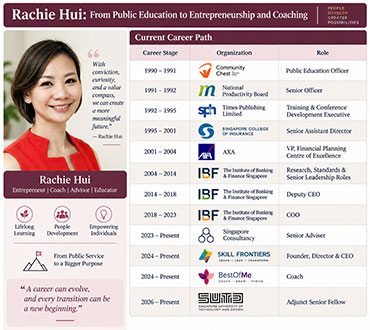 Rachie Hui’s career is a strong example of a professional identity evolving several times over the course of a career.Her working life began in 1990 with Community Chest Singapore, where she worked as a Public Education Officer. She then moved to the National Productivity Board as a Senior Officer in 1991.In 1992, she joined Times Publishing Limited as a Training and Conference Development Executive. Three years later, she moved to the Singapore College of Insurance, becoming a Senior Assistant Director.Her next major transition came in 2001, when she joined AXA as Vice President of the Financial Planning Centre of Excellence. This move brought her deeper into the financial-services sector.In 2004, Hui joined the Institute of Banking & Finance Singapore (IBF). What followed was almost two decades of increasing responsibility.She initially worked as a Research & Certification Consultant before progressing through roles including Head of Standards & Accreditation, Deputy Director and Senior Deputy Director. In 2014, she became Deputy Chief Executive Officer, and in 2018, she took on the role of Chief Operating Officer.Rather than continuing along the traditional corporate leadership path, Hui chose another transition.After stepping down from her COO role in 2023, she moved toward coaching, consulting and entrepreneurship. She later founded Skill Frontiers, where she now works as Founder, Director and CEO. She also works as a coach and adviser and has taken on an academic role as an Adjunct Senior Fellow at the Singapore University of Technology and Design.Reflecting on the transition from corporate leadership to entrepreneurship, Hui has described carrying:“conviction, curiosity, and a value compass”into the next stage of her career.Her career therefore did not end with her departure from a senior corporate position. Instead, her experience became the foundation for a new professional identity focused on coaching, skills and organizational development.
Her Success :
Rachie Hui’s journey demonstrates that a senior corporate career can become the starting point for a completely new professional chapter. Her move from public education and training to financial services, institutional leadership, entrepreneurship and coaching reflects the value of continuously developing skills and remaining open to change.Five Careers, Five Different Lessons
These five leaders reached senior positions through very different routes.Kunal Shah moved from entrepreneurship to fintech and then global technology leadership. Sundar Pichai built his career through product management before taking charge of Google and Alphabet. Vidit Aatrey moved from operations to strategy and then entrepreneurship. Michelle Ho expanded from finance into regional business leadership before becoming an executive coach. Rachie Hui moved from public education and training into financial services, institutional leadership and eventually entrepreneurship and coaching.Their stories highlight one common theme: career development does not have to follow a predetermined formula.For students and young professionals, the important lesson is not to replicate any one of these career paths. Instead, these journeys demonstrate the value of building strong skills, learning from each role and recognizing opportunities when a career begins to move in a new direction.A first job can provide the foundation. A second role can broaden that foundation. Over time, the combination of skills, experience and adaptability can create opportunities that may not have been visible at the beginning of the career.
🍪 Do you like Cookies?
We use cookies to ensure you get the best experience on our website. Read more...