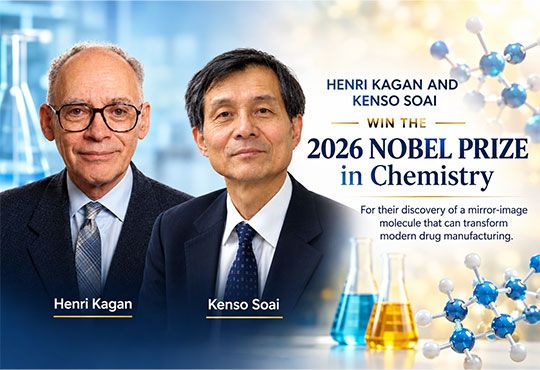
Henri B. Kagan of France and Kenso Soai of Japan have won the 2026 Nobel Prize in Chemistry for their discoveries on non-linear effects and autocatalysis in asymmetric organic synthesis. The Royal Swedish Academy of Sciences announced the award on October 7, recognising their work in solving a long-standing question about why living systems favour one mirror-image form of certain molecules.
Many molecules exist in two forms that are mirror images of each other, similar to the relationship between a left and right hand. These forms are known as chiral molecules. Although both versions can have the same chemical formula, they can behave differently when interacting with biological systems. This makes controlling molecular handedness particularly important in pharmaceutical research and drug development.
Henri Kagan made an important breakthrough in 1986 by demonstrating that chemical reactions could produce a greater amount of one mirror-image form than the other. His research showed that small differences in molecular handedness could be amplified during a chemical reaction, providing an important foundation for further work on asymmetric synthesis.
Kenso Soai took this research further through his work on asymmetric autocatalysis. In 1995, his research demonstrated a reaction in which a chiral product could help drive the formation of more of the same molecular handedness. In 2003, Soai succeeded in producing only one of the two possible mirror-image forms in a chemical reaction, a result that became a major milestone in the field.
“Kagan and Soai led the way in dreaming and making new ways to control molecular handedness with remarkable precision.” - Rigoberto Hernandez, President, American Chemical Society
Hernandez further highlighted that Kagan established principles for producing one molecular form with high selectivity, while Soai demonstrated how molecules could amplify their own handedness. Their discoveries have given chemists greater control over molecular structures and supported advances in medicines, materials and other areas of science.
The research has particular importance for pharmaceutical manufacturing because scientists often need to produce a specific mirror-image form of a molecule. The Nobel Committee noted that the discoveries made by Kagan and Soai have been decisive for chemists designing reactions used in the manufacture of pharmaceuticals.
The award also highlights the contribution of Asian scientific research through Kenso Soai, who is Professor Emeritus at Tokyo University of Science in Japan. Soai earned his PhD from the University of Tokyo in 1979 and has spent decades researching organic chemistry and molecular chirality.
Kagan, Professor Emeritus at Université Paris-Sud in France, and Soai will share the Nobel Prize amount of 12 million Swedish kronor equally. Their work represents a major achievement in fundamental chemistry while also contributing to scientific understanding relevant to pharmaceuticals and life sciences.