
-
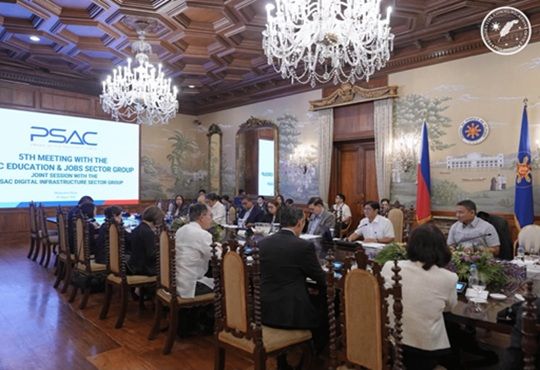
President Ferdinand R. Marcos Jr. chaired the 5th meeting of the Private Sector Advisory Council (PSAC) Education and Jobs Sector Group, placing artificial intelligence at the center of the country’s workforce and education agenda.
The high-level discussion, held in Manila, focused on expanding AI upskilling programs, reforming educational curricula, and generating new employment opportunities in emerging technology sectors. According to the Presidential Communications Office, the meeting underscored the government’s recognition that rapid advances in artificial intelligence will play a decisive role in shaping the Philippine economy in the coming decade.
President Marcos emphasized the need for close collaboration between government and the private sector to prepare Filipino workers for an AI-driven future. He directed relevant agencies to work with PSAC in revising school and university curricula, scaling specialized training programs, and creating pathways into high-value AI-related jobs. The goal, he indicated, is to build a workforce capable of competing in a global digital economy while reducing over-reliance on overseas employment.
Overseas Filipino Workers remain a vital pillar of the national economy through remittances. However, officials acknowledged that creating more high-quality jobs at home is essential for long-term economic stability and improved living standards. AI upskilling is seen as a key strategy to achieve this shift by opening new career paths for young Filipinos and raising the overall sophistication of domestic employment.
The Business Process Outsourcing industry, long a strength of the Philippine economy, stands to benefit significantly. As global clients increasingly demand AI-enabled services, the ability of Filipino talent to integrate artificial intelligence into customer experience, data analytics, software development, and process automation will determine the sector’s continued competitiveness. Targeted training programs could help the industry move up the value chain and protect its position against rising competition from other markets.
Participants in the PSAC meeting discussed practical measures to accelerate progress. These include expanding access to AI literacy courses at secondary and tertiary levels, establishing industry-aligned certification programs, and encouraging companies to invest in continuous employee reskilling. Private sector representatives highlighted the importance of aligning training content with actual industry needs so that graduates and mid-career workers can transition smoothly into new roles.
The initiative forms part of a broader national effort to accelerate the Philippines’ transition to a digital economy. By strengthening human capital in artificial intelligence and related fields, the government aims to attract higher-value investments, support innovation-driven enterprises, and improve the country’s standing in global competitiveness rankings. Officials noted that countries that successfully integrate AI into education and workforce development are better positioned to capture economic gains from technological change.
Education reforms are expected to play a central role. Updating curricula to include foundational AI concepts, data literacy, critical thinking, and ethical considerations around technology use will help prepare students from an earlier age. At the same time, short-term and modular training programs for existing workers can address immediate skills gaps in the labor market.
Also Read: AI Literacy: The New Core Competency for Education Leaders
Job creation strategies discussed during the meeting go beyond traditional employment models. New opportunities are anticipated in AI system development, data annotation and management, AI ethics and governance, specialized technical support, and hybrid roles that combine domain expertise with AI tools. Supporting startups and scale-ups in the AI space was also identified as a way to generate additional employment and foster local innovation.
The partnership between the government and PSAC reflects a shared understanding that neither the public nor the private sector can tackle the AI transition alone. Coordinated action is required to align education systems, labor market policies, and industry investment. Regular consultations through the PSAC platform allow both sides to track progress, identify bottlenecks, and adjust strategies as technology and market conditions evolve.
For young Filipinos, the push for AI upskilling offers the prospect of more diverse and future-proof career options. Rather than viewing artificial intelligence solely as a source of disruption, the government and private sector are framing it as a catalyst for higher productivity, better jobs, and stronger economic resilience.
As the Philippines continues to navigate global economic uncertainties, building domestic capacity in emerging technologies has become a strategic priority. The outcomes of the latest PSAC meeting signal a clear policy direction: equip the workforce with relevant AI skills, modernize education, and actively create opportunities that allow more Filipinos to build successful careers at home.
Further details on specific programs and timelines are expected to be announced as government agencies and private sector partners move from discussion to implementation. The success of these initiatives will depend on sustained collaboration, adequate resources, and the ability to adapt quickly to the fast-changing landscape of artificial intelligence.
🍪 Do you like Cookies?
We use cookies to ensure you get the best experience on our website. Read more...