
-
Australia’s quantum research community took a significant step forward this week as Fujitsu, Monash University and CSIRO signed a Memorandum of Understanding granting Australian researchers and students direct access to Fujitsu’s superconducting quantum systems in Japan. The agreement, announced on Tuesday, includes access to the 256-qubit processor co-developed with RIKEN and deployed in April 2025. It arrives just eight days after Australia and Japan formalised a bilateral quantum science agreement and further embeds quantum cooperation within the Quad framework.
Australia already possesses strong quantum research capabilities, yet it lacks large-scale domestic quantum hardware. Leading institutions such as UNSW, through its Silicon Quantum Computing spinout, have achieved world-class results including 99.99% two-qubit gate fidelity in silicon spin qubits. The Australian National University previously secured Fujitsu access in 2024. The new MoU elevates Monash and CSIRO to the same access tier, with a decisive difference: CSIRO’s national applied-science role.
Unlike a university, CSIRO maintains direct connections to industry, government and real-world problem domains spanning mining, healthcare, logistics and national security. Access to a 256-qubit system capable of quantum optimisation and advanced simulation therefore opens pathways beyond pure physics experiments toward practical applications such as logistics scheduling, molecular simulation for pharmaceuticals and decarbonisation modelling.
The partners will also explore establishing a shared quantum research and education facility at Monash University’s Faculty of Information Technology in Clayton, Victoria. If realised, the centre would create a permanent Australian node within Fujitsu’s quantum network, reducing reliance on purely remote access and providing a physical hub for workforce training. Monash, Australia’s largest university with more than 80,000 students, is well positioned to sustain such a facility at scale.
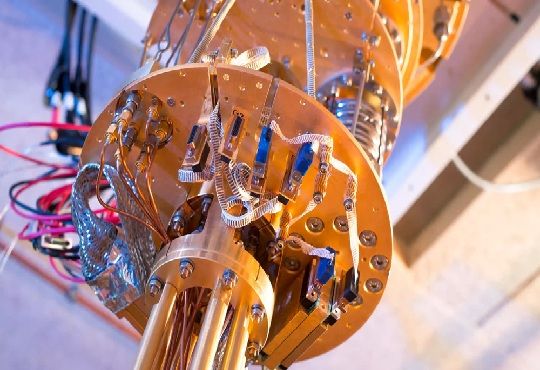
Fujitsu’s hardware is already operational. The 256-qubit superconducting system at the RIKEN RQC-Fujitsu Collaboration Center in Kawasaki operates at approximately 15 millikelvin and ranks among the largest deployed superconducting platforms globally. It is designed for near-term applications using variational quantum algorithms and hybrid quantum-classical workflows.
Researchers gain more than raw processor time; they access a hybrid platform that combines the quantum processor with a classical circuit simulator and a workload broker that automatically routes tasks between quantum and classical resources according to relative advantage.
Fujitsu’s roadmap extends further. A 1,000-qubit system is under installation at its Kawasaki Technology Park, with access continuing through March 2029 under the RIKEN agreement. Beyond that, development of a 10,000-plus qubit system based on the proprietary STAR architecture began in August 2025, targeting completion by fiscal 2030 and aiming for roughly 250 logical qubits.
Current error rates mean the existing 256-qubit machine supports only a limited number of error-corrected logical operations, underscoring that near-term value lies in optimisation, small-molecule chemistry, quantum machine learning and algorithmic skill-building rather than large-scale fault-tolerant computation.
Also Read: Monash University Opens Applications For K.C. Kuok Scholarship 2027
The timing and government backing distinguish this partnership. On 27 July 2026, Australian Industry and Innovation Minister Tim Ayres and Japan’s Minister of State for Science and Technology Policy Kimi Onoda signed a quantum Memorandum of Cooperation in Sydney covering research infrastructure access, supply-chain resilience, commercialisation and workforce development. Japan has now concluded quantum agreements with all three other Quad members, creating a concrete technology dimension to the grouping. Onoda’s attendance at the Monash-CSIRO-Fujitsu signing underscored the elevated diplomatic status of the arrangement.
For Fujitsu the partnership supplies an international research base that can stress-test its systems across diverse application domains before the larger STAR architecture arrives. CSIRO’s applied focus offers domain problems decarbonisation pathways, resource optimisation and climate modelling that internal teams may not prioritise. Fujitsu Oceania CEO Peter Grassi highlighted the company’s long presence in Australia and its ability to connect the two countries’ quantum ecosystems.
Workforce development forms the partnership’s long-term core. CSIRO’s 2025 Quantum Shift report identified a critical shortage of skilled quantum professionals even as awareness grows. Global estimates suggest the industry will need tens of thousands of specialised workers, including thousands focused on error correction, by the end of the decade.
Monash’s scale and international campuses position it to generate quantum-ready graduates at volume. New teaching initiatives will give students hands-on experience on actual superconducting hardware rather than simulators alone. A May 2026 Monash quantum workforce report emphasised the need for professionals who can translate across disciplines and connect technical advances to real-world use.
CSIRO projects a potential $6 billion Australian quantum industry by 2045 supporting nearly 20,000 jobs, with an interim $2.2 billion market by 2030. Realising those figures depends on building a trained workforce well ahead of domestic hardware maturity. The MoU activates immediate research access while exploring a permanent facility; capital commitments and detailed timelines for the latter remain to be settled.
Australia is not constructing a 256-qubit machine today. It is securing access to one while developing the human capital required to use larger systems and eventually to build its own. As CSIRO Technology Director Dr Katja Digweed noted, linking deep scientific capability with the right software and algorithms can move quantum computing closer to practical impact in cybersecurity, health and climate science. The hardware sits in Kawasaki; the problems worth solving, and the students who will solve them, are being prepared in Australia.
🍪 Do you like Cookies?
We use cookies to ensure you get the best experience on our website. Read more...