
-
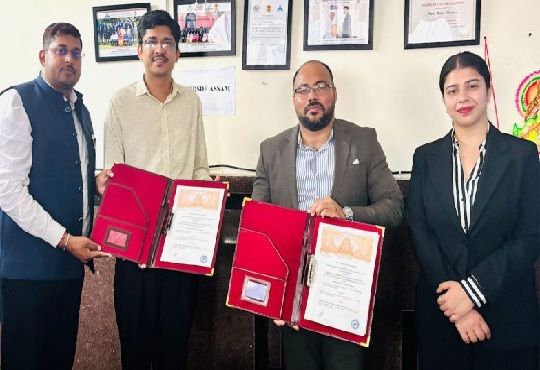
Medhavi Skills University (MSU), Sikkim, has signed a landmark Memorandum of Understanding with the Regional Directorate of Skill Development & Entrepreneurship (RDSDE), Assam, under the Directorate General of Training (DGT), Ministry of Skill Development and Entrepreneurship (MSDE), Government of India. The agreement focuses on implementing Flexi-MoU programmes and positions MSU as the only university in the country currently holding an active MoU with DGT under this scheme.
The Flexi-MoU framework allows the university to collaborate directly with industry partners to identify real-time workforce needs, design customised curricula, and deliver training through a structured Learn and Earn model. Trainees combine classroom instruction with practical learning and on-the-job training while receiving monthly stipends. Upon successful completion, they are awarded the National Trade Certificate (e-NTC) issued by DGT, creating a clear and recognised pathway into employment.
The MoU was signed by Shri Rohan Ramrao Patil, Deputy Director, RDSDE Assam, DGT (MSDE), and Shri Kuldip Sarma, Co-Founder and Pro-Chancellor of Medhavi Skills University, in the presence of Shri Pravesh Dudani, Founder and Chancellor of the university. The initial focus of the programme will be on manufacturing trades, with the flexibility to expand into other sectors as industry demand evolves.
Shri Rohan Ramrao Patil highlighted the importance of the scheme, stating that the Flexi-MoU enables greater industry participation in skill development by supporting training that responds to emerging workforce requirements. Such collaborations, he noted, strengthen practical learning, improve the relevance of vocational training, and contribute to building a skilled workforce essential for India’s growth.
Shri Pravesh Dudani emphasised that the future of education depends on how effectively it prepares individuals for the world of work. He said the collaboration brings industry requirements directly into the training process, helping young people acquire relevant skills, gain practical experience, and obtain recognised qualifications that improve employability.
Shri Kuldip Sarma added that skill universities can act as a vital bridge between industry and higher education. By translating the vision of the National Education Policy 2020 into meaningful employment pathways, the partnership advances the commitment to building a Skills-First India.
MSU’s engagement with DGT dates back to 2022. Over the years, hundreds of trainees have benefited from its industry-linked programmes. The university’s earlier work with partners such as RSB Transmissions demonstrates a consistent approach of integrating skilling with industry-led learning. The latest MoU further strengthens this model by bringing government, academia, and industry together to improve workforce readiness.
The collaboration comes at a time when the Government of India is accelerating efforts to modernise Industrial Training Institute (ITI) infrastructure through the ₹60,000-crore PM-SETU initiative. The programme aims to upgrade 1,000 government ITIs over five years, focusing on better equipment, updated curricula, and stronger industry linkages. By aligning training content with actual employer needs, the Flexi-MoU model supports this national push to equip young people with job-ready skills, raise workforce productivity, and contribute to the broader goal of a Viksit Bharat.
Under the Flexi-MoU structure, MSU will work closely with selected industry partners to map skill gaps, develop modular courses, and ensure that theoretical knowledge is reinforced through hands-on experience. The Learn and Earn component is particularly significant because it reduces the financial burden on trainees while giving them exposure to real workplace environments. Monthly stipends provide immediate economic support, and the e-NTC certificate offers formal recognition that is valued by employers across sectors.
The manufacturing focus in the first phase is strategic. India’s manufacturing sector continues to expand under various production-linked incentive schemes and the broader Make in India push. Demand for skilled technicians, machine operators, quality control personnel, and maintenance specialists remains high. By preparing trainees specifically for these roles, the programme addresses both immediate employer requirements and longer-term economic priorities.
Education experts note that the Flexi-MoU approach represents a shift from traditional supply-driven vocational training to a demand-driven model. Instead of designing courses in isolation, institutions under this framework respond directly to industry signals. This reduces the mismatch between skills taught and skills required, a long-standing challenge in India’s vocational education system.
For students and young job seekers, the benefits are concrete. They receive structured training, practical exposure, a stipend during the learning period, and a nationally recognised certificate upon completion. For industry, the model offers a pipeline of pre-trained talent familiar with workplace expectations. For the government, it strengthens the overall skill ecosystem and supports the objectives of NEP 2020, which places strong emphasis on vocational education, multiple entry and exit points, and closer academia-industry collaboration.
Also Read: MSU Partners with Woosuk University to Boost Global Skills & Career
MSU’s status as the only university with an active DGT Flexi-MoU underlines the uniqueness of the arrangement. While many institutions offer skill programmes, the formal linkage with DGT for the award of e-NTC certificates through a university platform is rare. This combination of higher-education infrastructure and government-recognised vocational certification creates a hybrid pathway that can appeal to a wider range of learners.
Looking ahead, the university plans to expand the scope of the partnership based on industry feedback. Additional sectors beyond manufacturing may be included once the initial cohorts demonstrate outcomes in placement and skill absorption. Continuous monitoring of trainee progress, employer satisfaction, and curriculum relevance will form part of the implementation process.
The signing of this MoU reflects a broader national movement toward making vocational and skill education more responsive, industry-aligned, and employment-oriented. As India aims to expand its skilled workforce and improve productivity across sectors, models that connect universities, government training directorates, and employers are likely to play an increasingly important role.
By combining classroom learning, on-the-job training, stipends, and nationally recognised certification, the Flexi-MoU programme at Medhavi Skills University offers a practical template for how skill development can be organised in the years ahead. The initiative supports the government’s larger vision of upgrading ITIs, strengthening vocational pathways, and preparing young Indians for the demands of a growing economy.
🍪 Do you like Cookies?
We use cookies to ensure you get the best experience on our website. Read more...