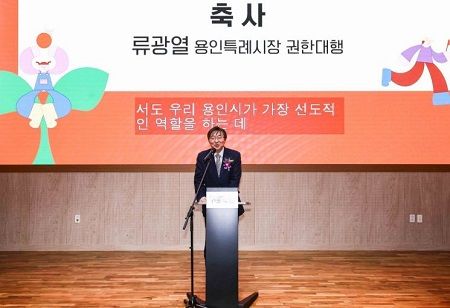
The National Human Rights Education Institute has officially opened its doors and begun full-scale operations on April 28 in Singal-dong, Giheung-gu, Yongin-si, marking a significant step forward in strengthening human rights education in South Korea. The launch ceremony brought together key leaders, including Acting Mayor Gwangyeol Ryu of Yongin Special City and National Human Rights Commission Chairperson Ahn Changho, along with around 100 officials and stakeholders.
The institute was established to address the growing need for a dedicated space focused on advancing human rights awareness and expanding structured human rights training programs across both public institutions and private organizations. Built with a total investment of 14.7 billion won, the facility is a transformation of a former customs logistics center into a modern educational hub. Spanning 4,637 square meters, the building includes one basement level and three above-ground floors equipped with advanced learning and experiential spaces.
Also Read: E-Learning Trends Transforming the Landscape of Philippine Education
Inside, the human rights education center features lecture halls, an online convergence education studio, a healing and training room, and multipurpose experiential classrooms designed to make learning more interactive. It also houses exhibition areas, a video experience room, and even a concert hall, reflecting a broader approach to engaging the public with human rights issues through both education and cultural experiences.
In his remarks, Acting Mayor Ryu emphasized the institute’s potential to go beyond traditional teaching, expressing hope that it will inspire deeper understanding of dignity and equality among citizens. Chairperson Ahn Changho reinforced this vision, noting that the commission will actively support the development of diverse and standardized human rights education programs, ensuring the institute becomes an inclusive learning space for all.