
-
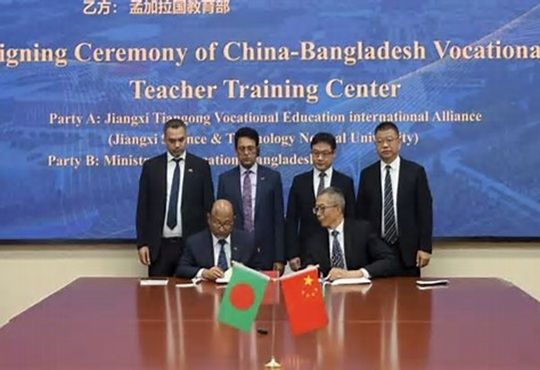
Bangladesh and China have formalised a significant step forward in bilateral educational collaboration by signing a memorandum of understanding aimed at strengthening technical education and skills development. The agreement focuses on establishing a dedicated training centre under the China-Bangladesh Vocational Education, Training and Research Centre, marking a new phase in cooperation designed to equip Bangladeshi youth with practical, industry-relevant skills.
The MoU was inked during the China-Bangladesh Education Exchange Conference held at Jiangxi Science and Technology Normal University. Representing Bangladesh, Md Daud Mia, secretary of the Technical and Madrasa Education Division under the Education Ministry, signed the document. On the Chinese side, Prof Zheng Pengwu, vice president of Jiangxi Science and Technology Normal University, put his signature on behalf of the institution. The ceremony took place on Friday morning local time, underscoring the growing emphasis both nations place on human resource development as a cornerstone of their partnership.
Prime Minister’s Education and Primary and Mass Education Adviser and Chief Spokesperson of the Prime Minister’s Office, Mahdi Amin, highlighted the broader significance of the initiative. Speaking at the conference, he noted that collaboration in education, technical training and skills development would elevate diplomatic relations between Bangladesh and China to a new height. Amin emphasised that such partnerships go beyond traditional diplomacy, directly addressing the practical needs of Bangladesh’s expanding workforce and industrial base.
The establishment of the training centre is expected to serve as a hub for vocational programmes tailored to emerging economic demands. Bangladesh has prioritised technical and vocational education and training (TVET) as a key strategy to reduce skills mismatches in the labour market, support industrial growth, and create employment opportunities for its large young population. China’s expertise in vocational education systems, built over decades of rapid industrialisation, offers valuable models and resources that can be adapted to local contexts.
Officials involved in the discussions indicated that the centre will facilitate joint curriculum development, trainer exchanges, research collaboration, and hands-on training programmes. Areas likely to receive early attention include manufacturing technologies, information technology, construction skills, and other sectors aligned with Bangladesh’s development priorities and China’s Belt and Road Initiative engagements in the region. By combining Chinese technical know-how with Bangladesh’s demographic advantages, the partnership aims to produce graduates who are better prepared for both domestic industries and international labour markets.
The timing of the MoU reflects ongoing efforts to diversify and deepen bilateral ties. Economic cooperation between Bangladesh and China has expanded steadily in recent years through infrastructure projects, trade, and investment. Education and skills development now form an increasingly important complementary pillar. Policymakers on both sides view human capital as essential for sustaining long-term growth and ensuring that infrastructure investments translate into productive employment.
At the conference, participants reviewed existing educational exchanges and explored opportunities for expanded student mobility, faculty collaboration, and joint research. The presence of senior officials and academics from both countries signalled strong institutional commitment. Mahdi Amin’s remarks framed the MoU not merely as a technical agreement but as a strategic investment in people-to-people connections that strengthen overall relations.
For Bangladesh, the initiative aligns with national goals of modernising technical education and increasing the proportion of skilled workers in the labour force. The Technical and Madrasa Education Division has been working to upgrade institutions, update curricula, and improve linkages with industry. Partnerships with experienced international partners such as Chinese universities and training organisations are seen as accelerators for these reforms. Jiangxi Science and Technology Normal University’s involvement brings specialised capacity in teacher training and applied sciences that can support capacity building within Bangladeshi institutions.
Observers note that successful implementation will depend on clear follow-up mechanisms, adequate resource allocation, and sustained coordination between the relevant ministries and the university. Monitoring frameworks, quality assurance processes, and mechanisms for evaluating graduate outcomes will be important to ensure the centre delivers measurable results. Both sides appear committed to moving from agreement to action, with the MoU providing a formal foundation for subsequent detailed planning.
The agreement also carries potential benefits for Chinese institutions seeking to internationalise their vocational education models and expand their regional presence. Collaboration with Bangladesh offers opportunities to adapt programmes to different linguistic, cultural, and economic settings while contributing to shared development objectives.
As Bangladesh continues to pursue higher economic growth and greater integration into global value chains, investments in technical skills remain critical. The China-Bangladesh Vocational Education, Training and Research Centre, once operational, is expected to become a visible symbol of practical cooperation that translates diplomatic goodwill into tangible opportunities for students and workers.
Mahdi Amin’s presence and public endorsement at the conference reinforced the political priority attached to the initiative. By linking skills development explicitly to the elevation of bilateral relations, the adviser positioned education cooperation as both a development tool and a diplomatic asset. The signing by senior officials from the Technical and Madrasa Education Division and a leading Chinese normal university further institutionalised the commitment.
Also Read: TVET Enrollment Surges in Malaysia as Trades Gain Popularity
Looking ahead, stakeholders will watch for announcements regarding the physical location of the training centre, initial programme offerings, funding arrangements, and timelines for commencement of activities. Successful rollout could encourage additional partnerships in higher education, research, and technology transfer.
In summary, the MoU signed in Jiangxi represents a concrete advance in Bangladesh-China educational collaboration. It focuses resources on vocational training and skills development at a time when both nations recognise the strategic value of human capital. Through the planned training centre, the two countries aim to create lasting channels for knowledge exchange that support economic progress and deeper mutual understanding. The conference and the agreement together signal a shared determination to move beyond rhetoric toward structured, results-oriented cooperation in technical education.
🍪 Do you like Cookies?
We use cookies to ensure you get the best experience on our website. Read more...