
-
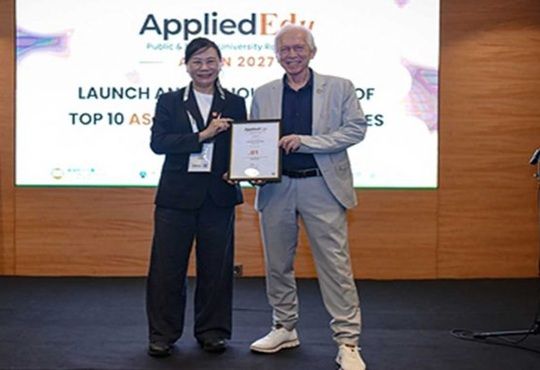
Singapore and Malaysia have emerged as the clear leaders in the largest AppliedEdu University Rankings for ASEAN to date, with the National University of Singapore retaining its position as the region’s top public university and Sunway University holding the private university crown for a fourth consecutive year.
The 2027 edition of the rankings, released on 21 October 2026 in Kuala Lumpur, evaluated 316 universities across nine ASEAN countries an increase of roughly one-third from the 237 institutions ranked the previous year. More than 100,000 validated student survey responses, academic peer nominations and verified institutional data underpinned the results. The findings were announced alongside AppliedEduXChange 2026, a gathering of more than 150 university leaders focused on the theme “Beyond Skills: Building Employable, Industry-Ready Graduates.”
NUS has now occupied the number-one public university slot for three successive years. Nanyang Technological University, Singapore, follows in second place, and four of Singapore’s five ranked universities appear in the overall top 50. On the private side, Sunway University retained its regional lead, while Asia Pacific University of Technology & Innovation rose from fifth to second. Taylor’s University and Universiti Teknologi PETRONAS occupy third and fourth places respectively.
Malaysia’s strength is particularly striking. The country claims seven of the top ten private university positions and five of the top ten public spots. It also places more institutions in the top 50 of each category than any other nation—21 private and 16 public universities. Universiti Kebangsaan Malaysia ranks as Malaysia’s highest public university and third overall in ASEAN.
Indonesia, with 102 institutions, has the largest national representation. Universitas Airlangga leads the country’s public universities at tenth regionally. Among private universities, Bina Nusantara University (BINUS) climbed from eighth to fifth, while Universitas Muhammadiyah Malang recorded the biggest rise of any institution, advancing 53 places to 57th. Muhammadiyah University of Sidoarjo moved up 39 places to 37th and Institut Teknologi Nasional Bandung gained 27 places.
The Philippines, with 79 ranked universities, is the second-largest contingent. The University of the Philippines heads the public list at 25th in ASEAN. University of Santo Tomas leads private institutions after climbing six places to eighth regionally; First City Providential College also advanced 27 places.
Thailand contributed 43 institutions. Chulalongkorn University ranks ninth among public universities, with 11 Thai universities inside the public top 50. Krirk University is Thailand’s highest-ranked private university at seventh regionally.
Vietnam posted notable gains among public universities. The University of Economics Ho Chi Minh City rose 23 places to 33rd, Ton Duc Thang University advanced 27 places to 34th, and Vietnam National University Ho Chi Minh City climbed 22 places to 44th. Duy Tan University leads Vietnamese private universities at 14th, while Nguyen Tat Thanh University jumped 30 places to 26th.
Universiti Brunei Darussalam returned to the public top ten, rising from 12th to eighth. In Cambodia the University of Puthisastra is the highest-ranked private institution at 28th. Myanmar’s University of Yangon sits in the 101–110 band among public universities. Across the region, 23 universities entered the top 100 for the first time, including Indonesia’s Universitas Brawijaya (36th public), Thailand’s Shinawatra University (21st private) and Malaysia’s IMU University (25th private).
Also Read: Sunway University Boosts Creativity Through Industry Partnerships
What sets the AppliedEdu rankings apart is their heavy emphasis on teaching and learning, which accounts for 40 per cent of the score. Employability contributes a further 20 per cent for private universities and 15 per cent for public ones, bringing the combined weight of education quality and graduate outcomes to 60 per cent and 55 per cent respectively. Research, institutional reputation, community engagement and internationalisation each carry 10 per cent, with research weighted slightly higher for public institutions.
Students play a central role. The AppliedEdu Student Survey 2026 collected more than 100,000 validated responses on teaching quality, facilities and campus life. A separate peer-nomination survey asks academics which universities they rate most highly, with each institution’s academics weighted equally and self-nominations excluded. Public and private universities are ranked in completely separate tables using different weightings that reflect their distinct missions.
Professor Sibrandes Poppema, President and Vice-Chancellor of Sunway University, described the fourth consecutive top ranking as “a proud moment for Sunway University and for Malaysia.” He emphasised the institution’s focus on producing graduates who leave with knowledge, confidence and experience to build meaningful careers and contribute to society what the university calls its mission as a “5th Generation University.”
Mandy Mok, Founder and Chief Executive Officer of AppliedEdu, said rankings should drive improvement rather than merely recognise achievement. “They should help universities build on their strengths, identify where change is needed, and make informed decisions that deliver better outcomes for students and the communities they serve.”
The rankings are overseen by an independent AppliedEdu Ranking Advisory Board and have been published annually since 2021. The first 100 places in each table are listed individually; positions from 101 onwards appear in bands of ten, ordered alphabetically. Full results and the detailed methodology are available at appliededu.com/rankings.
The AppliedEdu University Rankings 2027 for All Asia are scheduled for release on 30 November 2026. The ASEAN edition already stands as the most comprehensive assessment of Southeast Asian higher education the organisation has produced, reflecting both broader participation and a methodology that places student experience and graduate employability at the centre of evaluation.
🍪 Do you like Cookies?
We use cookies to ensure you get the best experience on our website. Read more...