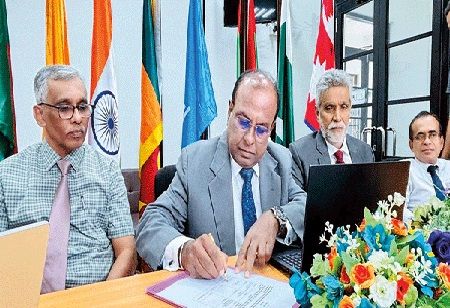
- SACTD hosts SERSA 2025, reinforcing its role as a regional teacher education hub under UNESCO after major institutional reforms.
- Symposium gathers educators from across South Asia, focusing on AI in education, inclusion, greening education, teacher wellbeing, and professional development.
- UNESCO renews SACTD’s Category 2 Centre status for eight years, while the Centre launches an Endowment Chair and Research Fund to strengthen regional educational research.
Sri Lanka’s South Asia Centre for Teacher Development (SACTD) has strengthened its position as a regional hub for teacher education under UNESCO, following major institutional reforms and the successful hosting of the Symposium on Educational Research in South Asia (SERSA) 2025 on December 20 at its campus in Meepe.
SACTD, a UNESCO-designated Category 2 Centre, organised SERSA 2025 as part of its flagship academic initiatives aimed at promoting educational research and professional development among teachers across South Asia. The symposium brought together educators and researchers from Sri Lanka, India, Nepal, Bhutan, Pakistan, the Maldives and Australia, with over 50 participants joining both physically and virtually.
More than 20 extended research abstracts submitted by teachers and educators were reviewed by a regional expert panel. The research themes focused on the use of artificial intelligence in education, inclusive and greening education, teacher wellbeing, and professional development, reflecting emerging priorities in regional education systems.
Addressing the symposium, Director General of SACTD H.T. Kamal Pathmasiri said the Centre has undergone significant transformation since 2023, following renewed government support and institutional restructuring. He highlighted reforms in governance, academic programming, human resources and regional outreach, which have repositioned SACTD as an active regional platform aligned with UNESCO priorities.
The Centre’s progress was formally recognised in November 2025, when the 46th Session of the UNESCO General Conference approved the renewal of SACTD’s Category 2 Centre status for a further eight years from 2026. This decision followed a recommendation by UNESCO’s Executive Board. Sri Lanka’s Cabinet of Ministers has also approved a new tripartite agreement between UNESCO, the Government of Sri Lanka and SACTD, reaffirming state support through financial and in-kind contributions.
Also Read: UNESCO, RIE NCERT Bhubaneswar Sign MoU To Promote Teacher Health
Prime Minister and Minister of Education, Higher Education and Vocational Education Dr Harini Amarasuriya, in a message to the symposium, said educational research would play a central role as Sri Lanka moves forward with the next phase of national education reforms.
The keynote address was delivered by Emeritus Professor Lakshman Samaranayake of the University of Hong Kong, who emphasised the importance of research in improving teaching and learning outcomes. UNESCO’s Head of the Teacher Development Unit, Carlos Vargas, addressed the symposium virtually from Paris, outlining UNESCO’s global work on teacher capacity development and challenges related to teacher shortages and professional competencies.
During the event, SACTD also announced the establishment of the SACTD-UNESCO Endowment Chair and a Research Fund in recognition of Professor Samaranayake’s contributions to teacher education. The Research Fund was launched with an initial personal donation of LKR 1 million, aimed at promoting research engagement among teachers and educators in the region.
Established in 2014, SACTD had faced governance and mandate-related challenges between 2019 and 2023. Since then, reforms have included the establishment of a multi-country Board of Management, legal incorporation as a company limited by guarantee, and expanded regional partnerships. With renewed UNESCO endorsement, SACTD is expected to play an expanded role in teacher capacity development across South Asia.