
-
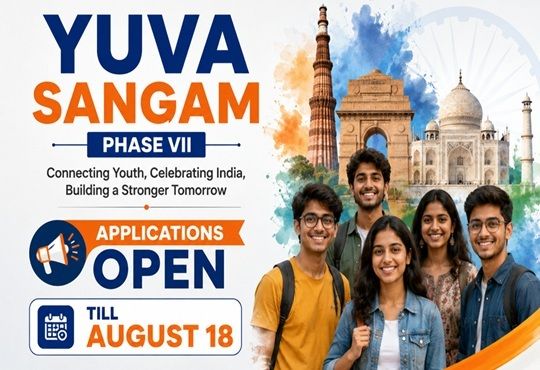
The Ministry of Education has officially opened the online application process for Yuva Sangam Phase VII, giving young Indians another opportunity to take part in one of the country’s flagship inter-state youth exchange programmes. Interested and eligible candidates can register on the Ek Bharat Shreshtha Bharat (EBSB) portal, with the application window remaining open until August 18, 2026.
Yuva Sangam is designed to promote national integration, mutual understanding, and cultural appreciation among the youth of different states and Union Territories. By bringing young people from diverse regions together, the programme aims to strengthen the spirit of “Ek Bharat Shreshtha Bharat” through direct personal experience rather than classroom learning alone.
The initiative is open to individuals aged between 18 and 30 years. Eligible participants include students enrolled in Higher Education Institutions (HEIs), volunteers of the National Service Scheme (NSS) and Nehru Yuva Kendra Sangathan (NYKS), young professionals, and other youth who meet the age criteria. This broad eligibility ensures that the programme reaches a wide cross-section of India’s young population.
Under Phase VII, 20 selected Higher Education Institutions will function as nodal centres. These institutions include leading IITs, IIMs, Central Universities, and NITs. Each nodal centre will be responsible for hosting participants, coordinating activities, and ensuring the smooth conduct of the exchange programme.
Participants selected for the programme will travel to their paired State or Union Territory for educational and cultural tours lasting five to seven days, excluding travel time. During these visits, they will gain first-hand exposure to local traditions, education systems, governance models, innovation ecosystems, industries, heritage sites, and everyday community life. The experience is intended to go beyond sightseeing and create meaningful interactions between youth from different parts of the country.
The pairing of states and institutions has been carefully structured to maximise diversity and learning. For example, students from Banaras Hindu University in Uttar Pradesh will be paired with IIT Palakkad in Kerala. SPA Bhopal in Madhya Pradesh is linked with Central University of Karnataka. IIT Guwahati in Assam is paired with Central University of Hyderabad in Telangana. Similar pairings connect institutions across Goa and Mizoram, Rajasthan and Sikkim, Jammu & Kashmir/Ladakh and Maharashtra, West Bengal and Uttarakhand, Chandigarh and Gujarat, Himachal Pradesh and Odisha, and Delhi and Tamil Nadu.
These carefully designed pairings allow participants to experience regions that are geographically, culturally, and linguistically different from their home states. The exposure is expected to broaden perspectives, challenge stereotypes, and foster long-term friendships and professional networks across state boundaries.
During the exchange, participants will engage in a mix of structured and experiential activities. These typically include visits to educational institutions, interactions with local administrators and innovators, cultural performances, heritage walks, and community engagement programmes. The aim is to give young people a balanced understanding of both the developmental challenges and the unique strengths of the host region.
Yuva Sangam has grown steadily in scope and participation since its earlier phases. Each new phase has refined the model of pairing institutions and states while maintaining the core focus on youth-to-youth interaction. Phase VII continues this trajectory by involving a fresh set of nodal centres and opening the programme once again to a new cohort of applicants.
Officials associated with the programme emphasise that the real value of Yuva Sangam lies in the personal connections it creates. When a student from the Northeast spends a week in a western state, or a young professional from the north experiences life in the south, the learning is immediate and lasting. Such experiences contribute to a more cohesive national identity at a time when India’s youth population is larger and more mobile than ever before.
Applicants are advised to complete the registration process well before the August 18 deadline. The online application on the EBSB portal requires basic personal and educational details, along with any supporting documents specified by the organisers. Selection is expected to be competitive, given the limited number of slots available through the 20 nodal centres.
For higher education institutions, participation as a nodal centre carries both responsibility and opportunity. Hosting youth from other states allows campuses to showcase their academic strengths, research culture, and regional identity while also learning from the visiting participants. Many institutions view the programme as an extension of their own efforts to promote national integration and student diversity.
Also Read: Preparing Students for Business Analytics, Cybersecurity & GCC Careers
The timing of Phase VII is significant. Coming in the second half of 2026, it offers students and young professionals a meaningful engagement opportunity during a period when academic calendars and professional schedules can accommodate short-duration travel. The five-to-seven-day format has been found practical for both participants and host institutions.
Beyond the immediate experience, alumni of previous Yuva Sangam phases often report long-term benefits. These include improved intercultural communication skills, greater awareness of India’s diversity, and professional networks that span multiple states. Some participants have gone on to collaborate on academic projects, social initiatives, and entrepreneurial ventures that cut across regional lines.
As India continues to invest in its demographic dividend, programmes such as Yuva Sangam play a complementary role to formal education. While classrooms and online courses build knowledge and skills, structured exchange programmes build empathy, understanding, and a lived sense of national unity.
Young people interested in applying are encouraged to visit the official EBSB portal, review the detailed guidelines, and submit their applications before the August 18 cutoff. With 20 leading institutions ready to host participants and a carefully designed set of state pairings in place, Yuva Sangam Phase VII is poised to offer another meaningful chapter in India’s ongoing effort to connect its youth across regional boundaries.
🍪 Do you like Cookies?
We use cookies to ensure you get the best experience on our website. Read more...