
-
- Leading in international campuses, offering affordable, accredited degrees.
- Aligning programs with regional job markets in tech, finance, and AI.
- Graduates gain global credentials and thrive in Asia’s interconnected economies.
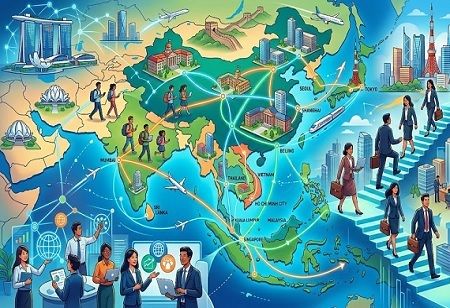
As 2026 unfolds, Asia's higher education landscape is undergoing a profound, border-defying transformation. No longer content with the idea of putting students to the west but is establishing its own multi-campus empires networks of international branch campuses (IBCs), joint programs, and intra-regional exchanges that value career readiness, affordability and regional relevance.
This shift accelerates sustainable learning hubs, where students gain global credentials while staying closer to emerging job markets in tech, finance, AI, and sustainability.
A surge in transnational careers, professionals who navigate Asia's interconnected economies with ease, blending cultural fluency, multilingual skills, and industry-aligned expertise.
Asia Hosts the World's Largest Share of IBCs
Asia is one of the continents that boasts of approximately 60 percent of the world in terms of branch campuses, surpassing other continents in transnational education (TNE). China has around 50 IBCs and hubs in Singapore, Malaysia, UAE (as a bridge to Asia) and emerging economies such as India and Kazakhstan attract Western institutions that are searching stable high demand markets. This boom is also driven by policies such as the National Education Policy 2020 of India and lax regulations in Malaysia and the UAE, with focus on quality rather than quantity.
The momentum is reflected in new openings in 2026. The GIFT City and Bengaluru in India are drawing in U.K. and Australian competitors, with Deakin University (Australia) already established as of 2024 and developments of degree courses in business and computing, engineering, and cybersecurity by institutions such as the University of Southampton, Lancaster University and Illinois Institute of Technology (U.S.).
These campuses also provide the same accredited degrees as the home institutions at a cheaper price and less visa requirements.
Malaysia is yet another TNE giant, with Monash University (with the second campus dedicated to AI, health, and energy transition), University of Nottingham and Heriot-Watt branches. Singapore, despite being pricey, is rich in innovation-related education in terms of partnerships as well as its universities reaching the first positions.
The UAE's Education City model though Middle Eastern mirrors Asia's approach, with clusters serving diverse nationalities and feeding into regional careers.
Also Read: Vietnam's Rising STEM Excellence Amid Semiconductor Boom
Top 5 Standout Institutions Driving Multi-Campus and Transnational Impact
Here are five leading examples in Asia's multi-campus ecosystem, selected for their scale, career outcomes, innovation focus, and role in fostering borderless talent:
- National University of Singapore (NUS) - Asia's perennial leader (top in QS Asia 2026 rankings), NUS embodies multi-campus excellence through global partnerships, extensive English-taught programs, and strong ties to multinationals. Its focus on AI, business, and sustainability produces graduates highly sought in Singapore's tech-finance hub and across ASEAN.
- Monash University Malaysia - One of the most established Australian branches in Asia, Monash's campuses deliver identical degrees with emphasis on research in emerging fields like data science and health. Its expansion signals commitment to career pipelines in Southeast Asia's growing industries.
- University of Nottingham Malaysia - A flagship U.K. branch, it offers full programs in engineering, business, and sciences at competitive costs. Nottingham's global network facilitates seamless transfers and placements, boosting transnational employability.
- Deakin University GIFT City (India) - Pioneering Australia's first full branch in India, Deakin focuses on postgraduate strengths in business analytics and cybersecurity. It bridges Indian talent with global firms, exemplifying how new campuses create local-to-international career ladders.
- Incheon Global Campus (South Korea) - Hosting SUNY Korea, George Mason University Korea, Ghent University Global Campus, and University of Utah Asia Campus, this government-backed hub delivers U.S./European degrees in one location. It supports intra-Asian mobility and tech-driven careers in a high-innovation economy.
Intra-Regional Mobility and Sustainable Career Hubs
Programs such as the AIMS of ASEAN and programs of the Asian Universities Alliance encourage credit transfers and exchanges so that people do not have to travel far to study.
Indians, Vietnamese, and Indonesians tend to have regional options as the Western visa offers are becoming unpredictable (e.g. U.S. revocations in 2025).
Hybrid models part online, part on-campus enhance accessibility.
Sustainability defines these hubs, Singapore and Malaysia link programs to multinationals for internships, India's new campuses target employability (77 percent of students prioritize it per recent surveys). East Asia's tech job growth (net gains from AI and automation) favors skilled graduates, especially women.
The Transnational Career Edge
Alumni of such ecosystems get hired into fluid roles across the USD 300 billion FDI projections projected in ASEAN in 2030, Belt and Road networks in China, or in the technology boom in India. They are multicultural, have regional language advantage and have credentials that are global but based on the history of Asian expansion.
There are still challenges of providing equity to rural/underprivileged students, sustaining quality with the mass expansion, and eliminating the digital divide.
However, 2026 will make Asia the new epicentre of education among 20,000-plus English-taught courses in 600-plus ranked universities, competing with Western domination.
Summing It up!
In this 'Asian Decade', multi-campus education isn't just expanding access, it's engineering a workforce for an interconnected future where careers flow freely across borders, innovation thrives regionally, and talent shapes tomorrow's Asia.
🍪 Do you like Cookies?
We use cookies to ensure you get the best experience on our website. Read more...