
-
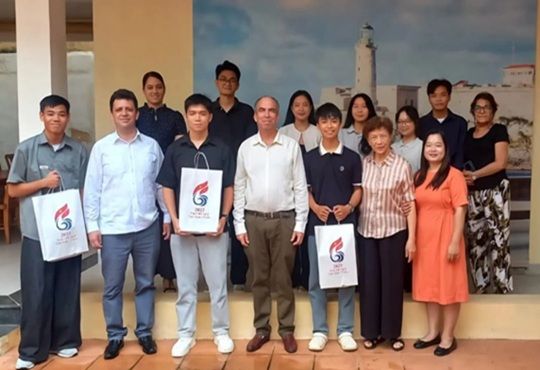
Cuba and Vietnam strengthened their longstanding friendship on Monday by formalizing a fresh round of scholarships for medical studies, underscoring a partnership that has endured for 65 years. In a symbolic ceremony at the Cuban Embassy in Hanoi, officials welcomed a group of young Vietnamese students selected to pursue undergraduate and postgraduate medical training on the Caribbean island.
The agreement calls for an annual exchange of 15 scholarships in each direction. Cuba prioritizes health sciences, leveraging its internationally recognized medical education system and track record of training doctors from developing nations. For decades, Cuban universities have educated Vietnamese students across multiple disciplines, turning academic cooperation into one of the most visible symbols of bilateral solidarity.
Vietnamese exchange students will soon travel to Cuba to begin their studies. Officials described the scholarships as more than academic opportunities. They represent a living connection to shared history and Cuba’s policy of internationalist solidarity, which continues despite the long-standing U.S. economic blockade. Vietnam, which once received Cuban support during its struggle for national reunification, is reciprocating by sending its youth to train on the island and later return to serve their country.
The ceremony highlighted the depth of people-to-people ties. Cuban diplomats and Vietnamese representatives emphasized that education remains a cornerstone of the relationship. Graduates from earlier cohorts have returned home to contribute to Vietnam’s healthcare system, carrying with them both professional skills and personal bonds formed during years spent in Cuba.
This latest exchange builds on a broader framework of cooperation. Recent high-level contacts, including parliamentary friendship groups and bilateral roadmaps, show both countries continue to expand collaboration in health, education, culture, and mutual support on the international stage. Vietnam’s Red Cross recently donated funds to Cuba in recognition of historical milestones, further illustrating the reciprocal nature of the relationship.
Also Read: Cuba and China will collaborate on artificial intelligence research
Cuban medical training is known for its emphasis on community-oriented primary care, preventive medicine, and service in challenging conditions. Students selected under the program commit to returning to Vietnam after completing their degrees, joining a network of alumni who have strengthened healthcare capacity in their home provinces. Officials noted that the program prioritizes applicants motivated by public service rather than private practice alone.
The timing of the announcement carries symbolic weight. It coincides with ongoing efforts by both nations to deepen South-South cooperation and resist external pressures. Cuban authorities routinely point to the U.S. blockade as a major obstacle to economic development, yet the country continues to share limited resources through scholarships and medical missions abroad. Vietnam’s decision to keep sending students is presented as an expression of enduring trust and gratitude.
Beyond the scholarships themselves, the partnership includes ongoing dialogue on medical research, public health strategies, and the exchange of expertise in areas such as tropical medicine and disaster response. Cuban institutions have long hosted Vietnamese learners, while Vietnamese professionals have shared experiences from their own rapid development trajectory.
Parliamentary ties reinforce the educational link. In a recent session of Vietnam’s National Assembly, the composition of friendship groups for the current legislature was confirmed, including the re-election of Vu Hai Ha as president of the Vietnam-Cuba Parliamentary Friendship Group. Such institutional mechanisms help sustain high-level political support for practical cooperation programs like the medical scholarships.
For the young Vietnamese students preparing to depart, the journey carries both opportunity and responsibility. They will study in a system that has produced generations of physicians known for working in underserved regions and participating in international medical brigades. Upon return, they are expected to apply their training within Vietnam’s public health network, contributing to national goals of universal access and improved medical services.
Cuban officials stress that the program is reciprocal. While the current focus highlighted Vietnamese students heading to Cuba, the agreement also provides opportunities for Cuban students and professionals to pursue studies or specialized training in Vietnam. This two-way flow aims to enrich both educational systems and foster long-term professional networks.
Observers of Cuba-Vietnam relations note that education and health cooperation have remained remarkably consistent across decades of changing global conditions. From the period of Vietnam’s reunification struggles through economic reforms and into the present, the two countries have maintained a relationship often described in official language as one of “brotherhood.”
The latest scholarship awards fit this pattern. They demonstrate that symbolic gestures and practical exchanges continue to reinforce political affinity. By investing in the next generation of medical professionals, both nations invest in the continuity of a partnership that has already spanned more than six decades.
As the selected students prepare for travel, the Cuban Embassy in Hanoi and Vietnamese education authorities will coordinate logistics, orientation, and support services. The program includes academic preparation, cultural adaptation assistance, and ongoing monitoring to ensure high completion rates and successful reintegration upon return.
In an era of shifting geopolitical alignments, the Cuba-Vietnam medical scholarship exchange stands as a concrete example of sustained South-South collaboration rooted in historical solidarity rather than short-term strategic calculation. Officials on both sides present it as evidence that long-term relationships built on mutual support can outlast external pressures and economic difficulties.
The students departing for Cuba carry expectations from their families, communities, and national institutions. Their success will be measured not only by academic performance but by their eventual contributions to Vietnam’s healthcare system and their role as living links between two nations that continue to value education as a tool of friendship and development.
Source material adapted from official statements and reporting on the August 24, 2026 ceremony.
🍪 Do you like Cookies?
We use cookies to ensure you get the best experience on our website. Read more...