
-
Stavian Group has officially launched its 'Nurturing Hope - Building the Future' community project in Bac Ninh province, combining education and healthcare support for local residents. The initiative, carried out in cooperation with the Vietnam Academy of Science and Technology (VAST) and local authorities, centers on providing modern learning facilities, medical equipment, and financial aid to students from disadvantaged backgrounds.
At the heart of the education component is the construction and full equipping of a STEM classroom at Trung Chinh Secondary School. Stavian Group financed the entire facility and its equipment, while VAST contributed expertise on classroom design, curriculum development, teaching tools, and professional training for teachers. The new space is intended to give students practical exposure to science, technology, engineering, and mathematics, enabling teachers to integrate these subjects more effectively into daily lessons.
STEM education has become a national priority in Vietnam as the country seeks to build a workforce capable of meeting the demands of Industry 4.0 and digital transformation. Access to well-equipped classrooms and trained instructors remains uneven, particularly in suburban and rural areas. By establishing a dedicated STEM facility at Trung Chinh Secondary School, the project aims to narrow that gap and encourage more students to pursue technical and scientific pathways.
Alongside the classroom, Stavian Group donated medical equipment to Trung Chinh Commune Health Station. The contribution strengthens primary healthcare services for local residents, supporting routine check-ups, basic treatment, and emergency response capacity. The dual focus on education and health reflects the company’s stated view that long-term community progress requires investment in both learning opportunities and physical well-being.
As part of the same initiative, Stavian Group awarded VND50 million (approximately US$1,900) in scholarships to disadvantaged students. The funds were channeled through the 'Cap La Yeu Thuong' (Leaves of Love Bag) program, jointly organized by Vietnam Television (VTV), the Ministry of Education and Training, and the Vietnam Bank for Social Policies. The scholarships are designed to ease financial pressures on families and help students remain in school and complete their education.
Vu Thuy Linh, director of Stavian Group’s Public Relations Division, emphasized the broader purpose of the project. “Investing in education and healthcare is an investment in the future,” she said. “Through the project, we aim to provide students with opportunities to learn and develop while supporting local access to healthcare services.”
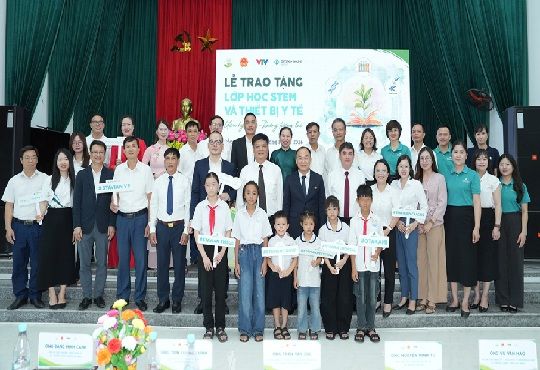
The handover ceremony brought together representatives of Stavian Group, Trung Chinh Secondary School, local authorities, and VAST. Photographs from the event show the formal transfer of the STEM classroom keys and medical equipment, marking the official start of the facilities’ use.
Stavian Group operates across four main pillars: industry, technology, energy, and trade. The company has indicated that community programs in education, healthcare, environmental protection, disaster response, and broader community development will remain part of its ongoing corporate social responsibility efforts. The Bac Ninh project is presented as one concrete step within that longer-term commitment.
Education experts and local officials have repeatedly noted that modern STEM classrooms can improve student engagement and learning outcomes when paired with teacher training and relevant curriculum. VAST’s involvement in advising on the classroom model and providing professional development is expected to help teachers make full use of the new equipment and teaching methods. Over time, the facility may also serve as a reference point for other schools in the province seeking to upgrade their science and technology instruction.
The medical equipment donation addresses another practical need. Commune-level health stations often operate with limited resources, and additional tools can improve the quality and reach of primary care. By supporting both the school and the health station in the same locality, the project creates complementary benefits for young people and their families.
Scholarships remain a critical form of support for students from low-income households. Even modest financial assistance can cover school fees, books, transportation, or other essentials that might otherwise force a student to leave school. Linking the scholarships to a nationally recognized program such as “Cap La Yeu Thuong” ensures transparency and alignment with existing government and media-backed efforts to assist vulnerable learners.
Stavian Group’s approach combines direct infrastructure investment with capacity-building and financial aid. The STEM classroom provides physical and instructional resources, the teacher training strengthens human capacity, the medical equipment improves community health services, and the scholarships address immediate economic barriers. Together these elements form a multi-pronged intervention aimed at nurturing both individual potential and local development.
As Vietnam continues to expand access to quality education and healthcare, private-sector partnerships of this kind are increasingly viewed as valuable supplements to public programs. Projects that deliver tangible facilities, professional support, and targeted assistance can produce measurable benefits in a relatively short time while signaling longer-term corporate engagement with community needs.
Also Read: Empowering Future Leaders: Scholarships for Women in STEM across Asia
The 'Nurturing Hope - Building the Future' project in Bac Ninh illustrates one company’s decision to translate its business presence into concrete educational and health support. With the STEM classroom now operational, medical equipment in place, and scholarships distributed, the immediate beneficiaries students, teachers, and residents of Trung Chinh are positioned to begin realizing the intended gains. Stavian Group has stated its intention to continue similar community programs, suggesting that the Bac Ninh initiative may serve as a model for future efforts in other localities.
🍪 Do you like Cookies?
We use cookies to ensure you get the best experience on our website. Read more...