
-
Synopsis
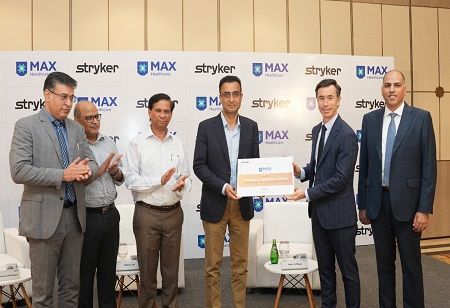
Medical technology company Stryker has partnered with Max Super Speciality Hospital, Saket, to launch a robotic surgery training initiative. The collaboration aims to enhance surgical skills through advanced robotic systems, helping doctors gain hands-on expertise and supporting innovation in minimally invasive procedures.Global medical technology company Stryker has partnered with Max Smart Super Speciality Hospital, Saket to establish a major surgeon training and education initiative focused on robotic-arm assisted joint replacement in India. The collaboration is aimed at strengthening clinical expertise, advancing medical education, and improving access to technology-driven orthopedic care as demand for precision-based surgeries continues to rise across the country.
Industry experts believe the partnership reflects a broader transformation taking place in India’s healthcare education ecosystem, where hospitals and medtech companies are increasingly investing in hands-on training programs for next-generation surgical technologies.
Under the agreement, Max Smart Hospital in Saket will function as a dedicated training and education center for orthopaedics, offering specialized learning opportunities for surgeons seeking expertise in robotic-assisted procedures. The initiative comes at a time when India is witnessing a sharp increase in arthritis cases, degenerative joint disorders, and age-related orthopedic conditions that are pushing healthcare institutions to adopt more advanced surgical systems.
Medical professionals say robotic-assisted procedures can help improve surgical precision, personalized treatment planning, and post-surgery recovery outcomes, making them increasingly important in modern orthopedic practice.
The partnership is expected to play an important role in addressing the growing need for structured surgeon training programs in India’s rapidly evolving healthcare sector. Unlike conventional medical education models that rely heavily on observation-based learning, robotic-assisted orthopedic systems require surgeons to develop specialized technical skills through simulation, hands-on procedures, and technology-focused clinical training. By combining hospital expertise with Stryker’s advanced robotic systems, the collaboration aims to create a long-term educational framework that supports wider adoption of robotic joint replacement surgeries across India.
Speaking on the collaboration, Abhay Soi, Chairman and Managing Director, Max Healthcare Institute Ltd., said, "At Max Healthcare, we are committed to building a future-ready healthcare ecosystem that combines clinical expertise, technology, and continuous learning. This collaboration with Stryker is an important step towards strengthening orthopaedic care delivery in India through structured training frameworks and advanced clinical education. The development of Max Smart Super Speciality Hospital, Saket, as a training and education center for orthopaedics reflects our focus on enabling wider access to next-generation orthopaedic care and creating long-term impact through skill development and collaborative learning". His remarks highlight how medical education is increasingly becoming interconnected with innovation, digital tools, and real-world surgical application.
Also Read: Top 5 Universities in Malaysia offering Healthcare & Nursing programs
Dr. Ramneek Mahajan, Chairman Orthopaedics, Joint Replacement and Chief Robotic Joint Replacement at Max Smart Hospital, emphasized that robotic-arm assisted surgery represents a major advancement in modern orthopedic treatment. He says, "Robotic-arm assisted joint replacement represents an important advancement in orthopaedic surgery, offering greater precision, personalized planning and potentially improved recovery outcomes for patients. However, the true impact of technology depends on how effectively it is adopted and practiced. Through this training and education center, we aim to create a robust platform for hands-on surgeon training and dissemination of best practices that can further strengthen robotic-assisted joint replacement in India". Healthcare analysts note that such initiatives are becoming critical as hospitals move toward evidence-based, technology-supported treatment models.
The collaboration also aligns with India’s broader healthcare priorities around innovation, medical skilling, and quality patient care. According to industry estimates, India performs nearly three lakh joint replacement surgeries annually, but robotic-assisted procedures still account for only a small percentage due to limited access to advanced systems and trained specialists. Through this educational partnership, both organizations aim to bridge that expertise gap while supporting the expansion of robotic surgery education in hospitals across the country.
Executives from Stryker said the company is working closely with hospitals across the Asia-Pacific region to strengthen robotic-assisted surgical capabilities and improve healthcare outcomes through education-focused collaborations. John Collings, President, APAC, Stryker, said the partnership with Max Smart Hospital reflects the company’s long-term commitment to scaling robotics-assisted surgery and expanding access to modern orthopedic treatment technologies in India. As hospitals increasingly integrate AI-powered surgical systems into mainstream healthcare delivery, experts believe collaborations centered around clinical learning and surgeon development will play a defining role in shaping the future of orthopedic education and patient care.
🍪 Do you like Cookies?
We use cookies to ensure you get the best experience on our website. Read more...