
-
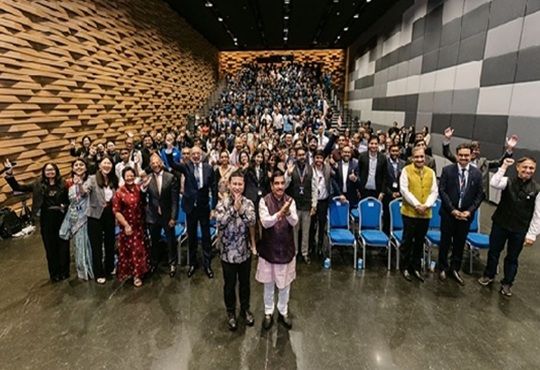
The growing collaboration between India and Singapore in education, technology, and innovation is creating new opportunities for students to develop industry-ready skills and explore global career pathways. Strengthening this partnership, the Singapore-India Hackathon (SIH) 2026 brought together 120 tertiary students from both countries at Singapore Management University (SMU) to develop solutions addressing real-world industry and societal challenges.
The fourth edition of the three-day hackathon commenced on November 15 and will conclude on November 17 under the theme 'Build a Better Future'. Singapore's Minister for Education and Minister-in-charge of Social Services Integration, Desmond Lee, and India's Union Minister of Education, Consumer Affairs, Food and Public Distribution, and New and Renewable Energy, Pralhad Joshi, jointly inaugurated the event.
The competition is co-organised by SMU's Institute of Innovation and Entrepreneurship (SMU IIE), the All India Council for Technical Education (AICTE), and the Innovation Cell of India's Ministry of Education, in collaboration with TiE Singapore. First proposed in 2018 by Indian Prime Minister Narendra Modi to Singapore's then-Prime Minister Lee Hsien Loong, the hackathon has returned to Singapore after two editions hosted in India.
This year's participants represent 55 higher education institutions across the two countries, including Dayananda Sagar College of Engineering, IIT Kharagpur, Rathinam Technical Campus, the National University of Singapore, Nanyang Technological University, and SMU. Working in 20 mixed-country teams, students are competing across four thematic tracks: Emerging Technologies; FinTech and InsurTech; Sustainability and Climate Action; and Social Innovation and Inclusive Development. The teams will present their solutions at the Grand Finals on November 17, competing for S$88,000 in cash prizes.
Beyond the competition, the initiative aims to connect students with postgraduate education, industry mentors, employers, and entrepreneurial opportunities. A major development announced during the event was the Nupur A. & Amrish Bahadur Scholarship, established through a contribution from the patrons of SIH 2026, Nupur and Amrish Bahadur.
The scholarship is open to participants from the 2026 edition and the two previous editions, irrespective of nationality. It will support four outstanding members of the hackathon community in pursuing postgraduate studies at SMU. Eligible programmes include the Master of IT in Business, Master of Science in Business AI, and Master of Science in Entrepreneurship and Innovation.
Professor Sun Sun Lim, SMU Vice President of Partnerships and Engagement and Lee Kong Chian Professor of Communication and Technology, highlighted the university's efforts to strengthen its connections with India through educational and industry partnerships. These initiatives include business study missions to Mumbai, overseas internships in technology hubs such as Bengaluru, Chennai, and Pune, and joint fintech courses developed with the Indian Institute of Management Ahmedabad for working professionals.
SMU has also established an India International Advisory Council, chaired by Uday Kotak, Founder and Director of Kotak Mahindra Bank, to strengthen its engagement with Indian business leaders. In October 2026, the university signed a strategic memorandum of understanding with Bengaluru-based quantum technology company QpiAI at SWITCH to support innovation in deep technology.
The collaboration provides SMU researchers and students with access to quantum hardware and cloud-based development tools. It also aims to encourage students from business, finance, engineering, and computing disciplines to explore quantum-enabled solutions.
Industry exposure is another important component of SIH 2026. A dedicated talent networking session will connect participants with more than 10 companies operating across Singapore and India, including GIC, Singapore Airlines, Singtel, and Temasek. These organisations are offering opportunities related to projects, internships, and potential careers beyond the competition.
Students will also have opportunities to interact with founders, industry leaders, and mentors. Teams interested in developing their ideas further can explore support through industry partners and SMU IIE's Business Innovations Generator (BIG), an equity-free incubator that supports early-stage start-ups.
The hackathon is being held alongside TiE Singapore's annual conference, TiECon 2026, giving participants access to discussions with entrepreneurs and business leaders who have built and scaled technology companies. The speakers include SMU Chairman Piyush Gupta, InMobi co-founder Piyush Shah, Razorpay co-founder Shashank Kumar, Brahma AI founder and CEO Prabhu Narasimhan, and Aspire co-founder Andrea Baronchelli.
The four competition tracks focus on challenges developed with industry and institutional partners. Singtel's Emerging Technologies track explores how AI can help enterprise sales teams understand customers, identify opportunities, and recommend appropriate actions. Income Insurance's FinTech and InsurTech challenge focuses on using data and AI to make climate-risk insurance more accessible and affordable for vulnerable households and small and medium-sized enterprises in Singapore.
Also Read: NTU Singapore Launches AI Programs To Aid Career Transitions
Singapore's Ministry of Energy, Trade and Industry is supporting the Sustainability and Climate Action track, which examines how technology can help Indian smallholder farmers improve the quality, consistency, and reliability of their produce for larger buyers, including Singapore importers. Meanwhile, the Social Innovation and Inclusive Development track, developed with the Singapore Centre for Social Enterprise (raiSE), challenges students to create solutions that help disadvantaged and lower-income seniors in Singapore and India improve their wellbeing and remain active in their communities.
Professor Yogesh Singh, Chairman of AICTE, emphasised the value of bringing young people from both countries together to work across disciplines, institutions, and national boundaries. He highlighted that such educational collaborations help students develop new perspectives and build relationships that can extend beyond the competition.
With opportunities spanning postgraduate scholarships, industry engagement, internships, and entrepreneurship, SIH 2026 extends beyond a conventional student competition. The initiative highlights how international academic partnerships can connect higher education with practical industry challenges while creating pathways for students to develop skills, exchange ideas, and pursue future opportunities across India and Singapore.
🍪 Do you like Cookies?
We use cookies to ensure you get the best experience on our website. Read more...