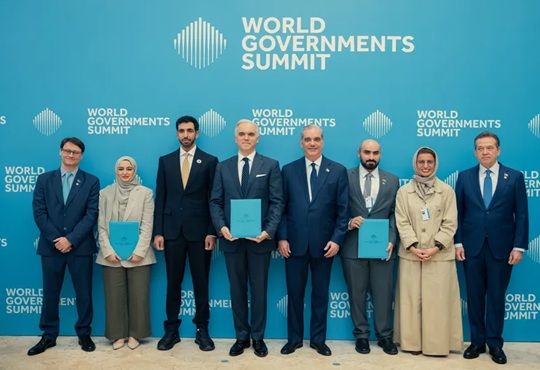
In Cap Cana, the President of the Dominican Republic, Luis Abinader, and UAE Minister of State Sheikh Shakhboot bin Nahyan bin Mubarak Al Nahyan witnessed the launch of two major education initiatives designed to equip citizens and schools with the skills and tools needed for a digital future.
The announcements formed a central part of the World Governments Summit Dialogue for Latin America and the Caribbean, translating high-level discussions into concrete programmes focused on artificial intelligence skills and expanded digital learning access.
The flagship ‘One Million AI Coders’ initiative, developed by the UAE Government Experience Exchange Office at the Ministry of Cabinet Affairs in cooperation with the Dominican Government, aims to equip one million Dominican citizens with foundational skills in artificial intelligence and prompt engineering.
Officials present at the launch included José Ignacio Paliza, Minister of the Presidency of the Dominican Republic; Noura Al Kaabi, UAE Minister of State; Omar Shehadeh, Envoy of the Minister of Foreign Affairs to the Caribbean and Pacific States; Manal bin Salem, Executive Director of the UAE Government Experience Exchange Office; and Saeed Miran, Executive Director at the same office.
The programme focuses on enabling participants to use AI tools effectively, raise productivity and innovation, and accelerate digital transformation across sectors. By building a large base of citizens comfortable with AI technologies, the initiative seeks to develop national talent capable of meeting the demands of the digital economy and supporting sustainable growth. It represents one of the most ambitious skills programmes announced at the Dialogue, directly linking government cooperation with measurable human-capital outcomes.
Alongside the AI skills drive, Abinader and Sheikh Shakhboot also witnessed the signing of a three-year partnership agreement to launch the ‘Classrooms of Hope’ project. The partners are the Foundation, The Digital School (an initiative of the Mohammed bin Rashid Al Maktoum Global Initiatives), and the Ministry of Education of the Dominican Republic.
Signatories were Luis Miguel De Camps, Minister of Education of the Dominican Republic; Latifa Al Qemzi, Director General of the Foundation; and Dr. Waleed Al Ali, Secretary General of The Digital School.
Classrooms of Hope targets approximately 60,000 beneficiaries across at least ten public schools. It will create an integrated digital learning environment that supports continuity of education, particularly during weather-related school closures that frequently disrupt learning in the region. Concrete deliverables include equipping classrooms with digital facilities and technology, providing 400 computers and satellite internet connectivity, and supplying Spanish-language digital learning content aligned with the national curriculum for Grades 1 to 12.
Equally important is the human side of the investment: the project will deliver 1,000 teacher training opportunities accredited by Arizona State University. These programmes are designed to strengthen teachers’ capacity to use technology and digital learning tools effectively in the classroom, ensuring that hardware and content translate into improved teaching practice and student outcomes.
Together, the two initiatives address both the skills gap at the population level and the infrastructure and capacity gaps inside schools. One Million AI Coders focuses on broad workforce readiness for an AI-driven economy, while Classrooms of Hope concentrates on equitable access to quality digital education for school-age learners and the professional development of their teachers. The combination reflects a practical approach to education reform: scale skills training nationally while simultaneously modernising the school environment that will prepare the next generation.
Also Read: HBMSU, The Digital School Partner to Build Future-Ready Digital Skills
These education-focused announcements sat within a wider set of partnerships signed during the Dialogue. The event itself, organised by the World Governments Summit Organization in partnership with the Government of the Dominican Republic and the Center for Public Policy Analysis, brought together more than 70 speakers, representatives from over 30 countries, and more than 120 private-sector companies and institutions across 35 sessions.
Themes included human capital and the future of work, reinforcing the centrality of skills and education to the broader agenda of government cooperation between the UAE and Latin American and Caribbean nations.
By grounding cooperation in specific, measurable education programmes rather than general declarations, the UAE and Dominican Republic have set a clear direction. Success will be judged by the number of citizens who gain practical AI skills, the number of schools that maintain learning continuity through digital tools, and the number of teachers equipped to use those tools well. The initiatives announced in Cap Cana provide a concrete starting point for that work.