
-
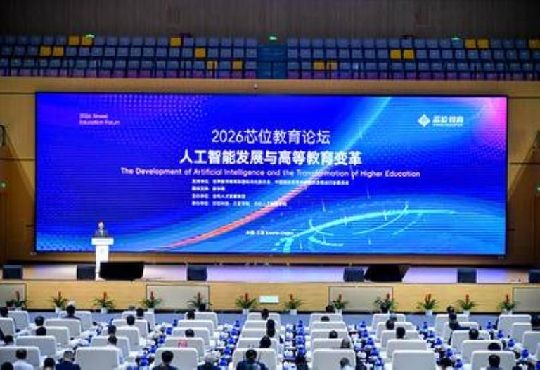
The 2026 Xinwei Education Forum has brought together more than 1,000 representatives from government, industry, academia and research institutions across over 30 countries and regions to examine how artificial intelligence (AI) is reshaping higher education and talent development. Held in Sanya, Hainan Province, China, the forum concluded on November 20 under the theme 'Artificial Intelligence Development and Higher Education Transformation', highlighting the growing importance of collaboration between universities and industries in preparing students for an AI-driven economy.
Hosted by Geely Talent Development Group and co-organised by Xinwei Technology, University of Sanya and Xinwei Institute of Artificial Intelligence, the event provided a platform for international participants to exchange perspectives on education reform, institutional innovation and practical applications of emerging technologies. Discussions focused on how universities can adapt their educational models, strengthen industry connections and develop graduates with the capabilities required in rapidly evolving professional environments.
Li Shufu, Chairman of Geely Holding Group and initiator of the forum, highlighted the need to rethink university education and talent development in response to advancements in artificial intelligence. He introduced the 'AI Era + Three Campuses' approach, which seeks to connect theoretical learning with practical experience. The model aims to help students strengthen their understanding through academic study, gain insights through practice and develop professional capabilities by participating in real-world projects.
The approach reflects the growing importance of integrating academic knowledge with practical industry exposure. As AI continues to influence business operations, research and professional activities, educational institutions face the challenge of ensuring that students can apply their knowledge to real-world situations. The forum emphasised the importance of creating learning environments where students can develop technical understanding alongside practical problem-solving capabilities.
A major announcement at the forum was Xinwei Technology's preparation to establish Xinwei University. Geely Talent Development Group will support the development of undergraduate, master's and doctoral programmes, while Geely Holding Group will provide access to industrial applications and real-world business environments.
The proposed university aims to develop into a high-level, globally oriented research institution with an innovative educational model. Its planned academic structure and access to industry applications are intended to connect higher education with practical technological and business developments. The initiative also reflects the organisers' broader emphasis on developing talent capable of responding to the demands of an AI-driven economy.
Lu Dan, CEO of Geely Talent Development Group and Chairman and Global CEO of Xinwei Education and Xinwei Technology, highlighted the importance of organisational transformation for both universities and businesses. He noted that identifying and developing new forms of talent has become a shared priority for Xinwei Education and its academic and industry partners worldwide.
He also pointed to the changing role of education as large language models make standardised knowledge increasingly accessible. In this environment, educational institutions need to explore innovative approaches to learning and talent development rather than relying solely on established teaching models. Xinwei Education expressed its interest in exchanging ideas with international partners and examining new approaches to higher education.
The forum also resulted in three major partnerships aimed at strengthening cooperation between education and industry. The first was the inauguration of the Peking University-Geely Group Industry-Education Integration Project Base, creating a platform for collaboration between academic and industrial stakeholders.
The second development was a strategic cooperation agreement between Geely Talent Development Group and China Industry and Information Technology Publishing & Media Group, facilitated by Xinwei Education. The agreement represents another step towards strengthening institutional cooperation and connecting educational initiatives with industry-related knowledge and resources.
The third partnership involved a framework cooperation agreement between Xinwei Universal Tech Group (Hong Kong) Co., Limited and China Merchants Testing Vehicle Technology Research Institute Co., Ltd. The agreement further expands the collaboration announced during the forum between organisations operating across technology and industry.
Together, the three partnerships reflect the forum's emphasis on building stronger connections between higher education institutions, businesses and research organisations. Such collaboration can provide opportunities to align academic programmes with evolving industry requirements, encourage practical learning and strengthen the relationship between research and real-world applications.
Also Read: OFG Education Enters GCC With Two UAE School Acquisitions
The participation of representatives from more than 30 countries and regions also gave the forum an international dimension, bringing together perspectives from different education systems and industries. The discussions highlighted the importance of knowledge exchange and institutional partnerships as universities respond to the opportunities and challenges associated with artificial intelligence.
As AI technologies continue to influence how knowledge is accessed, applied and developed, higher education institutions are being encouraged to reconsider traditional approaches to teaching, research and professional preparation. The 2026 Xinwei Education Forum placed industry engagement, practical learning and international cooperation at the centre of this discussion, with its proposed university and newly announced partnerships outlining the organisers' approach to connecting education with technological and industrial transformation.
🍪 Do you like Cookies?
We use cookies to ensure you get the best experience on our website. Read more...