- UNESCO and Kazakhstan partner to integrate Media and Information Literacy (MIL) into state compulsory education standards and secondary school curricula.
- National training workshops and curriculum analysis conducted, involving educators, universities, and policy institutions to align MIL with global frameworks.
- Teacher guide and regional workshops rolled out to support systematic MIL implementation and strengthen students’ critical thinking and media awareness skills.
In 2025, UNESCO’s Regional Office in Almaty, working in close partnership with the National Academy of Education named after Y. Altynsarin under the Ministry of Education of the Republic of Kazakhstan, undertook a comprehensive initiative to support the integration of Media and Information Literacy (MIL) into the country’s state compulsory education standards and secondary school curricula. The project reflects Kazakhstan’s growing commitment to preparing students for life and learning in an increasingly complex digital and information-rich environment.
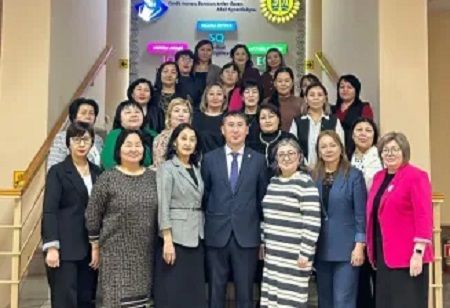
The initiative began with a three-day national training workshop designed to build a shared understanding of MIL among key education stakeholders. During the sessions, participants explored international approaches to media and information literacy from both UNESCO’s Communication and Information and Education sectors, while also examining methodological principles for embedding MIL into education policy and classroom practice.
Practical tools for developing students’ critical thinking, media awareness, and information evaluation skills were also discussed. In total, 36 specialists took part in the workshop, including representatives from regional methodological centres, faculty members from leading pedagogical universities, staff from the National Centre for Professional Development 'Orleu' JSC, and experts from the National Academy of Education.
Following the training, a detailed analysis of Kazakhstan’s existing state education standards and model curricula was carried out. This review assessed where MIL-related elements already exist and where there is potential for further integration. According to the Academy, the analysis enabled the team to formulate evidence-based conclusions and recommendations aimed at strengthening regulatory and educational frameworks.
The study covered major educational areas, including Language and Literature, Mathematics and Informatics, Natural Sciences, Person and Society, Technologies and Arts, as well as the cross-cutting course on Global Competencies. While the findings showed that media and information literacy elements are present across all core subjects, experts noted that their inclusion remains uneven and would benefit from a more systematic approach.
Also Read: Thailand to Host UNESCO's 3rd Global AI Ethics Forum in 2025
As part of the project’s outcomes, a dedicated methodological guide for teachers was developed to support the practical introduction of MIL in schools and to enhance teaching quality in the context of digital transformation. The guide offers clear recommendations aligned with Kazakhstan’s state education policy priorities, UNESCO’s international competency frameworks, and both current and updated State Educational Standards for Secondary Education.
To ensure the effective rollout of these approaches, a series of regional workshops was organised in Uralsk, Taraz, Semey, Pavlodar, and Almaty. Each workshop brought together 25 to 30 methodologists, creating space for in-depth discussions on the conceptual foundations of MIL, identifying real-world challenges in implementation, and building a professional network capable of supporting schools during this transition.
The National Academy of Education worked closely throughout the project with national MIL experts and media trainers Meiramkhan Zhepek and Tatiana Golubtsova. Their contribution focused on adapting international MIL practices to Kazakhstan’s school education context and engaging directly with educators to refine methodological materials. As UNESCO representatives noted, the initiative marks an important step toward equipping Kazakhstani students with the critical media and information skills needed to navigate modern society responsibly and confidently.