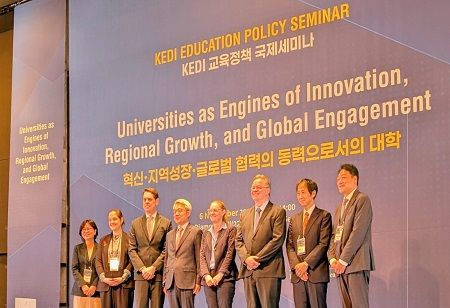
- KEDI, together with the Australian Embassy in Korea, hosted a high-level seminar in Seoul on how universities can drive innovation, regional development, and global engagement featuring leaders from Korea, Australia, and Japan.
- A key highlight was Hokkaido University’s presentation of its fast-expanding Strategic International Partnership with the University of Melbourne, which has scaled joint research, mobility, and a joint PhD program since 2021.
- Discussions spanned policy challenges from research capacity metrics and tuition reforms to regional funding gaps while speakers from Monash and Deakin showcased new models of cross-border collaboration and research commercialisation.
KEDI, in cooperation with the Australian Embassy in Korea, organized the KEDI Educational Policy Seminar entitled 'Universities as Engines of Innovation, Regional Growth, and Global Engagement' held in Seoul. It brought together leaders, researchers, and policymakers from Korea, Australia, and Japan to discuss how universities can enhance innovation capacity, drive regional development, and promote international collaboration. One important invitation of the seminar was for Hokkaido University to present its successful long-term partnership with the University of Melbourne, showcasing it as a model for cross-border cooperation.
Since recognizing their collaboration as a Strategic International Partnership in 2021, the scope of joint activities by HU and UoM has greatly increased. That partnership was supported by a jointly budgeted Research Workshops Fund and further developed into a joint PhD program. In the seminar, Professor Toshiro Ohashi from HU's Faculty of Engineering, along with Senior Academic Specialist Taena Uemura, presented how these programs have solidified research networks, improved mobility of talent, and further deepened academic engagement. They went on to explain opportunities and challenges associated with building large-scale and long-term international partnerships.
The academic mobility of the HU–UoM collaboration has seen an impressive development, in particular. In just three years, the number of exchanged staff and students rose from under 80 to more than 800, showing a steep acceleration in joint activity. This mobility supported wider external research grant acquisition, co-taught academic modules, and broader research capacity-building efforts. Professor Ohashi also presented the Emerging Research Leaders Exchange Programme, jointly operated by the Engineering Academy of Japan and the Australian Academy of Technological Sciences & Engineering. Having been both an alumnus and an active contributor, he noted its work in fostering future research leaders with the ability to drive cross-border innovation.
Also Read: The Intersection of Talent Management and Innovation in Modern Organizations
During the seminar, several policy issues pressing Korean higher education were discussed, such as the use of tools like CWTS Leiden Ranking to track research capacity, graduate employability gaps between metropolitan and regional institutions, and university tuition fee adjustments. Attendees have also discussed the necessity for continued communication with the Korean Ministry of Education to secure government subsidies, financial inequalities that create challenges between regional and metropolitan universities, and the persistent advantage held by students from higher-income families when accessing top-tier institutions.
Joining the discussion, Professor Lucas Walsh, Director of the Monash Centre for Youth Policy & Education Practice, spoke about the various collaborations Monash University has entered into in Korean Studies and its joint academic appointments with South Korea’s K-Bio Lab Hub, a major biotech and innovation incubator based in Incheon. Amy Hunter, Executive Director of Australia’s Deakin University, presented the Recycling and Clean Energy Commercialisation Hub, or REACH, and described how this structured research ecosystem supports early-career researchers continuously as they move between institutions.
Participants from regional universities and private secondary schools in Seoul asked questions related to funding sustainability, international partnerships, and how to enhance the global competitiveness of Korea's higher education and research. This seminar provided a venue for sharing lessons that highlighted the continuing importance of cross-national relationships and opened further prospects for trilateral cooperation among Korea, Australia, and Japan regarding higher education and research.